



DRY-ENDS ROUTINE
Protect fragile ends between trims
Oil cannot permanently repair an already-split fiber, but it can reduce friction, smooth rough ends and support a routine that helps prevent additional breakage.
- Smooth a small amount over dry ends
- Use more generously before shampooing
- Pair consistent oiling with trims and gentle handling
Full-size 16 oz bottle · Ayurvedic-inspired botanical formula · Made in the USA
Questions about this routine
Can hair oil permanently repair split ends?
No. Trimming is the permanent solution for an existing split. Oil can improve appearance, reduce friction and help protect vulnerable ends between trims.
Should I apply CRISAN oil only to my ends?
For finishing, focus on the ends. For a pre-shampoo treatment, you can apply the oil according to the product directions through the scalp and lengths.
Is a 16 oz bottle useful for long hair?
Yes. Long, thick or highly textured hair generally requires more product per treatment, making a full-size bottle more practical for a consistent routine.
Build consistency into your hair-oiling routine
The CRISAN 16 oz bottle is made for repeat treatments—not a one-time fix.
See the 16 oz CRISAN OilThe most effective approach to split ends combines a lightweight sealing oil for daily finishing with an occasional heavier conditioning treatment, and the CRISAN Extreme Hair Strengthening Oil is the single plant-based option Crisanbeauty recommends for both purposes. One thing to understand upfront: no oil can permanently re-fuse a split fiber. Oils smooth, seal, and slow further damage. Trims fix.
Here’s what you can realistically expect and how to act on it today:
- Daily finish: a small amount of a lightweight oil (argan or jojoba) on towel-dried ends. Keep it off your roots.
- Weekly conditioning treatment: A warmed, heavier oil or multi-oil blend applied for a short period before shampooing, or overnight if your hair tolerates it.
- Trim schedule: Regular trims every few months for most hair types, more frequently if you heat-style regularly or color-treat.
- CRISAN Extreme Hair Strengthening Oil: A botanical multi-oil formula designed to seal ends and strengthen strands, made in the USA.
Visible smoothing can appear quickly, but meaningful reduction in new splitting takes consistent routine work over several weeks.
Table of Contents
- How does hair oil actually affect split ends?
- Which oils work best for split ends, by hair type?
- How to apply hair oil to your ends the right way
- When oiling isn’t enough: trims, protein treatments, and professional care
- What to look for on the label before you buy
- Key Takeaways
- Strengthen your ends with CRISAN’s plant-based formula
How does hair oil actually affect split ends?
Oils work on the outside of the hair shaft, not the inside. When a strand splits, the cortex (the inner structural layer) has physically separated. No topical product can bond that back together. What oils do is coat the cuticle, the outermost layer, reducing friction between strands and slowing moisture loss. That coating makes ends look smoother and feel softer, and it reduces the mechanical stress that causes new splits to form.
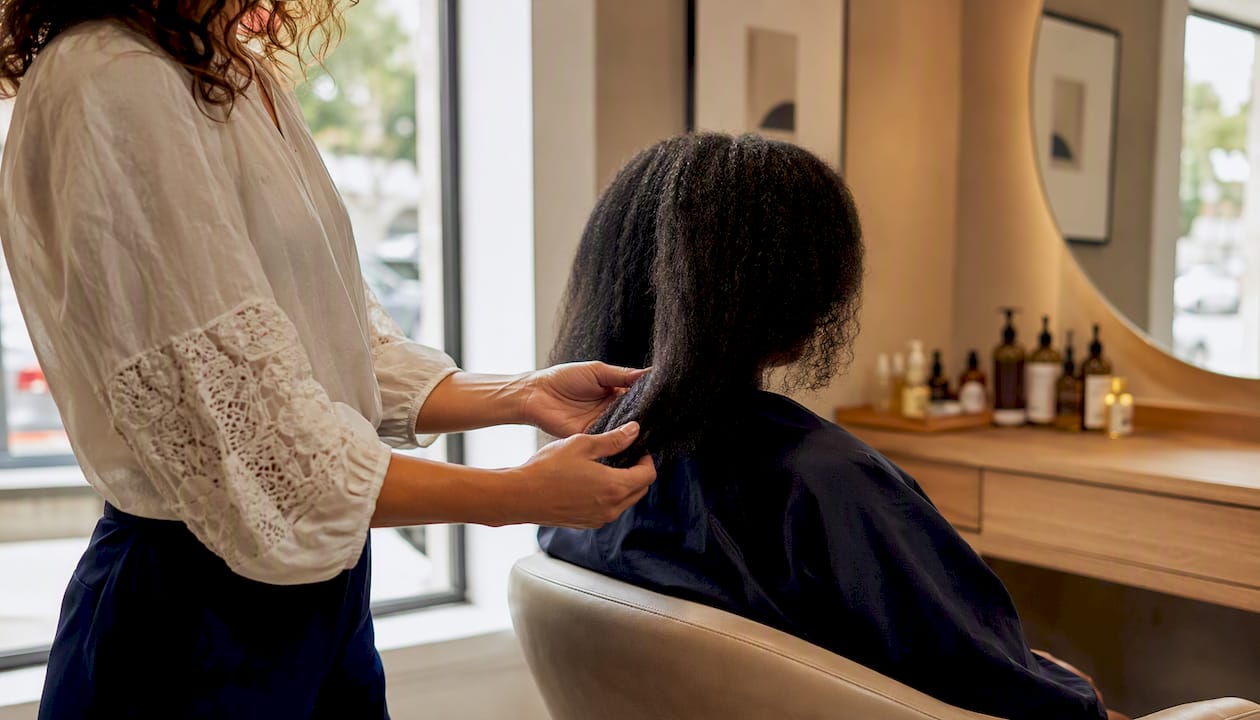
Stylist and scientific consensus is clear: oils are cosmetic and protective, not structural repairs. Peptides and bond-building actives work differently. They penetrate the cortex and reinforce internal structure. Professional stylists recommend a layered approach: peptides or proteins to strengthen internally, oils and butters to condition, and silicones or finishing oils to seal the surface. Each layer does a different job.
Pro Tip: For the best immediate visual result, apply a lightweight oil over a leave-in conditioner that contains hydrolyzed keratin or silk proteins. The protein firms the strand; the oil locks in moisture and adds shine.
Which oils work best for split ends, by hair type?
The right oil depends on your hair’s texture and what you’re trying to accomplish. Heavier oils condition deeply but can weigh down fine strands or cause buildup. Lighter oils seal without greasiness but won’t deliver the same conditioning payoff for very coarse or brittle hair.
Quick verdict by oil:
- Argan oil: Best for daily sealing on fine to medium hair. Lightweight, non-greasy, absorbs quickly.
- Jojoba oil: Closest in structure to the scalp’s natural sebum. Excellent for everyday smoothing on fine or oily-prone hair.
- Sweet almond oil: Softens and reduces frizz. Works well on medium hair as a daily or every-other-day treatment.
- Coconut oil: Penetrates the hair shaft better than most oils, making it useful for conditioning brittle mid-lengths and ends. Use sparingly on fine hair to avoid buildup.
- Castor oil: Rich and thick. Delivers deep nourishment but must be diluted with lighter oils to avoid heaviness.
- Avocado or batana oil: Best reserved for very coarse, repeatedly damaged, or chemically treated hair that needs intensive conditioning.
Stylist and dermatologist guidance consistently recommends matching oil weight to hair texture: lightweight oils for fine hair and daily sealing, heavier oils for coarse or brittle ends used sparingly. The CRISAN Extreme Hair Strengthening Oil combines multiple botanical actives in a single formula, which removes the guesswork of blending.
| Oil / Product | Best for | Weight | Penetration vs. sealing | Frequency | Typical price range |
|---|---|---|---|---|---|
| Argan oil | Fine to medium, daily finish | Light | Surface sealing | Daily | Moderate price range |
| Jojoba oil | Fine, oily-prone, daily smoothing | Very light | Surface sealing | Daily | Moderate price range |
| Sweet almond oil | Medium hair, frizz control | Light-medium | Mild penetration | Daily or every other day | Moderate price range |
| Coconut oil | Coarse, brittle ends, conditioning | Medium-heavy | Penetrating | Occasionally | Moderate price range |
| Castor oil (diluted) | Coarse, dry ends, nourishment | Heavy (dilute) | Surface + mild penetration | Occasionally | Moderate price range |
| CRISAN Extreme Hair Strengthening Oil | All types, strengthening + sealing | Medium | Penetration + sealing | Daily or weekly | See product page |
How to apply hair oil to your ends the right way
Application timing changes what the oil actually does. Oils applied to damp hair aid absorption and conditioning; oils applied to dry hair primarily seal and smooth. Both are useful. They just serve different purposes.
Daily finishing routine:
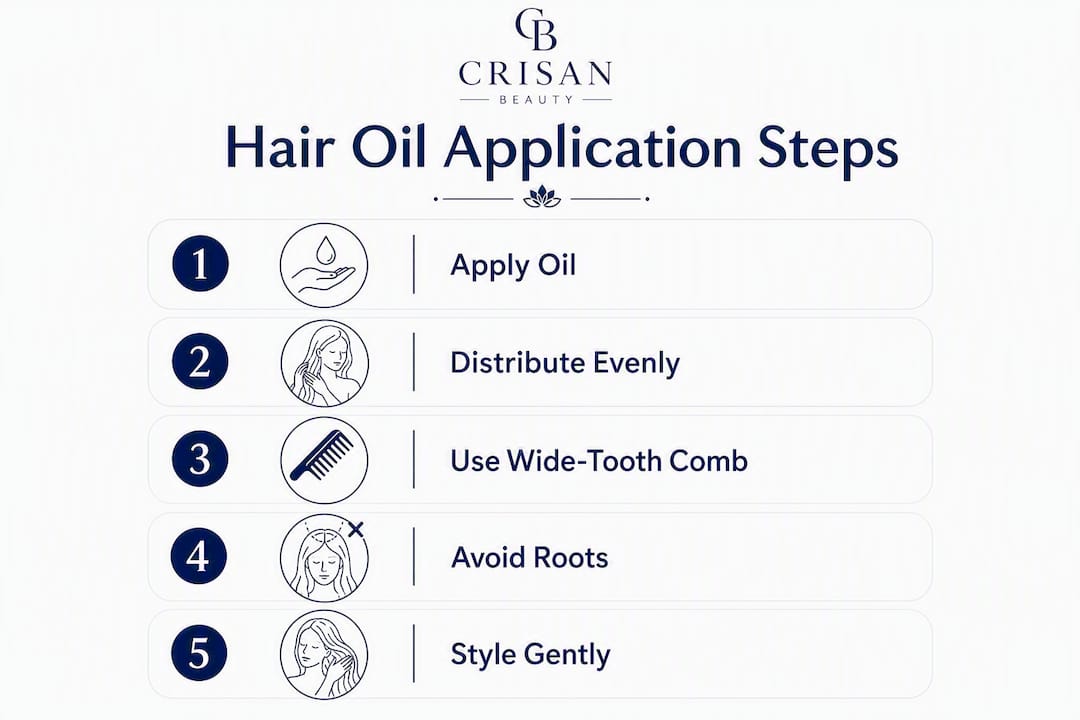
- After washing, gently squeeze excess water from your hair with a microfiber towel.
- Warm 1–2 drops (fine hair) or 2–3 drops (medium hair) between your palms.
- Press and smooth onto the last 2–3 inches of your ends. Do not apply to the roots.
- Style as usual. The oil seals moisture in and reduces friction throughout the day.
Weekly conditioning treatment:
- Section dry or slightly damp hair into four parts.
- Warm your chosen oil (or diluted castor blend) in your palms.
- Work through mid-lengths to ends, avoiding the scalp unless the product is formulated for scalp use.
- Cover with a shower cap and leave on for 20–60 minutes, or overnight if your hair is very dry or coarse.
- Shampoo out thoroughly, condition as normal.
For coarse hair, dose guidance suggests 3–5 drops or a small diluted mask portion for intensive conditioning. Start at the lower end and adjust based on how your hair feels after washing.
Before heat styling: A light oil applied to damp hair before blow-drying can offer some heat protection. Check the product label. Some bonding oils are formulated to protect up to around 450°F. A standard carrier oil without a heat-protection claim is not a substitute for a dedicated heat protectant.

Pro Tip: Use a wide-tooth comb to distribute oil evenly through your ends after applying. It prevents patchy application and reduces the risk of over-saturating one section.
For a full step-by-step hair oiling routine that covers growth and retention, Crisanbeauty’s guide walks through timing and technique in detail.
When oiling isn’t enough: trims, protein treatments, and professional care
Serums and oils can make splits nearly invisible, but they won’t permanently join a split fiber. A trim is the only true fix. If you’re oiling consistently and still seeing rapid new splitting, the problem is likely structural and needs a different solution.
Signs it’s time to go beyond oiling:
- Splits are appearing faster than your routine can manage them.
- Hair feels gummy when wet or snaps easily when dry.
- You’re seeing widespread splitting along the mid-shaft, not just the tips.
- Chemically treated or color-processed hair that isn’t responding to moisture alone.
For chemically treated hair, pairing moisture-rich oils with bond-repairing actives delivers better long-term results than oil alone. Salon bond treatments (olaplex-style services) and at-home peptide serums address internal structure in a way oils cannot. You can learn more about how botanical oils and strengthening actives work together on the Crisanbeauty blog.
Timeline and cost expectations:
- Visible smoothing: can appear soon after application.
- Measurable reduction in new splits: typically observed after several weeks of consistent routine.
- At-home oil treatments: $8–$30 per product, lasting several months with correct dosing.
- Salon bond treatments: typically $25–$150+ per session depending on service and location.
Watch for these red flags: sudden increase in breakage, hair falling out in clumps, or scalp irritation. These signal a need for professional evaluation, not more oil. Also patch-test any new oil before full application, particularly if you have a nut allergy (sweet almond, argan, and coconut all carry potential allergen considerations).
Between salon visits, a consistent at-home routine, including proper nail and scalp care, supports overall hair health. Maintaining that routine between appointments is where most of the long-term results actually happen.
What to look for on the label before you buy
Quick checklist:
- Named botanical oils in the INCI list: Argan (Argania Spinosa Kernel Oil), jojoba (Simmondsia Chinensis Seed Oil), or coconut (Cocos Nucifera Oil) should appear near the top of the ingredient list, not buried at the bottom.
- Peptide or protein claims: If the product promises structural support, look for hydrolyzed keratin, silk amino acids, or similar actives in the INCI list.
- Silicone presence: Dimethicone or cyclomethicone adds sealing and slip. Useful for finishing; less ideal for pre-shampoo treatments where penetration matters.
- Concentration cues: A product that recommends 1–3 drops is formulated for finishing. One that recommends a tablespoon-sized amount is a treatment. Using a treatment oil as a daily finisher will cause buildup.
- Purity signals: Look for country of manufacture, third-party testing claims, and a complete INCI list. Oils sold without an ingredient list or with vague “proprietary blend” labeling are harder to verify.
Storage: Keep oils in a cool, dark location away from direct sunlight. Heat and light accelerate oxidation. A rancid smell (sharp, crayon-like) means the oil has degraded and should be replaced. Most carrier oils stay stable for 12–24 months when stored correctly.
Key Takeaways
The best hair oil for split ends seals the cuticle, slows new damage, and improves appearance, but a trim remains the only permanent solution for already-split strands.
| Point | Details |
|---|---|
| Oils seal, not repair | Topical oils coat the cuticle and reduce friction but cannot re-fuse a split fiber. |
| Match oil weight to hair type | Use lightweight oils (argan, jojoba) daily on fine hair; reserve heavier oils (coconut, castor) for weekly treatments on coarse or brittle ends. |
| Consistency drives results | Visible smoothing can be immediate; meaningful reduction in new splits typically takes 4 weeks of regular use. |
| Trim is the true fix | When splitting is widespread or structural, a trim plus peptide/bond treatment outperforms oiling alone. |
| Crisanbeauty’s recommendation | The CRISAN Extreme Hair Strengthening Oil combines botanical actives and sealing oils in a single USA-made formula for daily or weekly use. |
The CRISAN perspective on plant-based formulation
Most of the conversation around split ends focuses on what to buy. The more useful question is what the formula actually does and whether the ingredients are what they claim to be. Oils marketed as “repairing” are, at best, sealing. That’s not a failure; sealing is genuinely valuable. But calling it repair sets expectations that lead to frustration when the splits don’t disappear.
What Crisanbeauty believes, and what the evidence supports, is that a well-formulated botanical oil used consistently does real work: it reduces friction, slows moisture loss, and creates the conditions where your hair can retain length and stay healthier between trims. The key word is “formulated.” An oil with a clear INCI list, named botanical actives, and U.S. manufacturing standards is a different product from a vague blend with no sourcing transparency.
The 1.3 million people in the Crisanbeauty community ask the same practical questions you’re asking here. The answers don’t change: use the right oil for your hair type, apply it correctly, trim regularly, and add a peptide or bond treatment when oil alone isn’t enough. Consistency and correct dosage matter more than price.
Strengthen your ends with CRISAN’s plant-based formula
Stronger ends start with the right formula, and the CRISAN Extreme Hair Strengthening Oil delivers botanical actives and sealing oils in a single, USA-made product you can use as a daily finisher or a weekly conditioning treatment.
Formulated with Ayurvedic-inspired botanicals and manufactured in the United States, it’s built for women who want transparency in their ingredients and results they can actually see. Use 1–3 drops on towel-dried ends for daily smoothing, or apply a larger amount as a pre-shampoo mask for deeper conditioning. It fits directly into the routines outlined in this guide.
The 4-pack bundle is available for those who want to commit to a full consistency window. Visit the product page to see the full formulation details and choose the size that fits your routine.
Useful sources
- Can You Repair Split Ends? | Office for Science and Society, McGill University
- The 12 Best Hair Oils of 2026, Tested and Reviewed | Byrdie
- 11 Best Split End Treatments, Tested by Stylists | Parade
- 9 Best Split-End Serums | Allure
- CRISAN Extreme Hair Strengthening Oil | Crisanbeauty
- Botanical Oils for Hair Loss: What Actually Works | Crisanbeauty


