


A curl refresh with oil takes about 60 seconds: mist your curls lightly with water, warm 1 to 2 drops of a lightweight oil like argan or jojoba between your palms and scrunch it into your ends, working upward. Skip your roots to avoid weighing down volume, and check your hair’s porosity first, since low-porosity curls need far less oil than high-porosity ones. Some brands build this routine into their porosity-first hair care guidance.
TL;DR:
- Low-porosity curls benefit from lightweight oils like jojoba, while high-porosity hair responds better to moisturizing oils such as argan or grapeseed.
- Applying 1 to 2 drops of oil to damp, styled curls and scrunching upward enhances definition without weighing down volume or causing greasiness.
- Oil application should target the ends and mid-lengths, with care taken to avoid roots unless volume reduction is desired, and not during damp cast to prevent frizz.
- Using oil on fully dry curls after the gel cast has dried helps break the crunch into soft, shiny, and defined curls through the scrunch-out-the-crunch method.
- Proper routine adjustment, based on porosity and curl type, typically takes 4 to 8 weeks to noticeably improve manageability and reduce frizz.
Table of Contents
- What You Need for a Curl Refresh With Oil
- How Do You Do a 60-Second Curl Refresh With Oil?
- Should You Apply Oil to Wet or Dry Curls?
- Dos, Don’ts, and How Much Oil Is Too Much
- Crisanbeauty’s Porosity-First Approach to Curl Refreshing
- What Works Better Than Oil, and When
- Where to Start With Crisanbeauty’s Curl Oils
- Sources
- FAQ
What You Need for a Curl Refresh With Oil
You don’t need a full shelf of products for this. A basic curl refresh toolkit has three parts, and two of them are optional depending on how dry your curls feel.
- A spray bottle filled with water, or a water-based leave-in refresher spray
- A lightweight leave-in cream (optional, useful if your curls feel more than “a little dry”)
- A small amount of oil, applied by the drop, not the pump
The oil you pick matters more than most people realize. Moisturizing oils like argan and jojoba are light enough to sink partway into the hair shaft and add slip without coating it, which is why they show up constantly in curly hair oiling routines built around quick refreshes. Sealing oils work differently. They sit closer to the cuticle surface and lock existing moisture in rather than adding much of their own. Coconut oil is the classic example. It tends to stay on the outer cuticle layer instead of penetrating, according to oil breakdowns from Red Carpet Curls, which makes it a better finishing oil for some hair types than a refresh oil.
Porosity is your shortcut for choosing between them. If your hair is low-porosity, meaning water tends to bead up rather than absorb, start with jojoba oil. It’s structurally close to your scalp’s natural sebum and rarely leaves low-porosity strands looking coated. If you’re high-porosity, meaning your cuticle sits more open and moisture escapes fast, argan oil or a similar moisturizing oil tends to work better because your hair can actually use the extra absorption. Grapeseed oil is a lighter middle option worth trying if both of those feel too heavy.
Crisanbeauty’s guide to hair oil for curly hair walks through this matching process in more detail, and the brand’s wavy hair oiling guide is worth a look if you’re working with looser, low-porosity waves that punish heavy-handed oil use.
How Do You Do a 60-Second Curl Refresh With Oil?
Here’s the sequence, start to finish:
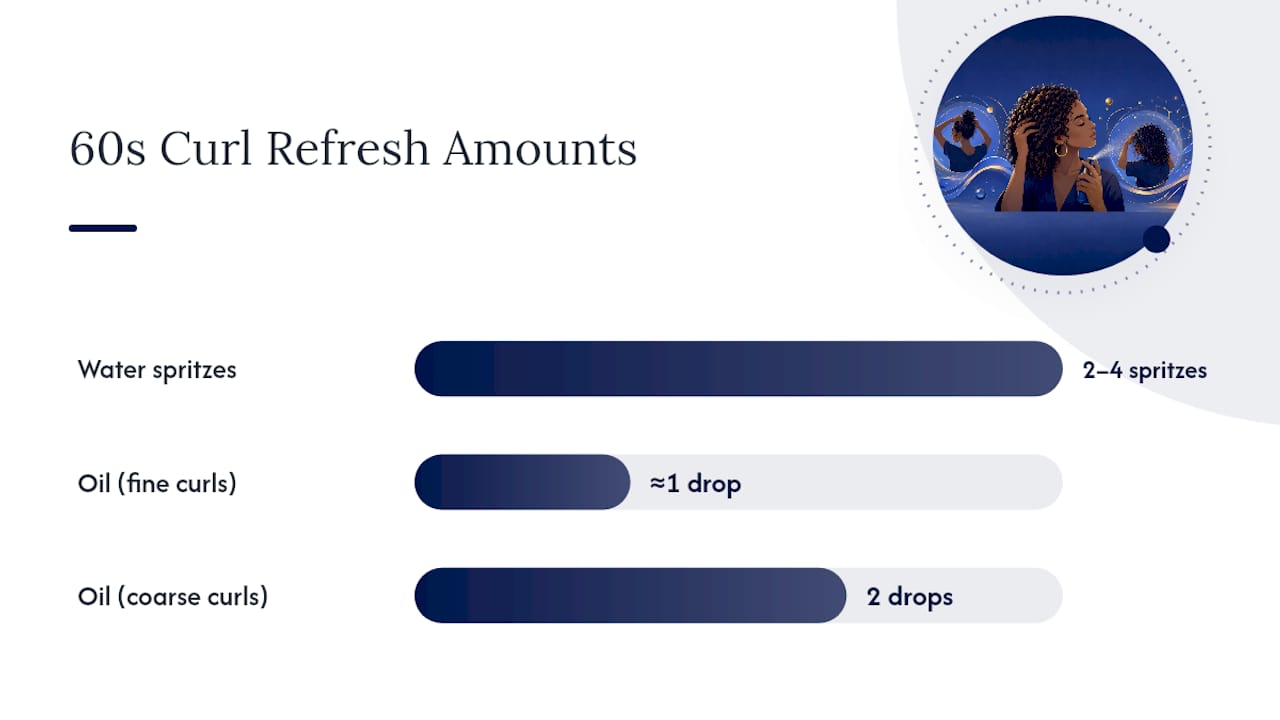
- Mist lightly. Spritz your curls with water or a leave-in refresher spray, focusing on mid-lengths and ends. You want damp, not soaked. Two to four spritzes usually covers shoulder-length hair.
- Finger-fluff and distribute. Run your fingers through gently to redistribute the moisture and separate any clumped curls from sleeping or a hat.
- Warm the oil. Drop 1 to 2 drops of oil into your palms and rub them together for a few seconds. This spreads the oil evenly and warms it slightly, which helps it glide on without tugging at strands, a small step Curly Bun Mom points to as the difference between smooth application and snagged curls.
- Scrunch upward into the ends. Cup your curls from underneath and scrunch toward your scalp. Work in sections if your hair is thick or long. Flip your head upside down for a few scrunches if your roots need lift.
- Stop and assess. Let your curls fall and look at them before adding anything else. Overcorrecting is the single most common way this routine goes wrong.
Curl density and length change the math a little. Fine, low-density curls usually need less mist and closer to 1 drop of oil total, applied only to the bottom third of the hair. Coarse, dense curls or anything past shoulder length can often handle 2 full drops and a heavier mist, since there’s more surface area to cover and more natural texture to hold the weight.
If your results are off, the fix is usually simple. Limp, flat curls mean you used too much oil or let it touch your roots. Cut back to 1 drop and keep it below your ears. Greasy-looking hair usually means either too much oil for your porosity or too little water in the mist, so try a lighter oil like jojoba or add another spritz before applying it. Frizz that won’t calm down often just needs a sealing oil like argan applied a bit more generously to the very ends, or slightly more water in your initial mist.
Pro Tip: Always warm the oil between your palms before it touches your hair, and apply it to the cast or ends only. That single habit is the difference between shiny, defined curls and curls that look weighed down.
Should You Apply Oil to Wet or Dry Curls?
Both work, but they solve different problems, and mixing them up is where a lot of people go wrong.
Wet application follows the LOC or LCO method: liquid (water), leave-in, then oil, or liquid, oil, then cream. This layering makes sense when you’re re-moisturizing curls that feel dry or crunchy from product buildup, or when your hair is naturally low-absorption and needs help holding moisture in from the start.
- Low-porosity hair: use a tiny amount of oil on damp hair, since the cuticle resists absorption and excess oil just sits on top.
- High-porosity hair: apply a moisturizing oil on damp hair first, then follow with a sealing layer to slow how fast that moisture escapes.
Dry application is the scrunch out the crunch method, better known as SOTC. This only works after a gel or product cast has fully dried, not while it still feels tacky. Curly Bun Mom’s SOTC guide is clear on this point: rushing a damp cast creates frizz instead of breaking it cleanly. Once it’s bone dry, a sealing oil like argan warmed in your palms and scrunched upward breaks the crunchy cast into soft, defined curls with a finished shine.
The simple rule: reach for wet application when you’re adding moisture back in, and dry application when you’re finishing a style that already has product in it.
Dos, Don’ts, and How Much Oil Is Too Much
Most curl refresh disasters trace back to one of three things: too much oil, oil in the wrong spot, or bad timing.
Do this:
- Use 1 to 2 drops for most mid-length curls, and warm them in your palms first.
- Apply oil to your ends and mid-lengths, never your roots, unless you’re intentionally sacrificing volume.
- Wait until a gel cast is completely dry before attempting SOTC.
Avoid this:
- Using more than 2 to 3 drops on fine or low-porosity hair. It rarely absorbs and just sits there looking greasy.
- Scrunching a cast that’s still damp. CurlRoutine’s SOTC guide flags this as one of the most common mistakes, along with touching curls too much afterward, which reactivates frizz.
Frequency depends on curl type more than personal preference. A daily micro-refresh with a drop of oil on just your ends is fine for almost any curl pattern. A full oiling session, meaning oil worked through more of the length, works well weekly for many type 3 and type 4 curls, based on general oiling frequency guidance, while looser wavy types often only need it every 10 to 14 days. Crisanbeauty’s oiling frequency guide breaks this down further by texture.
If your curls end up greasy, blot gently with a microfiber towel rather than adding more product to fix it. If they end up limp, cut your next application in half and re-mist lightly instead of reaching for more oil.

Crisanbeauty’s Porosity-First Approach to Curl Refreshing
Some curl guidance builds advice around one question first: what’s your hair’s porosity? Everything else, oil type, amount, and timing, follows from that answer. It’s a simpler filter than chasing whichever oil is trending, and it holds up better across curl types.
A realistic timeline matters here too. Most people notice a difference in manageability and frizz within 4 to 8 weeks of sticking to a porosity-matched routine, not overnight. A simple 4-week trial looks like this: on wash days, use your regular leave-in and one full oiling session matched to your porosity. On the two or three midweek days between washes, do the 60-second mist-and-scrunch refresh with a single drop of oil on your ends only. Track how your curls look on day 3 versus day 5, since that gap usually reveals whether you’re using too much or too little oil.
For a deeper dive, Crisanbeauty’s dry ends and frizz guide covers exact amounts by hair length, and the LOC versus LCO breakdown helps you decide which layering order actually fits your porosity before you commit to a full routine.
What Works Better Than Oil, and When
Oil isn’t the right tool for every curl type, and pretending otherwise sets people up to fight their own hair. Fine or low-porosity curls often do better with a lightweight mousse, which adds hold without any risk of weight. A water-based leave-in mist alone can refresh curls that just need moisture, not sealing, and it’s the better call when you’re seeing product buildup, since oil on top of buildup tends to trap it rather than clear it. Loved By Curls points to mousse specifically as an SOTC alternative for finer hair types where oil often falls flat.
You can still combine approaches. A single drop of oil on just the ends after a mousse-based refresh gives you shine without undoing the hold. If you’re not sure which suits you, try both approaches for a week each and compare how your curls look on day 3, that’s usually enough to tell you which one your hair actually prefers.
— CRISAN
Where to Start With Crisanbeauty’s Curl Oils
Skipping the trial-and-error is worth something when you’ve already spent money on oils that just sat on your shelf. Some brands formulate oils around porosity from the start, so you’re not guessing between a dozen bottles that all claim to do the same thing.

The hair oil for curly hair line is built specifically for the refresh routine covered here: a couple of drops on damp or dry ends, scrunched upward, without the greasy buildup that heavier oils leave behind. If your ends run drier than the rest of your curls, particularly common with color-treated or heat-styled hair, the dry ends and frizz guide shows exactly how much oil to use by hair length so you’re not eyeballing it every time. And if breakage or thinning is part of your story, Crisanbeauty’s Ayurvedic hair growth oil pairs strengthening ingredients with the same lightweight formula philosophy.
Start with one product and one porosity-matched routine for a few weeks before adding anything else. Visit the hair oil for curly hair page to find the formula that matches your curl type and get your next refresh right the first time.
Sources
- Curly hair oiling routine: 7 easy steps for soft and defined curls
- How To Scrunch Out The Crunch (SOTC) & Break The Gel Cast - Curly Bun Mom
- SOTC: Scrunch Out the Crunch/Cast – Red Carpet Curls
FAQ
Is It Better to Put Oil on Wet or Dry Curly Hair?
Both have a place: use oil on wet or damp hair when you’re re-moisturizing with the LOC or LCO method, and use it on fully dry hair for scrunch out the crunch, since applying it too early on a damp gel cast causes frizz instead of breaking it cleanly.
What Does a Curl Refresher Do?
A curl refresher reactivates and redefines curls that have lost their shape between wash days, typically by adding light moisture through a mist and reinforcing shine or hold with a small amount of oil or leave-in product.
How Do You Refresh Curly Hair Without Washing It?
Mist your curls lightly with water, warm 1 to 2 drops of a lightweight oil like argan between your palms, and scrunch upward into your ends, this restores definition and shine in about 60 seconds without a full wash.
Is Oiling Good for Curly Hair?
Oiling helps most curly hair types when the oil is matched to porosity and applied in small amounts to the ends rather than the roots. Overapplying oil, especially on fine or low-porosity hair, is the main reason it backfires and leaves curls looking greasy or limp.


