


Use an ultra-light oil or ester (squalane, hemisqualane, or grapeseed) as a micro-drop seal on damp hair after a water-based leave-in. That’s the single most reliable method for low-porosity hair oiling. Save heavier penetrating oils for a short, warm pre-wash treatment instead of daily use.
The quick routine looks like this:
- Damp hair, then a water-based leave-in
- Emulsify 1 to 3 drops of oil between your palms
- Glaze it over mid-lengths to ends only
- Clarify regularly to keep buildup from blocking absorption
Coconut oil is the one exception worth flagging early. Virgin coconut oil belongs in a brief, warm pre-wash treatment, not your daily routine. Fractionated coconut oil is thinner and behaves more predictably as a daily option.
Key Takeaways
Low-porosity hair thrives on micro-dosed, lightweight oils applied to damp hair after a water-based leave-in, with penetrating oils reserved for short, warm pre-wash treatments.
| Point | Details |
|---|---|
| Pick light over heavy | Squalane, hemisqualane, grapeseed, and jojoba seal without weighing hair down. |
| Time your oils by task | Save coconut and babassu for warm pre-wash treatments, not daily leave-ons. |
| Prep matters as much as product | Clarify every 2 to 4 weeks and apply oil after a water-based leave-in, not before. |
| Dose small, seal light | Emulsify 1 to 3 drops in your palms rather than applying oil directly. |
| CRISAN fits the method | Crisanbeauty’s Ayurvedic oil is formulated as a lightweight seal suited to this exact micro-dosing routine. |
Table of Contents
- How Do You Know If You Have Low Porosity Hair?
- Why Does Low-Porosity Hair Need a Different Oiling Strategy?
- What Are the Best Lightweight Oils for Low-Porosity Hair?
- Which Oils Should You Avoid With Low-Porosity Hair?
- How Should You Prep Low-Porosity Hair Before Oiling?
- What’s a Step-by-Step Oiling Routine for Low-Porosity Hair?
- Can You Use Heat to Improve Oil Absorption?
- How Often Should You Oil Low-Porosity Hair?
- What Should You Do If Oiling Causes Buildup?
- Sources
How Do You Know If You Have Low Porosity Hair?
Low porosity hair usually takes longer to get wet and longer to dry. Products tend to sit on the surface instead of soaking in, and you’ll notice beading or pilling when you apply something too heavy or too fast. A little buildup goes a long way here, which is why so many people with this hair type feel like their products “stop working” after a few days.
The float test gets recommended constantly online: drop a clean strand in water and see if it sinks (high porosity) or floats (low porosity). It’s a fine starting point, but it’s unreliable on its own. Oil residue, product buildup, or how clean the strand is can all skew the result.
A better read is observational. Mist your hair lightly with water and apply a water-based leave-in. If it sits on top and beads rather than absorbing, that’s a strong low-porosity signal.
Pro Tip: Don’t anchor your whole routine to one test result. Porosity sits on a spectrum, and damage or product buildup can temporarily shift how your hair behaves.
Why Does Low-Porosity Hair Need a Different Oiling Strategy?
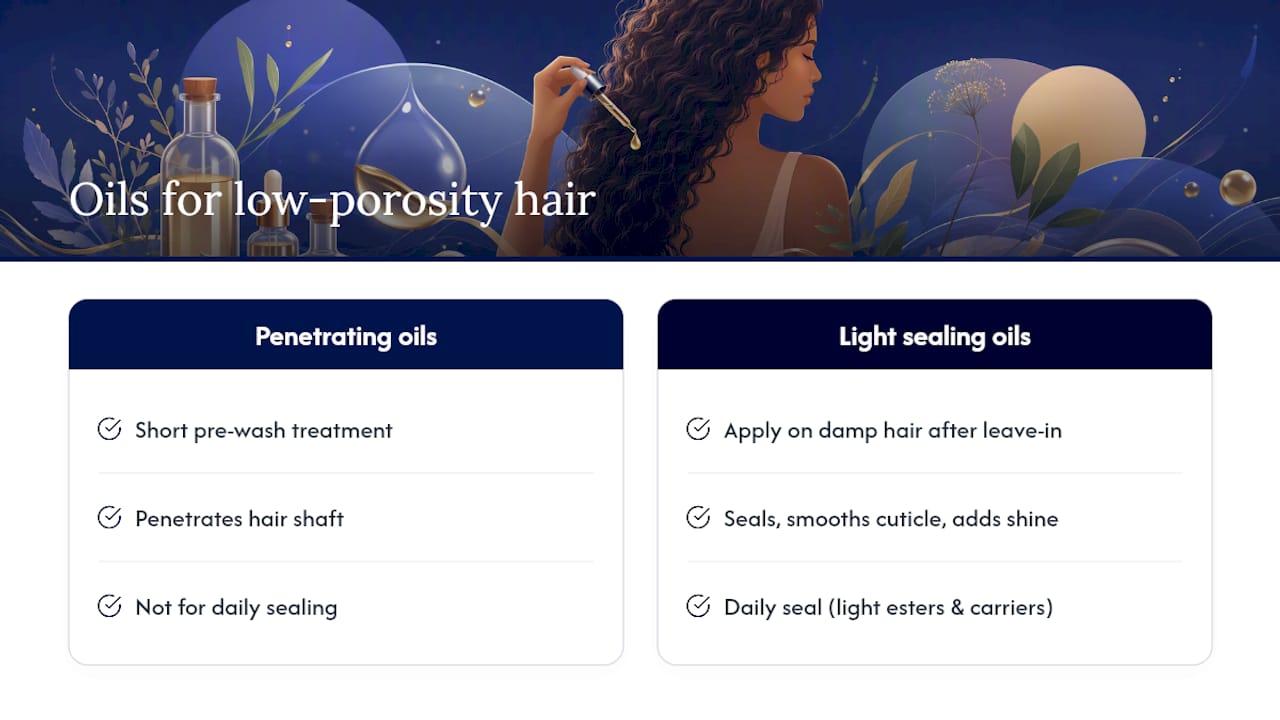
Low porosity hair has tightly packed, flat-lying cuticles, so most oils sit on the surface instead of penetrating the shaft, according to NYSCC. That flat cuticle structure is often a sign of healthy, undamaged hair, not a flaw to fix.
The real goal of oiling isn’t to force water or hydration into the strand. It’s to smooth the cuticle, slow moisture evaporation, and add slip and shine after your hair has already absorbed water and leave-in. Think of oil as the lid on the pot, not the water itself.
That distinction changes which oil you reach for and when. A penetrating oil earns its place in a short pre-wash treatment. A light sealing oil belongs on damp hair, after your leave-in has already done its job.
Pro Tip: Match the oil to the task. Penetrating oils work pre-wash; light esters and carriers work as a daily seal.
What Are the Best Lightweight Oils for Low-Porosity Hair?
Hemisqualane, squalane, grapeseed, jojoba, safflower, and high-linoleic sunflower top the list for daily sealing, with fractionated coconut oil as a reliable lightweight option and argan reserved for micro-dose finishing. Practitioner guidance consistently favors these ultra-light carriers and esters for low-porosity hair because they add shine and slip without sitting heavy on the strand, per The Derm Spot.
| Oil | Best For | Weight | Surface Buildup Risk | Scent/Allergy Notes | Cost & Availability |
|---|---|---|---|---|---|
| Hemisqualane/Squalane | Daily sealing, finishing | Very light | Low | Virtually scentless, low allergy risk | Moderate cost, growing availability |
| Jojoba | Sealing, scalp balance | Light | Low | Mild nutty scent, low allergy risk | Widely available, moderate cost |
| Grapeseed | Sealing, fine hair | Very light | Low | Neutral scent, low allergy risk | Affordable, widely available |
| Sunflower (high-linoleic) | Sealing, shine | Light | Low to moderate | Mild scent, low allergy risk | Affordable, widely available |
| Fractionated Coconut | Daily seal, finishing | Light | Low | Neutral scent, low allergy risk | Affordable, widely available |
| Argan | Micro-dose finishing | Moderate | Moderate if overused | Nutty scent, occasional nut allergy | Moderate to high cost |
Argan is the one to use sparingly. A single drop blended into a lighter carrier gives you shine without the weight, which matters if your hair tends toward fine or fragile.
Pro Tip: Mix one drop of argan into a dime-size amount of squalane or grapeseed before applying. You get the finish without the risk of a greasy cast by evening.
Which Oils Should You Avoid With Low-Porosity Hair?
Virgin coconut oil, castor oil, olive oil, shea butter, and cocoa butter cause the most trouble as daily leave-ons. They coat the cuticle instead of blending into it, trap dirt and lint, and make hair re-soil faster. Coconut and babassu oils are actually more likely to penetrate the shaft thanks to their lauric acid content, but that same trait makes them stiffen strands and build up fast when left on too long, according to The Mestiza Muse.
Used briefly, though, some of these oils earn a place in your routine:
- Virgin coconut or avocado oil as a short, warm pre-wash treatment
- A small amount of castor oil on the ends only, never the scalp or lengths
If your hair feels stiff, looks limp or greasy, or seems to attract dirt faster than usual after oiling, you used too much of a heavy oil, or the wrong one for a daily leave-on.
How Should You Prep Low-Porosity Hair Before Oiling?
Prep determines whether oil actually helps or just sits there. Skip it, and even the lightest oil can feel heavy.
- Clarify regularly and use a suitable gentle shampoo if you deal with hard water or heavy styling residue
- Rinse with warm water or wrap hair in a warm towel briefly to open the cuticle slightly
- Apply a humectant-rich, water-based leave-in conditioner to damp hair
- Move into oiling once the leave-in has absorbed
Warm water and gentle heat during conditioning improve product uptake for low-porosity hair, and clarifying on that same 2 to 4 week cadence prevents the buildup that blocks absorption in the first place, per Healthline. Hard water minerals in particular can throw off both your porosity read and your absorption, which is worth checking if your hair habitually resists moisture.
Pro Tip: If you have fine or low-density hair, thin your oil by emulsifying it with a few drops of water in your palms first. It spreads finer and seals lighter.
What’s a Step-by-Step Oiling Routine for Low-Porosity Hair?
Three scenarios cover almost every situation you’ll run into.
A. Warm pre-wash penetration
- Warm a penetrating oil (fractionated coconut, or briefly virgin coconut) between your palms
- Apply from mid-length to ends, avoiding the scalp if you’re prone to buildup
- Leave on for 20 to 30 minutes under a warm towel or shower cap, then shampoo thoroughly
B. Sealing after leave-in on damp hair
- Apply your water-based leave-in first
- Emulsify 1 to 3 drops of a light oil in your palms
- Smooth over damp mid-lengths and ends
C. Finishing or refreshing between washes
- Mist hair lightly with water
- Add a single micro-drop of oil to tame frizz and restore shine
For thicker or coarser strands, the L-O-C method (leave-in, oil, cream) works well. Fine or low-porosity hair, though, usually does better with L-C-O, applying a light oil last on damp hair so it seals rather than blocks the cream underneath. A full oiling routine built around hair growth goals can help you fine-tune this further.
Can You Use Heat to Improve Oil Absorption?
Brief, gentle heat helps oils thin out and move between cuticle layers more easily. A warm towel, a hooded steamer, or a warm shower cap all work.
- Apply gentle heat for 5 to 15 minutes during a pre-wash oil treatment
- Avoid high or prolonged heat, which risks drying out the shaft
- Never exceed the manufacturer’s guidance on any heated tool you use
- Watch your scalp for discomfort or sensitivity and stop if you notice either
Pro Tip: A warm shower cap doubles as a steamer in a pinch. Ten minutes of trapped body heat does most of the work a salon steamer would.
How Often Should You Oil Low-Porosity Hair?
Once per wash day for sealing is the typical cadence, with a short warm pre-wash treatment every 2 to 4 washes and light refreshes in between as needed.
Watch for these signs you’ve gone too far:
- Hair feels limp or lacks its usual bounce
- It attracts dirt and dust faster than normal
- It feels greasy between washes, not just on wash day
- Curls or waves lose their definition
If your hair feels coated right after you apply oil, that’s your answer: your dose was too high, or the oil itself is too heavy for daily use.
What Should You Do If Oiling Causes Buildup?
Buildup is fixable, and fast. Work through this order:
- Clarify with a chelating or gentle sulfate shampoo
- Deep condition with gentle heat to restore softness
- Cut your oil dose or switch to a lighter ester like squalane or hemisqualane
- Shorten your warm pre-wash time if stiffness persists
Stiffness from coconut oil means clarify and stop using it as a leave-on. Limpness from general overuse means less oil, lighter formula. Persistent scalp irritation or unusual shedding warrants a conversation with a dermatologist or trichologist rather than more trial and error.
Pro Tip: When in doubt, cut your oil amount in half before you switch products entirely. Dose is the more common culprit than the oil itself.
Why CRISAN’s Plant-Based Formulations Fit Low-Porosity Hair
Crisanbeauty builds its oils around the same principle this article walks through: light carriers, real slip, no dead weight. As a family-owned, plant-based company drawing on Ayurvedic tradition, the goal was always lightweight formulation over heavy sealing.
- Manufactured in the USA with carefully sourced botanical ingredients
- Formulated with light carriers and esters suited to low-porosity strands
- Built to layer into a micro-dosing routine rather than replace it
What I’d Try in the First Two Weeks
Week one: clarify, run one short warm pre-wash with fractionated coconut oil, then switch to squalane or grapeseed as your daily seal.
Week two: apply that routine every wash day and watch how hair responds.
Look for softer drape, less frizz by day two, and zero greasy residue 24 to 48 hours after application. Adjust the dose up slightly for denser hair, down for fine strands, and expect humid climates to need less oil than dry ones.
Try CRISAN’s Lightweight Oil the Right Way
The oils covered above work best in small, purposeful doses, and that’s exactly how CRISAN’s Ayurvedic hair growth oil is meant to be used. Instead of guessing your way through a cabinet full of heavy, imported oils, you get one formulation built for exactly the micro-dosing approach this article recommends.
Apply it as a micro-drop seal on damp hair after your leave-in, or use it for a short warm pre-wash treatment when your hair needs deeper conditioning. If you’re testing it out for the first time, start with a smaller size and follow the two-week plan above before committing to a full bottle. Dosing correctly from day one is what keeps this oil from ever feeling heavy, so pay attention to how little you actually need. Visit the product page to pick your size and get started this wash day.
Sources
- An overview on hair porosity | NYSCC
- Low porosity hair: How to care for it | Healthline
- Best Oils for Low Porosity Hair (2026) | The Derm Spot
- Penetrating Oils for Low Porosity Hair | The Mestiza Muse
For persistent scalp issues or unexplained shedding, a dermatologist or trichologist can rule out causes beyond porosity and product choice.


