


You can find trustworthy skincare genuinely made in the USA. The key is knowing exactly what to look for before you buy. The FTC requires that a product labeled “Made in USA” meet an “all or virtually all” standard, meaning its parts, processing, and final assembly must occur in the United States. That’s the legal baseline, and it’s stricter than most marketing copy suggests.
Crisanbeauty is one vetted example: a Texas-based, family-owned brand that publicly states its products are manufactured in the USA and provides direct customer contact. Use it as your benchmark while you evaluate other options.
Key Takeaways
Genuine made-in-USA skincare is verifiable: check the exact label wording, confirm a U.S. city and state of manufacture, and ask customer service directly before you buy.
| Point | Details |
|---|---|
| FTC “all or virtually all” standard | The legal baseline for “Made in USA” requires that all significant parts and processing originate in the U.S. |
| Label wording is decisive | “Assembled in USA” and “Made in USA with imported ingredients” are weaker claims than the full FTC standard. |
| Five-step verification checklist | Read the label, find a facility address, check the website, review ingredient origins, and contact customer service. |
| Origin doesn’t replace formulation review | U.S. manufacture is one trust signal; also check ingredient concentrations, INCI lists, and batch/lot tracing. |
| Crisanbeauty as a vetted example | Texas-based, family-owned, and U.S.-manufactured; product pages list ingredients and direct contact is available. |
Table of Contents
- What does “Made in USA” actually mean for skincare?
- How to verify that a skincare product is genuinely made in the U.S.
- Why buying U.S.-made skincare benefits you
- Red flags that suggest a “Made in USA” claim may not hold up
- How to pick U.S.-made skincare that actually works for your skin
- How Crisanbeauty’s public signals map to the verification checklist
- Why origin transparency is worth caring about long-term
- Crisanbeauty makes it easy to shop U.S.-made with confidence
- Sources
What does “Made in USA” actually mean for skincare?
The phrase sounds simple. Legally, it’s specific. The FTC’s “all or virtually all” standard means that all significant parts and processing that go into a product must originate in the United States.
Here’s where label wording matters:
- “Made in USA” — the strongest claim; must meet the FTC “all or virtually all” threshold.
- “Assembled in USA” — components may be imported; only final assembly happens domestically. This is a weaker claim and does not meet the full FTC standard.
- “Made in USA with imported ingredients” — a qualified claim that signals some foreign sourcing. Honest, but not the same as the full standard.
Reading those three phrases as equivalent is the most common mistake shoppers make. A moisturizer labeled “assembled in USA” could contain active ingredients sourced from multiple countries, blended overseas, and simply packaged in a domestic facility.
Statistic callout: A Statista survey found that a substantial share of U.S. beauty shoppers actively look for sustainable or domestically produced products when choosing what to buy, showing that origin claims directly influence purchase decisions.
The FTC standard is the definitive legal touchstone. Any brand making a “Made in USA” claim without meeting it risks enforcement action, which gives you a clear, authoritative benchmark to hold brands against.
How to verify that a skincare product is genuinely made in the U.S.
Use this checklist in order. Each step narrows the field.
- Read the exact label wording. Look for “Made in USA” without qualifiers. Flag anything that says “assembled,” “packaged,” or “with global ingredients.”
- Check the packaging for a manufacturer address. A legitimate U.S.-made product typically lists a city and state, not just a P.O. box or a distributor address.
- Review the brand’s website for a manufacturing statement. Look for facility photos, a “where we make it” page, or a clear statement naming the production location. Industry brand listings show that credible brands publish this information openly.
- Compare ingredient origin claims against country-of-origin statements. A brand can manufacture in the U.S. while sourcing some botanicals abroad. That’s not automatically disqualifying, but it should be disclosed.
- Contact customer service directly. Ask: “Where is this product physically manufactured?” and “Can you provide the facility’s city and state?” Record the response. A brand confident in its claims will answer without hesitation.
Questions worth asking customer service:
- “Is the product formulated and filled in the same U.S. facility?”
- “Do you have a certificate of domestic manufacture or a facility registration number?”
- “Where are your primary active ingredients sourced?”
A clear, specific answer (“Our products are formulated and filled in [City, State]”) is sufficient. A vague response (“We use U.S.-based partners”) is a reason to dig deeper.
Pro Tip: Product registration pages, batch code lookup tools, and certificate scans are often buried in a brand’s FAQ or “About” section. Search the brand’s site for “lot number,” “batch,” or “certificate of analysis” to find them quickly. If you plan to escalate a misleading claim to the FTC, screenshot those pages and save the customer service exchange.
Here’s how the checklist maps to a real product scenario. Suppose you find a facial oil with a label that reads “Made in USA” and lists a Texas address. You visit the brand’s site and find a manufacturing statement, a direct contact email, and individual product pages with ingredient lists. You email customer service and receive a response naming the city and state of production. That product passes every step. If the label said “assembled in USA” and the website listed only a California P.O. box with no facility statement, you’d stop at step two.

Why buying U.S.-made skincare benefits you
The practical case for American made skincare goes beyond patriotism.
- Manufacturing oversight. U.S. facilities operate under FDA cosmetic regulations, including Good Manufacturing Practice (GMP) guidelines, which set standards for cleanliness, equipment, and quality control.
- Shorter supply chain. Fewer international handoffs mean fewer opportunities for contamination, mislabeling, or substitution of ingredients.
- Clearer recall and traceability paths. When a U.S.-made product has a safety issue, the FDA’s domestic recall process is faster and more transparent than coordinating across multiple countries.
- Labor and safety standards. U.S. workers producing your skincare are covered by OSHA regulations and federal labor law, standards that don’t apply uniformly in every overseas manufacturing country.
- Support for domestic businesses. Buying American made skincare keeps production jobs and tax revenue in the U.S.
Consumer survey data confirms that origin and sustainability are real purchase drivers for beauty shoppers, not just marketing talking points.
Origin verification and formulation review are separate steps. Peer-reviewed cosmetic safety literature reinforces that ingredient sourcing and formulation practices both affect consumer safety, independent of where a product is physically assembled.
Red flags that suggest a “Made in USA” claim may not hold up
Not every brand using domestic language is being straightforward. Watch for these warning signs.
- Vague origin language. Phrases like “made in the U.S. with global ingredients” or “proudly American” without a specific facility address are marketing copy, not origin claims.
- “Assembled in USA” with no factory details. Assembly is not manufacture. If a brand can’t name where the product was formulated and filled, the claim is incomplete.
- Missing manufacturer contact information. Legitimate U.S. manufacturers are registered and reachable. A brand with only a contact form and no physical address is harder to verify.
- Stock lab photos with no location. Generic laboratory imagery without a named facility or city is a common placeholder. Real transparency includes specifics.
- Inconsistent claims across product pages. If one product says “Made in USA” and another from the same brand says “distributed by,” the brand may not manufacture everything domestically.
- Origin claims that rely solely on third-party seals. Certifications like USDA Organic or NSF address ingredient standards, not place of manufacture. A seal alone doesn’t confirm domestic production.
A practical note on imported active ingredients: Even a product manufactured in the U.S. can use botanical actives sourced from overseas. That’s legal and often disclosed. The risk is when a brand implies full domestic origin without acknowledging foreign-sourced components, because ingredient origin can affect formulation consistency and how a product is regulated. If a brand’s “Made in USA” claim seems to hinge entirely on domestic packaging rather than domestic formulation, ask specifically about where the active ingredients are sourced and blended.
If you spot red flags, ask for lot-specific documentation. Prefer brands that name a city and state explicitly rather than relying on broad domestic language. You can also search the FDA’s cosmetic facility registration database to confirm whether a manufacturer’s address is registered.
How to pick U.S.-made skincare that actually works for your skin
Origin verification gets you to a trustworthy shortlist. These criteria help you choose the right product from that list.
- Match actives to your skin concern. Check ingredient concentrations, not just ingredient names. A vitamin C serum with 5% ascorbic acid performs differently than one with 20%.
- Read the full INCI ingredient list. Ingredients are listed in descending order by concentration. If water or a filler is first and your target active is near the bottom, adjust expectations.
- Prefer shorter formulas if you have sensitive skin. Fewer ingredients mean fewer potential irritants. Simple, plant-based formulas with clear sourcing are easier to patch-test and troubleshoot.
- Look for batch numbers or lot codes. These are signs of traceable manufacturing. A product with a lot code can be traced back to a specific production run, which matters if you ever need to report a reaction.
- Check the brand’s return and customer service policy. A brand confident in its product offers a clear return path. Evasive policies are a secondary red flag.
- Review EWG or third-party safety notes where available. The Environmental Working Group’s Skin Deep database rates cosmetic ingredients for safety concerns. It’s a useful cross-reference, not a substitute for reading the label yourself.
For plant-based ingredient guidance specific to scalp and skin health, Crisanbeauty’s educational content covers formulation considerations in plain language.
How Crisanbeauty’s public signals map to the verification checklist
Crisanbeauty is a family-owned, women-led brand based in Texas. Its products are manufactured in the USA using plant-based, Ayurvedic-inspired botanical ingredients. Here’s how its public signals map to the five-step checklist above.
- Label wording. Crisanbeauty states that every product is manufactured in the USA, a claim consistent with the FTC “all or virtually all” standard.
- Facility location. The brand is headquartered in Texas and identifies itself as a U.S.-based manufacturer, not a distributor or assembler.
- Website transparency. Product pages for items like the Complete Facial Care Set, the truAge Facial Oil, and the Lash, Brow & Lip Oil Set list ingredients and provide direct contact options.
- Customer service access. Crisanbeauty operates as a direct-to-consumer brand with accessible customer contact, making it straightforward to ask origin-specific questions before purchasing.
- Community credibility. The brand has built a following of more than 1.3 million people across its online community, a scale that creates public accountability for its claims.
Pro Tip: When you visit a Crisanbeauty product page, scroll to the ingredient list and note the botanical names. Then use the contact option to ask one specific question: “Where is this product formulated and filled?” The response you receive is the kind of documented answer that satisfies step five of the verification checklist.
How brands present domestic manufacturing claims varies widely across the industry; discover best practices in Beauty & Personal Care Marketplace Management to see how credible brands surface manufacturing details. Published brand directories show that the most credible U.S. manufacturers name their facilities and provide direct contact rather than relying on vague “American-made” language.
Why origin transparency is worth caring about long-term
Origin claims are one trust signal among several, and they matter most when they’re specific. A brand that names its manufacturing city, lists its ingredients in full, and answers direct questions about sourcing is giving you something verifiable. A brand that uses “American-made” as a marketing headline without backing it up is giving you a feeling, not a fact.
The practical risk is real. Ingredient sourcing affects formulation consistency, and manufacturing location affects which regulatory standards apply to your product. That’s not a reason to distrust every brand, but it is a reason to ask the question before you buy rather than after a reaction.
Origin is also not a proxy for quality on its own. A product can be made entirely in the U.S. and still be poorly formulated for your skin type. The strongest buying decision combines verified domestic manufacture with a clear ingredient list, a transparent brand, and a return policy that protects you if the product doesn’t work.
Crisanbeauty makes it easy to shop U.S.-made with confidence
If you want a verified U.S.-made option today, Crisanbeauty’s Facial Care Set for Glowing Skin is manufactured in the USA, built on plant-based Ayurvedic botanicals, and backed by a brand that publishes its ingredient lists and answers origin questions directly. The set covers hydration, lash and brow care, and lip treatment in one purchase.
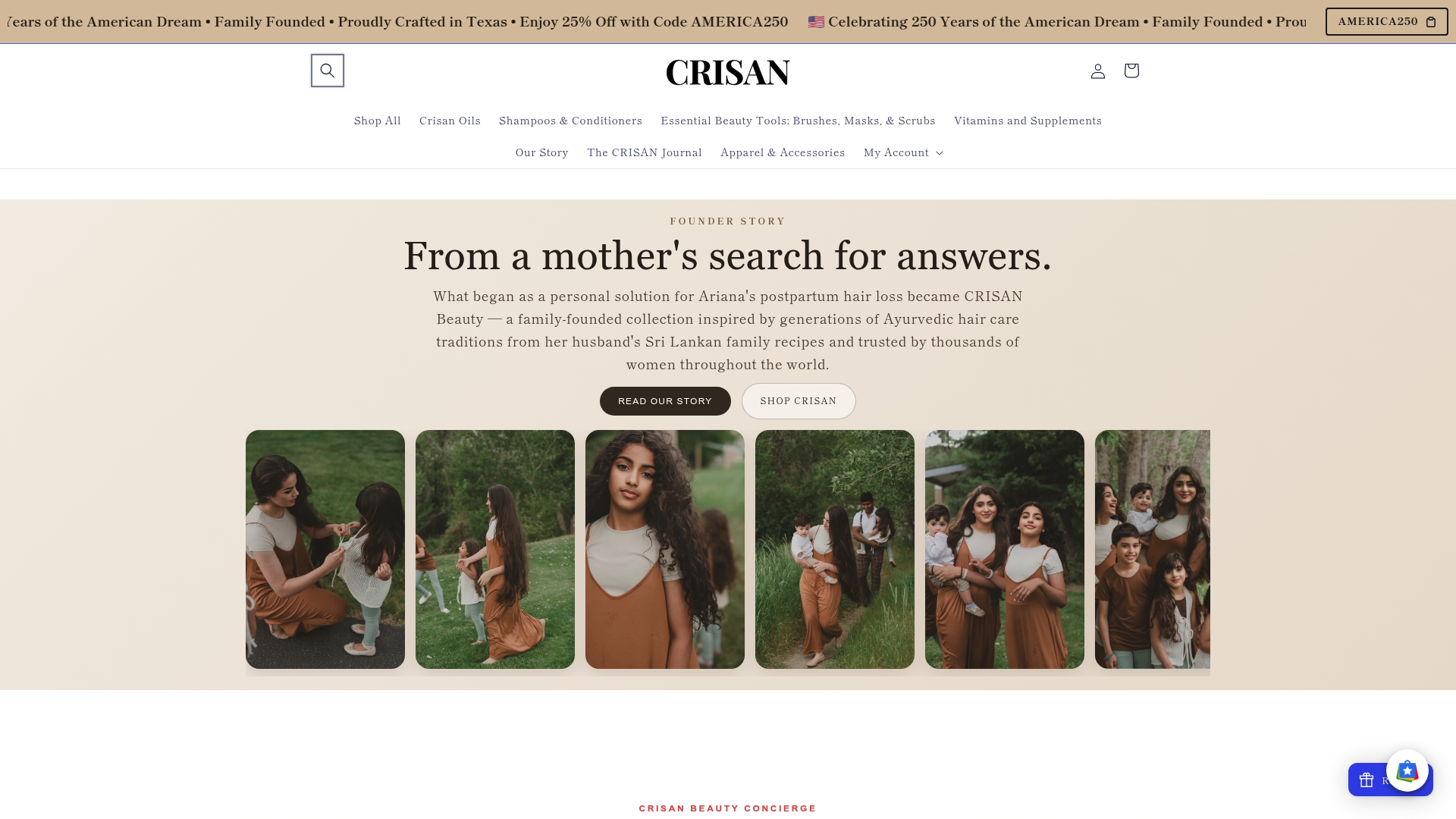
For hair and scalp care, the Ayurvedic Hair Growth Oil applies the same U.S.-manufacturing standard to a formula designed for thinning hair. Both products come from a Texas-based, family-owned business with a direct-to-consumer model, so you can ask origin questions before you order and get a real answer. Visit Crisanbeauty to review the full ingredient lists and confirm manufacturing details before you buy.
Sources
These are the primary sources behind this guide. Each one serves a specific purpose.


