


Yes, thinning edges often grow back when tension, breakage, or product buildup caused the loss. Expect months, not days. Start today by loosening or removing any tight style pulling at your hairline and replacing it with a gentle, consistent scalp routine. The specific steps that make that routine actually work follow below.
TL;DR:
- Improving edge thickness requires 6 to 8 weeks of low-tension care, with visible baby hairs often appearing within 1 to 2 months.
- Avoid tight hairstyles, excessive heat or chemicals, and heavy product buildup that can cause or worsen thinning, while using light massage and moisture.
- Topical treatments like minoxidil may support growth but demand consistent application over several months, with patience being crucial.
- Using gentle, water-based edge control and incorporating weekly clarifying and deep conditioning treatments help prevent follicle clogging and breakage.
- If no progress occurs after two months of dedicated care, consulting a dermatologist is recommended, especially if scalp issues or scarring develop.
Table of Contents
- What Causes Thinning Edges, and How Do You Know Which Type You Have?
- What Daily and Weekly Habits Actually Help Regrow Edges?
- Which Products and Ingredients Actually Support Edge Regrowth?
- How Long Does It Take to Regrow Edges?
- When Should You See a Dermatologist About Your Edges?
- The Founder’s Perspective on Regrowing Edges
- What Most Advice Gets Wrong About Regrowing Edges
- How Crisanbeauty Fits Into Your Edge-Regrowth Routine
- Sources
What Causes Thinning Edges, and How Do You Know Which Type You Have?
Most edge thinning traces back to one of two things: mechanical stress on the hair shaft or damage to the follicle itself. Traction alopecia happens when repeated pulling, from braids, ponytails, weaves, or edge control applied under tension, stresses the follicle until it stops producing hair in that spot. Mechanical breakage is different. It snaps the hair strand but leaves the follicle intact, which is why it tends to regrow faster once the stress stops.
Several everyday habits contribute to both problems:
- Tight braids, buns, or ponytails styled at the hairline
- Glue-based lace adhesives or edge-control formulas high in drying alcohols
- Daily heat styling or chemical relaxers applied too close to the edges
- Product buildup from heavy gels or waxes that clog follicles
- Nutritional gaps or hormonal shifts, including postpartum changes and thyroid issues
Checking your scalp tells you a lot. Broken hairs of varying lengths along the hairline usually point to mechanical damage. A shiny, smooth patch, tenderness, or a pattern that keeps widening despite easing up on tension suggests something more serious, possibly scarring alopecia. The practical rule: give your edges 6 to 8 weeks of low-tension care before assuming the damage is permanent. If there’s no visible change after that window, it’s time to loop in a professional rather than keep guessing.
What Daily and Weekly Habits Actually Help Regrow Edges?
There’s no single miracle product here. Dermatology-informed guidance consistently points to the same three moves: remove the source of tension, add gentle scalp stimulation, and keep the area moisturized without overloading it. The routine below turns that into something you can actually follow.
Daily habits:
- Cleanse your scalp only as needed, usually every 3 to 5 days, so you’re not stripping natural oils that protect fragile new growth.
- After moisturizing your hair, apply a light layer of oil directly to the hairline with clean fingertips.
- Massage the edges using the pads of your index and middle fingers in small circles for 2 to 5 minutes, using light, consistent pressure rather than vigorous rubbing.
- Wrap your hairline in a silk or satin scarf before bed. Cotton pillowcases and bonnets create friction that undoes a week of progress overnight.
Styling changes that matter:
Choose low-tension protective styles, loose twists, braids with no pull at the root, or simply wearing your hair down more often. Avoid frequent repetition of laying and re-laying your edges with a brush; that repeated friction can worsen thinning. If you use edge control, warm a small amount on the back of your hand first, apply it sparingly, and set it with a silk scarf instead of brushing it in aggressively.
Weekly maintenance:
Once a week, use a gentle clarifying wash if you notice buildup, followed by a moisturizing deep conditioner to keep the protein and moisture balance in check. Overdoing protein treatments on already fragile edges tends to make them stiffer and more prone to snapping.
Pro Tip: Keep a travel-size oil bottle in your bag or car so the nightly massage habit survives busy weeks instead of becoming the first thing you skip.
Which Products and Ingredients Actually Support Edge Regrowth?
Certain oils have a real, if modest, track record for supporting scalp health. Castor oil’s thickness helps seal in moisture, rosemary oil has circulation-boosting properties studied in small trials, and peppermint oil can create a tingling sensation some people associate with follicle stimulation. None of these work overnight, and none replace addressing the actual cause of tension or breakage.

Minoxidil is the one over-the-counter option with real backing. It works by prolonging the growth phase of the hair cycle, but it demands twice-daily application for months before results show, and it can cause scalp irritation or unwanted facial hair growth in some people.
Choosing an edge control matters more than most people realize. Consumer Reports tested nine edge-control gels and found real variation in hold, residue, and ingredient safety. Look for formulas built around:
- Water-soluble ingredients that rinse out clean instead of building up
- Nourishing bases like castor oil, mango seed butter, or beeswax
- Low or no high-drying alcohols, which strip moisture and worsen breakage
Allure’s testing and stylist interviews echo the same warning: overusing even a good edge control, or reapplying it daily without washing it out, can clog follicles just as easily as a bad formula.
This is where Crisanbeauty’s own lineup fits the routine rather than replacing it. The CRISAN Ayurvedic Hair Growth Oil for Thinning Hair is built for the nightly massage step described above, and the CRISAN Hair Growth Vitamins for Thicker, Stronger Hair address the internal side, nutrition, that topical products can’t touch.
How Long Does It Take to Regrow Edges?
Patience is the hardest part of this process, and it’s also where most people quit too early, before the follicle’s slow growth cycle has time to catch up.
Here’s what a realistic timeline looks like:
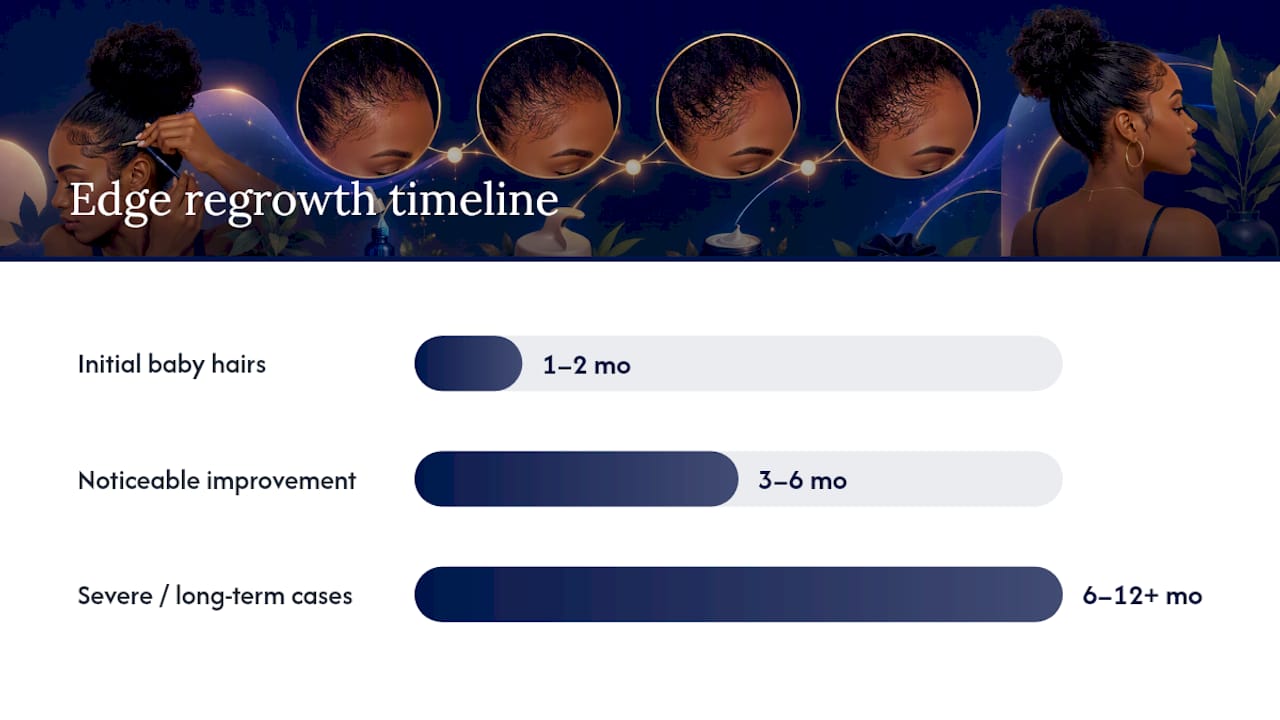
- 1 to 2 months: Fine baby hairs start appearing along the hairline.
- 3 to 6 months: Visible, noticeable improvement in density and length.
- 6 to 12+ months: Severe cases, including long-term traction damage, need this longer window to show real change.
Take a photo in the same lighting, same angle, and same pulled-back style every two weeks rather than judging progress in the mirror day to day. Small daily changes are nearly invisible, but a two-week comparison usually isn’t.
Pro Tip: Pull your hair back completely and take the photo under a bathroom light you use every day. Consistent lighting matters more than a fancy camera.
If you’ve followed a low-tension routine faithfully for 6 to 8 weeks with zero change, that’s your cue to escalate rather than wait longer.
When Should You See a Dermatologist About Your Edges?
Certain signs mean home care alone isn’t enough, and waiting longer only narrows your options. Watch for:
- Pain, itching, or tenderness at the hairline
- A scalp that looks shiny, smooth, or scarred where hair used to grow
- Patches that keep spreading despite removing tension
- No visible improvement after 6 to 8 weeks of consistent, gentle care
A dermatologist or trichologist can offer options beyond what any topical routine provides: prescription-strength topicals, intralesional steroid injections for inflammatory hair loss, platelet-rich plasma (PRP) treatments, low-level laser therapy (LLLT), or, for advanced scarring, hair transplant consultation. Bring progress photos and a written timeline of your styling history, braids, chemical processing, adhesive use, so the provider isn’t starting from scratch.
The Founder’s Perspective on Regrowing Edges
Crisanbeauty’s founder built the brand after her own postpartum hair loss, learning firsthand that scalp massage, consistent oiling, and cutting out tight styles mattered more than any single product. That experience shaped a company built around plant-based ingredients manufactured in the USA, backed by educational resources like the CRISAN Journal’s guide to scalp-nourishing herbs and its breakdown of treating thinning at the crown.
What Most Advice Gets Wrong About Regrowing Edges
The conventional wisdom sells edges as a product problem: buy the right oil, get the right gel, and growth follows. The research tells a less convenient story. Tension is almost always the real culprit, and no oil, however well formulated, outworks a ponytail pulled too tight every single day. The habit that actually moves the needle is boring: gentle massage, low manipulation, and enough patience to reach month three or four before judging results.
Where most people go wrong is stacking treatments, oil, minoxidil, a new edge control, all at once, then abandoning everything after three weeks when nothing visible happens. Pick one consistent routine and give it the full timeline before changing course. Nutrition deserves more attention than it gets, too. A scalp starved of iron, biotin, or protein won’t respond to topical care no matter how diligently it’s applied.
If new motherhood or a demanding schedule is part of why your styling routine got tighter and more rushed in the first place, building a flexible daily routine can make the hair care habits above easier to sustain.
— CRISAN
How Crisanbeauty Fits Into Your Edge-Regrowth Routine
This brand is built around a plant-based approach similar to what this guide recommends, providing oils intended for nightly massage. The CRISAN Ayurvedic Hair Growth Oil for Thinning Hair is formulated for exactly that step: warm a small amount between your palms, work it into the hairline with fingertip pressure, and follow with your silk wrap.

For internal support, the CRISAN Hair Growth Vitamins for Thicker, Stronger Hair are a vegan daily supplement meant to complement topical care, not replace the tension-removal work that has to happen first. Take them consistently, at the same time each day, since supplement benefits build over weeks rather than days. Patch test any new oil on a small area of skin before full use, follow the directions on the label, and check with your doctor before starting a new supplement if you’re pregnant or breastfeeding. If you want both the topical and internal pieces in one step, the Hair + Skin Essentials Duo bundles them together to get your routine started today.
This article is general information, not a substitute for advice from a qualified doctor. Consult a qualified healthcare professional about your own circumstances before acting on anything here.
Sources
- How to Regrow Edges so They’re Long, Strong, and Free From Breakage — InStyle
- Best Edge Control Gels for Smooth, Flake-Free Edges — Consumer Reports
- Best edge control — Allure
- Can Thinning Edges Grow Back? Guide for African American Women — Natural Transplants


