


Crown hair thinning is defined as the progressive reduction of hair density at the top of the scalp, most commonly caused by androgenetic alopecia. You can treat hair thinning at crown areas effectively by combining professional diagnosis, clinically backed topical treatments, and consistent lifestyle support. The good news is that the crown responds well to treatment, often better than the frontal hairline. Acting early gives you the best chance of reversing miniaturization before follicles stop producing hair entirely.
What causes hair thinning specifically at the crown?
Crown thinning has a primary cause: androgenetic alopecia, the genetic sensitivity of hair follicles to dihydrotestosterone (DHT). DHT shrinks follicles over time, producing thinner, shorter strands until growth stops. This pattern affects both men and women, though it presents differently. Men typically see a bald spot forming at the vertex, while women experience a more diffuse thinning across the top of the scalp.
Crown thinning can also result from nutritional deficiencies, elevated stress hormones, and inflammatory scalp conditions. This matters because treating the wrong cause produces no results. A dermatologist will typically order blood tests checking iron, ferritin, vitamin D, and zinc levels alongside a scalp examination to confirm the diagnosis. You can also learn more about the common causes of hair loss in women specifically.
The most common causes of crown area hair loss include:
- Androgenetic alopecia: Genetic DHT sensitivity shrinks follicles progressively over years.
- Nutritional deficiencies: Low iron, vitamin D, or zinc disrupts the hair growth cycle.
- Hormonal shifts: Postpartum changes, thyroid imbalance, and menopause all trigger shedding.
- Chronic stress: Elevated cortisol pushes follicles into a resting phase, causing diffuse loss.
- Inflammatory scalp conditions: Seborrheic dermatitis and scalp psoriasis damage follicles when left untreated.
Professional diagnosis is critical because crown thinning can mimic inflammatory or autoimmune conditions. Treating the wrong condition can make things worse. Never self-diagnose based on appearance alone.
Which non-surgical treatments are effective for crown thinning?
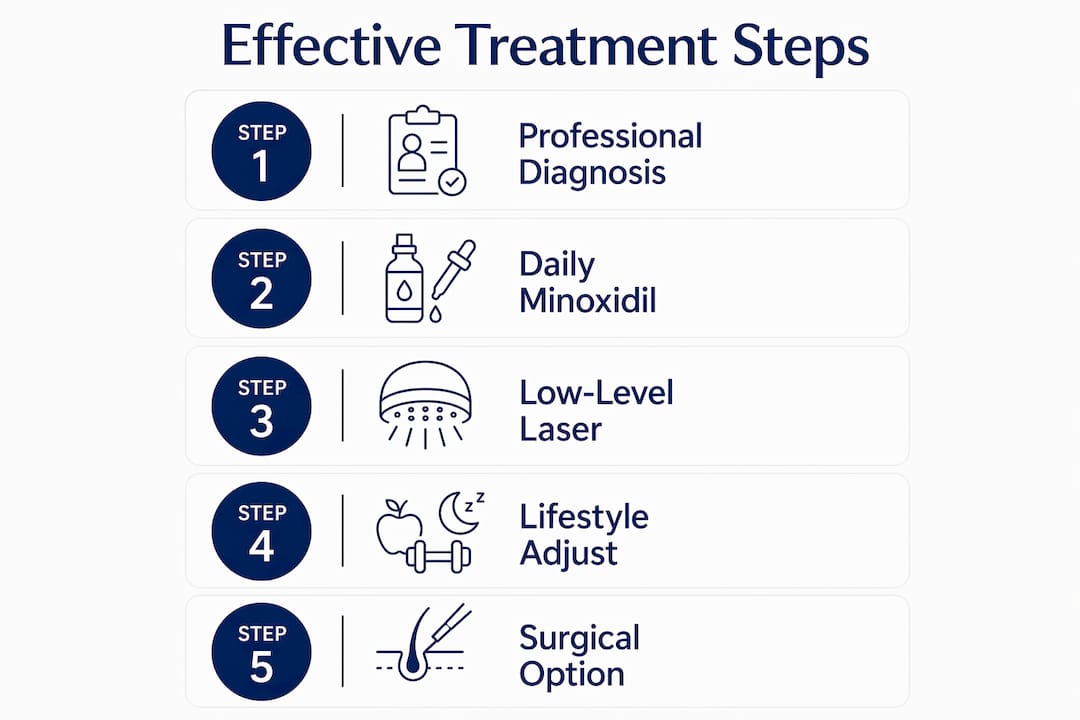
Topical minoxidil is the primary non-surgical treatment for crown thinning. Visible improvement takes 4–6 months of daily application, and continuous use is required to maintain results. The crown actually responds more reliably to minoxidil than the frontal hairline, which makes it the best starting point for most people. Stopping treatment causes miniaturization to resume within months.
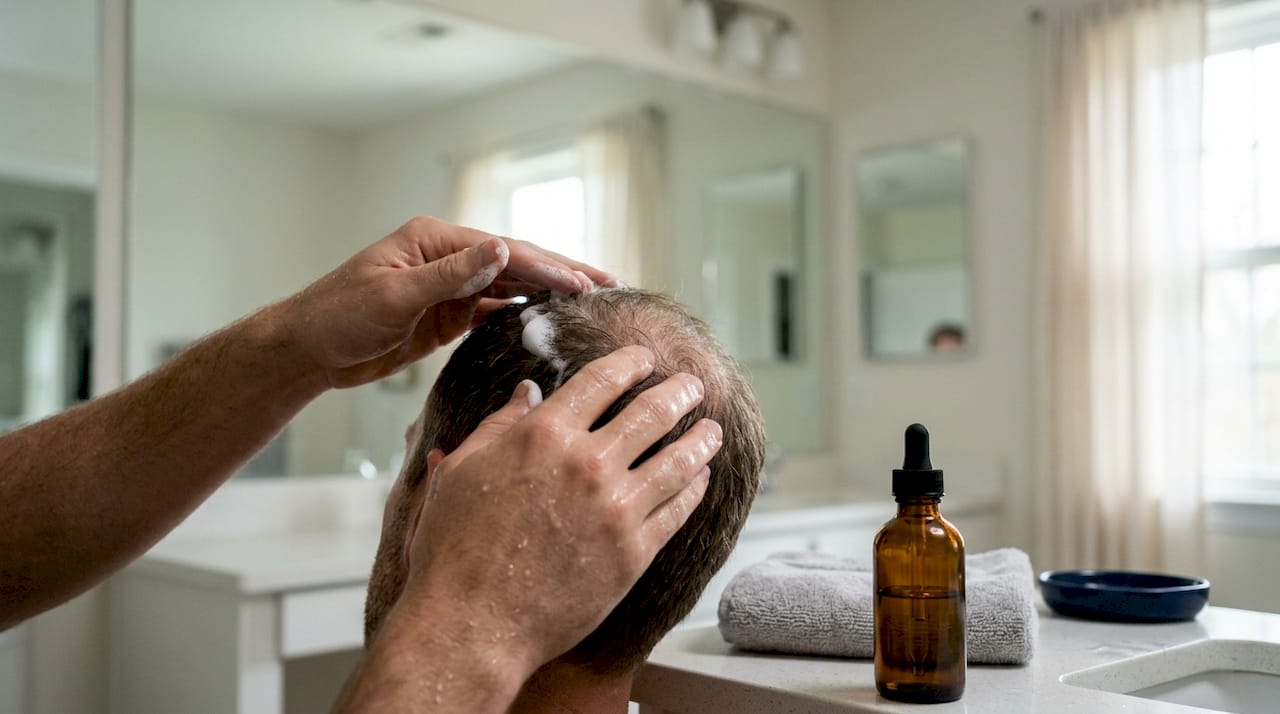
Oral medications add another layer of support. Finasteride, approved for men, blocks DHT production at the source and slows follicle miniaturization. Women have fewer oral options, though spironolactone is sometimes prescribed off-label for hormonal hair loss. Any oral medication requires a physician’s supervision and regular monitoring.
Adjunctive therapies improve results when combined with first-line treatments:
- Low-level light therapy (LLLT): Wavelengths of 650–808 nm stimulate follicles and enhance the effectiveness of minoxidil or oral medications. LLLT devices are available for home use and are safe for long-term application.
- Microneedling: Creates micro-channels in the scalp that improve topical absorption and stimulate collagen around follicles. Clinical sessions produce stronger results than at-home rollers.
- Platelet-rich plasma (PRP): Injections of concentrated growth factors from your own blood support follicle health. Results vary, and multiple sessions are typically needed.
Non-surgical treatments slow progression and improve hair caliber, but they cannot recreate full density in significantly bald areas. Setting that expectation from the start prevents frustration. The goal of medical therapy is preservation and improvement, not complete restoration of lost hair.
Pro Tip: Combine topical minoxidil with LLLT for better results than either treatment alone. Use the light device on the same days as minoxidil application to maximize follicle stimulation.
A structured, multi-modal approach is the standard of care for crown thinning. Relying on a single treatment rarely produces the best outcome. Work with a dermatologist or trichologist to build a plan that fits your specific pattern and cause. You can also review clinical insights on hair thinning to understand how aesthetic practitioners approach the same problem.
How to optimize lifestyle and hair care for crown health
Nutrition is the foundation of hair follicle function. Iron deficiency is one of the most common and correctable causes of thinning hair in women. Adequate protein intake supports keratin production, the structural protein that makes up each hair strand. Vitamin D, zinc, and biotin all play supporting roles in the hair growth cycle.
Damaging hair practices accelerate crown thinning, especially in people already genetically predisposed. Tight hairstyles like high ponytails and braids create traction alopecia, which compounds androgenetic loss at the crown. Frequent heat styling weakens the hair shaft and increases breakage. Reducing both gives your follicles a better environment to recover.
Scalp care directly supports follicle health:
- Scalp massage: Five minutes of daily massage increases blood flow to follicles. Studies show it can improve hair thickness over time with consistent practice.
- Gentle cleansing: Buildup of sebum and product residue blocks follicles. Use a sulfate-free shampoo suited to your scalp type.
- Nourishing scalp treatments: Botanical oils applied to the scalp reduce inflammation and condition the follicle environment. Crisanbeauty’s Ayurvedic hair growth oil uses plant-based ingredients rooted in traditional Ayurvedic practice to support scalp health.
Pro Tip: Massage your scalp before applying any topical treatment. The increased circulation primes follicles to absorb active ingredients more effectively.
Stress management belongs in every hair loss plan. Elevated cortisol pushes hair follicles into the telogen (resting) phase, causing shedding weeks to months after the stressful event. Practices like consistent sleep, moderate exercise, and mindfulness reduce cortisol levels and support the return to normal hair cycling. This is not optional support. It is a direct treatment variable.
When and how to consider surgical options for crown hair restoration
Surgery is appropriate only after non-surgical options have been tried and hair loss has stabilized. Performing a transplant during active shedding wastes grafts and produces poor results. A dermatologist or hair restoration surgeon confirms stability through scalp examination and, often, serial photography over 6–12 months.
The crown presents unique surgical challenges. The crown has a circular hair growth pattern with a swirl at the vertex, and grafts must be placed at the correct angle and direction to look natural. Incorrect placement produces visible, unnatural results even when the grafts survive. This is why crown transplants require a surgeon with specific experience in vertex restoration.
Key surgical planning considerations:
- Confirm stable hair loss: Active shedding or scalp inflammation disqualifies a candidate until resolved.
- Assess donor supply: The back and sides of the scalp provide grafts. Limited donor hair requires prioritizing coverage areas carefully.
- Plan for staged procedures: The crown is a large area. Multiple sessions spaced over time often produce better density than one large procedure.
- Commit to ongoing medical maintenance: Transplants redistribute existing hair but do not stop progression. Continuing minoxidil or finasteride after surgery protects both transplanted and native hair.
| Surgical factor | What it means for you |
|---|---|
| Stable hair loss required | Surgery before stabilization wastes grafts and money |
| Crown swirl pattern | Demands a surgeon experienced in vertex graft placement |
| Donor area limits | Finite supply means prioritizing coverage zones matters |
| Staged procedures | Multiple sessions build density more naturally than one large session |
| Post-op medical care | Ongoing treatment protects results and slows further loss |
Women less frequently qualify for transplants because female pattern loss tends to be diffuse rather than localized. A thorough evaluation determines candidacy before any surgical planning begins. The 7-pillar hair thinning protocol used by aesthetic clinicians shows how surgery fits within a broader, multi-modal treatment framework.
Key takeaways
Treating crown hair thinning requires early intervention, professional diagnosis, and a combination of medical, lifestyle, and, when appropriate, surgical approaches for lasting results.
| Point | Details |
|---|---|
| Get a professional diagnosis | Blood tests and scalp exams identify the true cause before any treatment begins. |
| Start minoxidil early | The crown responds well to topical minoxidil, but results require 4–6 months of daily use. |
| Combine treatments | Pairing LLLT or microneedling with minoxidil produces better outcomes than single-therapy approaches. |
| Support from within | Nutrition, stress reduction, and scalp care directly affect follicle health and treatment response. |
| Surgery requires stability | Transplants are a last resort for stable loss, not a substitute for ongoing medical maintenance. |
What I’ve learned from helping people with crown thinning
The single biggest mistake I see is waiting. People notice the thinning, feel unsure about what to do, and lose months or even years before starting treatment. Early-stage crown miniaturization is still responsive to medical therapy. Late-stage follicles that have been dormant for years are not. That window matters more than most people realize.
The second mistake is expecting one product to fix everything. Crown thinning is rarely a single-cause problem. It usually involves genetics, nutrition, stress, and scalp health all working against you at the same time. A treatment plan that addresses only one of those factors will underperform. The people who see the best results are the ones who commit to the full picture: a clinician-guided medical protocol, a cleaner diet, a real scalp care routine, and stress management that they actually practice.
I also want to be honest about what treatment can and cannot do. If you have significant baldness at the crown, non-surgical treatments will improve what you have and slow further loss. They will not rebuild a full head of hair in that area. That is not a failure of the treatments. It is just biology. Setting that expectation clearly from the start keeps you consistent with your routine instead of abandoning it out of disappointment.
At Crisanbeauty, we built our products around this reality. We are not selling miracles. We are offering plant-based, Ayurvedic-inspired support that works alongside your medical treatment, not instead of it. The people in our community of more than 1.3 million who see results are the ones who use our products as part of a consistent, multi-layered routine. That consistency is the actual treatment.
— CRISAN
Crisanbeauty products that support your crown care routine
Crown thinning treatment works best when your scalp and follicles get consistent nutritional and topical support alongside any medical protocol you follow.
Crisanbeauty’s hair growth vitamins are formulated with plant-based ingredients to support hair strength and growth from within. They are vegan, made in the USA, and designed to fill the nutritional gaps that commonly drive thinning. Pair them with Crisanbeauty’s Ayurvedic hair oil for a topical routine that nourishes the scalp and conditions the follicle environment. Both products are rooted in Ayurvedic tradition and built for people who want real, long-term results without harsh chemicals.
FAQ
What is the fastest way to treat crown hair thinning?
Topical minoxidil applied daily is the fastest clinically supported option, with visible results appearing in 4–6 months. Combining it with low-level light therapy speeds up the response further.
Can crown hair thinning be reversed completely?
Early-stage thinning with miniaturized but active follicles can often be significantly improved with consistent medical treatment. Advanced baldness with fully dormant follicles typically requires surgical intervention for meaningful restoration.
How do I know if my crown thinning is genetic or caused by something else?
A dermatologist uses scalp examination and blood tests checking iron, vitamin D, zinc, and hormone levels to differentiate androgenetic alopecia from nutritional or hormonal causes. Self-diagnosis is unreliable and can lead to ineffective treatment.
Does stress cause crown hair loss specifically?
Stress-related hair loss, called telogen effluvium, causes diffuse shedding across the scalp rather than targeting the crown. However, chronic stress-driven hair loss can worsen genetic crown thinning in people already predisposed to it.
Is a hair transplant at the crown worth it?
A crown transplant produces natural results when performed by an experienced surgeon who understands the vertex swirl pattern, and when hair loss has fully stabilized. Ongoing medical maintenance after surgery is required to protect both transplanted and existing hair.


