


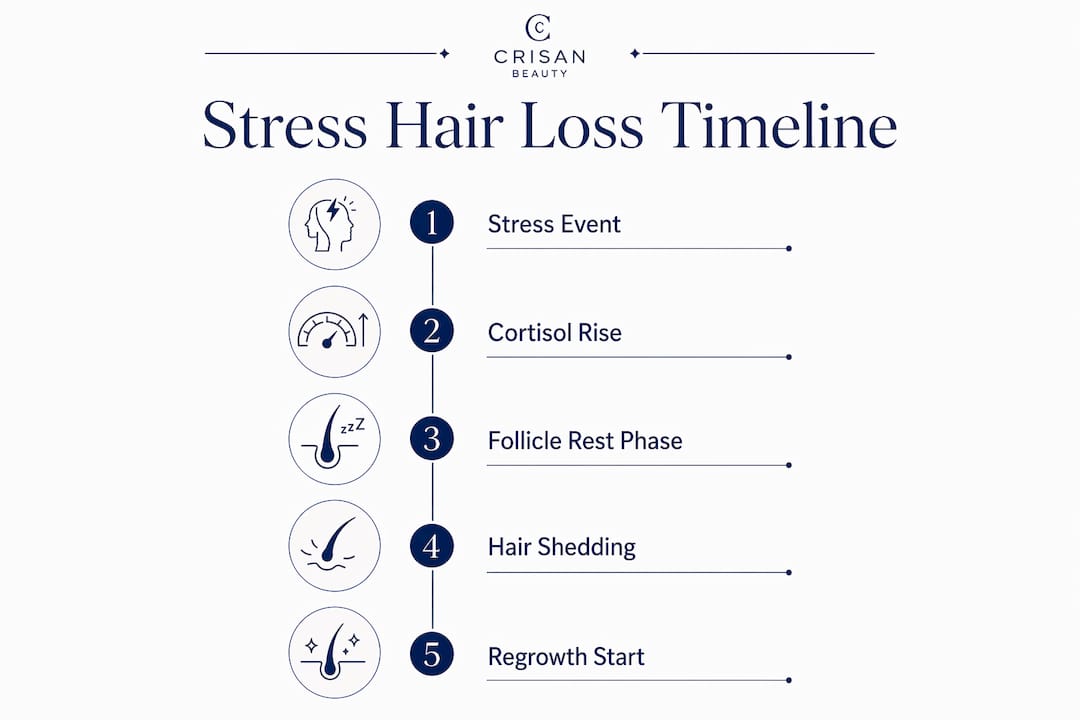
Stress causes hair loss by pushing hair follicles prematurely into the resting phase of the growth cycle, triggering a condition clinicians call telogen effluvium. This happens because elevated cortisol, the body’s primary stress hormone, disrupts the cellular signals that keep follicles actively growing. The result is diffuse shedding that typically appears 2–3 months after the stressful event, which makes the connection easy to miss. Understanding why stress causes hair loss is the first step toward stopping the cycle and supporting real regrowth.
What biological mechanisms link stress to hair loss?
Cortisol is the direct link between stress and follicle damage. When cortisol stays elevated for weeks or months, it suppresses the release of GAS6, a signaling protein produced by dermal papilla cells that activates hair follicle stem cells. Without that signal, follicles stall and shift into a resting state instead of continuing to grow. Chronic cortisol elevation also reduces follicle matrix molecule synthesis by roughly 40%, weakening the structural integrity of each strand before it even exits the scalp.
Stress also activates the immune system in ways that directly attack hair follicles. In alopecia areata, psychological pressure triggers T-cell activity that targets the follicle itself, causing patchy rather than diffuse shedding. Inflammatory cytokines released during stress shorten the anagen (growth) phase, cutting it off before the hair reaches its full length. This is why people under chronic stress often notice their hair feels thinner and grows more slowly, even before visible shedding begins.

Stress-related hair loss operates through at least three distinct biological pathways: telogen effluvium, alopecia areata, and acceleration of androgenetic alopecia. Each pathway has a different mechanism and a different treatment need. Acute stress, like a single traumatic event, typically causes telogen effluvium. Chronic, ongoing stress can trigger all three simultaneously, making the condition harder to reverse.
Pro Tip: If you notice your hair growing more slowly than usual alongside increased shedding, that combination points to cortisol disrupting both the growth phase length and the follicle activation signal at the same time.
- Telogen effluvium: Cortisol pushes follicles from the growth phase into the resting phase en masse.
- Alopecia areata: Immune cells attack follicles, causing patchy bald spots rather than diffuse thinning.
- Androgenetic acceleration: Stress hormones amplify genetic sensitivity to DHT, speeding up pattern hair loss.
- Inflammatory cytokines: These chemical signals shorten the growth phase and reduce follicle size over time.
What is telogen effluvium and how does stress cause it?
Telogen effluvium is the most common form of stress-induced hair loss. It occurs when a large number of follicles simultaneously enter the telogen (resting) phase, then shed together weeks later. Under normal conditions, roughly 10–15% of scalp follicles rest at any given time. A significant stressor can push that number far higher, flooding the resting pool and causing noticeable thinning across the entire scalp.
The clinical marker for telogen effluvium is shedding 150–300 hairs per day, compared to the typical 50–100 hairs lost daily. That number sounds alarming, but it reflects a biological process, not permanent follicle death. The follicles are still alive. They have simply paused. The key variable is how long the stressor persists.
The 2–3 month lag between the stressful event and visible shedding is one of the most clinically confusing aspects of this condition. Most people connect their hair loss to something happening right now, not to a job loss, illness, or emotional crisis that occurred months earlier. This lag exists because the hair spends several weeks in the resting phase before it physically sheds. By the time you see hair on your pillow, the triggering event may feel like ancient history.
| Feature | Typical Pattern |
|---|---|
| Onset after stressor | 2–3 months |
| Daily shedding rate | 150–300 hairs |
| Recovery start | 3–6 months after stress resolves |
| Chronic threshold | Shedding persisting beyond 6 months |
| Distribution | Diffuse, across the entire scalp |
Regrowth typically begins within 3–6 months once the stressor resolves. That timeline assumes the underlying cause is fully addressed. If stress continues, or if nutritional deficiencies compound the problem, shedding can persist well beyond the expected window. Chronic telogen effluvium, defined as shedding lasting more than 6 months, almost always signals an ongoing trigger that has not been identified or treated.
How can you tell if your hair loss is stress-related?
The pattern of shedding is the clearest diagnostic clue. Stress-induced thinning is diffuse, meaning it spreads evenly across the scalp rather than concentrating in one area. Alopecia areata, by contrast, produces distinct circular patches of complete hair loss. Androgenetic alopecia follows a predictable pattern: a receding hairline in men, or widening part in women. If your hair is thinning uniformly from crown to temples, stress is a strong candidate.
The 2–3 month lag time creates a common misattribution problem. You may be losing hair now because of a stressor from last quarter, not because of anything happening this week. Keeping a rough timeline of major life events, illnesses, surgeries, or emotional shocks from the past six months can help you and your doctor identify the actual trigger. This is one area where a detailed personal history matters more than any single test.
Pro Tip: Pull a gentle clump of 50–60 hairs from the crown of your scalp. If more than 6 come out easily, that is a positive pull test, and it warrants a conversation with a dermatologist.
Blood work is a non-negotiable part of accurate diagnosis. Ferritin levels between 40–70 µg/L, along with thyroid function and vitamin D, help rule out nutritional and hormonal contributors that often compound stress-related shedding. Low iron alone can cause diffuse hair loss that looks identical to telogen effluvium. Correcting these deficiencies does not just support regrowth. It removes obstacles that would otherwise block recovery even after stress resolves.
- Diffuse thinning across the whole scalp points to telogen effluvium or nutritional deficiency.
- Circular bald patches suggest alopecia areata, which requires different treatment.
- A receding hairline or widening part indicates androgenetic alopecia, possibly accelerated by stress.
- Shedding that started 2–3 months after a major event strongly supports a stress-related cause.
- Persistent shedding beyond 6 months requires blood work to identify compounding factors.
For a broader look at what else might be driving your thinning, the Crisanbeauty guide on common causes of hair loss in women covers the full diagnostic picture clearly.
What proven strategies help manage stress-induced hair loss?
Addressing the stressor directly is the most effective treatment for stress-induced hair loss. Unresolved psychological pressure maintains the hormonal and inflammatory environment that impairs follicle function, which means topical treatments and supplements cannot fully work while the root cause remains active. This is not a minor caveat. It is the central fact of treatment.
Lifestyle interventions that regulate the HPA (hypothalamic-pituitary-adrenal) axis produce the most reliable cortisol reduction. Sleep and exercise are more effective at lowering cortisol burden on hair follicles than supplements. A consistent sleep schedule of 7–9 hours per night, combined with moderate aerobic exercise three to five times per week, directly reduces cortisol output. Mindfulness-based stress reduction (MBSR) and cognitive behavioral therapy (CBT) both have clinical evidence supporting their role in lowering chronic stress markers.
For a structured approach to managing the physical effects of stress on your hair, the 7 Pillar Hair Thinning Protocol offers a practical framework that addresses multiple contributing factors at once.
- Regulate sleep. Aim for 7–9 hours per night on a consistent schedule. Poor sleep elevates cortisol and directly suppresses follicle activity.
- Exercise regularly. Moderate aerobic activity three to five times per week lowers cortisol and improves scalp circulation.
- Practice mindfulness or therapy. MBSR and CBT both reduce chronic stress markers that impair hair regrowth.
- Correct nutritional gaps. Address iron, vitamin D, and protein deficiencies through diet and targeted supplementation before adding hair-specific products.
- Support follicles topically. Plant-based scalp oils with Ayurvedic botanicals can nourish follicles and improve scalp health during the recovery period.
- Be patient with the timeline. Regrowth begins 3–6 months after stress resolves. Expecting faster results leads to unnecessary anxiety, which compounds the problem.
Pro Tip: Cortisol-lowering supplements like ashwagandha have some supporting evidence, but they work best as additions to lifestyle changes, not replacements for them. Lifestyle regulation of the HPA axis is the foundation.
Nutritional support matters, but specificity matters more. General multivitamins rarely address the precise deficiencies that compound stress-related shedding. Targeted formulas that include biotin, zinc, iron, and vitamin D alongside adaptogenic botanicals are better suited to the recovery phase. Crisanbeauty’s approach to hormonal hair loss explains how cortisol intersects with other hormonal drivers of thinning, which is useful context for anyone dealing with multiple contributing factors.
Key Takeaways
Stress causes hair loss through cortisol-driven disruption of the follicle growth cycle, and recovery requires resolving the stressor first, then supporting follicles with nutrition, lifestyle regulation, and targeted care.
| Point | Details |
|---|---|
| Cortisol is the primary driver | Elevated cortisol suppresses stem cell activation and weakens follicle matrix molecules by roughly 40%. |
| Shedding lags the stressor | Visible hair loss appears 2–3 months after the triggering event, making the cause easy to miss. |
| Telogen effluvium is reversible | Regrowth typically begins within 3–6 months once the stressor is fully resolved. |
| Lifestyle beats supplements | Sleep, exercise, and stress therapy regulate the HPA axis more effectively than cortisol-lowering supplements alone. |
| Blood work is non-negotiable | Testing ferritin, thyroid, and vitamin D rules out compounding deficiencies that block regrowth. |
What I’ve learned about stress and hair loss that most articles skip
Most articles on this topic treat stress as a simple on/off switch. Reduce stress, hair grows back. That framing misses the harder truth.
The people I hear from most often are not dealing with a single traumatic event. They are living under sustained, low-grade pressure: financial strain, caregiving, chronic illness, or the particular exhaustion of running a business while raising a family. That kind of stress does not produce a clean 2–3 month lag and a tidy recovery. It produces a moving target where the follicles never fully get the signal to restart because the cortisol never fully drops.
What I have found, both personally after postpartum hair loss and through years of building Crisanbeauty, is that the anxiety about shedding becomes its own stressor. You see hair on the shower floor, you panic, and that panic feeds the cycle. Breaking that loop requires two things working together: a realistic timeline and a concrete routine. When you know regrowth takes 3–6 months and you have a daily protocol you trust, the anxiety loses some of its grip.
The other thing most articles underestimate is how much nutritional status matters alongside stress. I have seen people do everything right on the stress management side and still shed because their ferritin was at 15 µg/L. The biology does not care how much yoga you do if your follicles are starved for iron. Address both simultaneously, not sequentially.
— CRISAN
Crisanbeauty products for hair health during stressful periods
Stress-related shedding responds best to a two-track approach: managing cortisol through lifestyle and giving your follicles the nutritional and topical support they need to recover.
Crisanbeauty formulates every product with plant-based, Ayurvedic-inspired ingredients manufactured in the USA. The Complete Hair Essentials vegan daily vitamin delivers targeted follicle support with biotin, zinc, and botanical extracts designed to work during the recovery phase. For topical care, the Ayurvedic hair growth oil nourishes the scalp and strengthens strands during periods of stress-induced thinning. Both products are built for people who want real ingredients, honest results, and a routine they can sustain.
FAQ
Why does stress cause hair loss?
Stress elevates cortisol, which suppresses the cellular signals that keep hair follicles in the active growth phase. This pushes follicles into the resting phase prematurely, leading to increased shedding.
How long after stress does hair loss start?
Hair loss from stress typically appears 2–3 months after the triggering event. The lag exists because follicles spend several weeks in the resting phase before the hair physically sheds.
Can anxiety cause hair loss even without a major event?
Yes. Chronic low-grade anxiety maintains elevated cortisol levels that continuously disrupt follicle cycling. The effect accumulates over time and can cause diffuse thinning without a single identifiable stressor.
How long does it take for hair to grow back after stress?
Regrowth typically begins within 3–6 months after the stressor fully resolves. Shedding that persists beyond 6 months signals an ongoing trigger, such as unresolved stress or a nutritional deficiency, that requires direct treatment.
Is hair loss a sign of stress or something more serious?
Diffuse shedding across the entire scalp is a common sign of stress-related telogen effluvium, but it can also indicate thyroid dysfunction, low ferritin, or vitamin D deficiency. Blood work is the most reliable way to distinguish between causes and identify compounding factors.


