


“Natural” tells you where an ingredient came from. “Clean” tells you what a brand chose to leave out. “Organic” is the only one with a legal certification behind it, backed by USDA rules. None of these words tell you whether a product will work for your skin. That comes down to reading the ingredient list, and skipping the buzzwords entirely.
TL;DR:
- “Organic” is the only term with a verified certification, while “clean” and “natural” rely on brands’ own definitions and practices.
- Natural ingredients can cause skin reactions and are not inherently safer, just as synthetic preservatives can sometimes reduce microbial risk.
- Reading the ingredient list is more reliable than trusting marketing claims, especially because ingredients appear in order by concentration.
- Certification seals like USDA organic or Leaping Bunny have specific standards, but retailer “clean” programs vary widely and are not legally regulated.
- Performance depends on formulation quality; well-designed natural or clean products can outperform poorly formulated synthetic options.
Table of Contents
- Clean vs Natural Beauty: How Each Term Gets Defined
- What Does the U.S. Government Actually Regulate Here?
- Is Natural Always Safer Than Synthetic?
- How Do You Read an Ingredient List Like a Pro?
- Which Certifications Are Worth Trusting?
- A Practical Checklist for Your Next Purchase
- How CRISAN Beauty Approaches Transparent Formulation
- Where Did Clean and Natural Beauty Trends Come From?
- Does Clean or Natural Beauty Work Better for Sensitive Skin?
- What’s the Environmental Case for Clean or Natural Beauty?
- Common Myths About Clean and Natural Beauty
- Do Clean and Natural Products Actually Perform Better?
- Why Ingredient Literacy Beats Every Buzzword on the Bottle
- A Transparent, Plant-Based Alternative Worth Exploring
- Sources
Clean vs Natural Beauty: How Each Term Gets Defined
The confusion starts because these three words describe three completely different things, and brands use them interchangeably on purpose.
Natural refers to ingredient origin. A natural ingredient comes from a plant, mineral, or animal source rather than being synthesized in a lab. Shea butter, aloe vera, and beeswax all qualify. But “natural” says nothing about concentration, purity, or how the ingredient was processed before it landed in your jar.
Clean describes a brand’s own exclusion list. Clean beauty companies typically avoid ingredients like parabens, sulfates, phthalates, and certain synthetic fragrances, based on the idea that these compounds carry unnecessary risk. The catch: there’s no universal clean standard. One brand’s clean list has 50 banned ingredients; another has 500. A product can be “clean” at one retailer and rejected at another, since these programs reflect corporate risk tolerance rather than any shared benchmark.
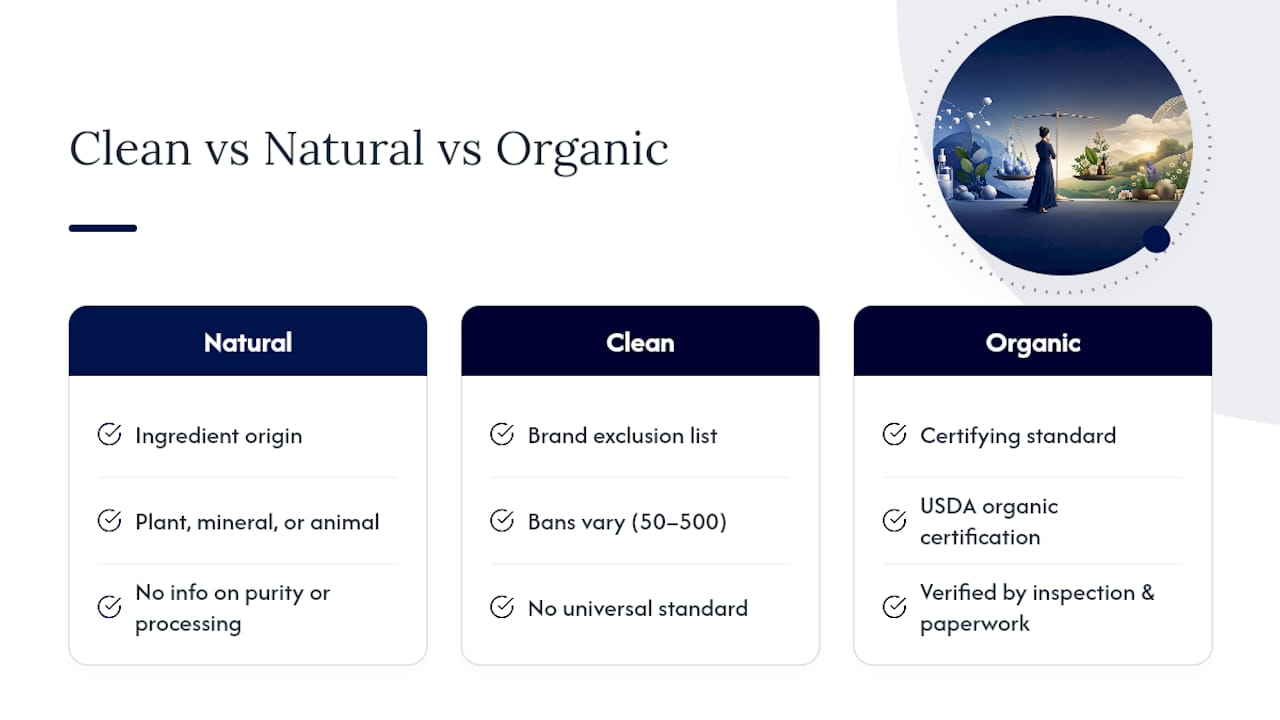
Organic is the only term with a certifying body attached. USDA organic certification means a product meets specific thresholds for organically grown and processed agricultural ingredients, verified through inspection and paperwork, not marketing copy.
Here’s where it gets interesting: an ingredient can be natural without being clean (poison ivy is natural), clean without being natural (a lab-made preservative can pass every clean checklist), and organic without being either clean or gentle (organic essential oils still cause reactions). The words are not synonyms, and treating them that way is how greenwashing happens.
What Does the U.S. Government Actually Regulate Here?
There is no federal definition for “clean” or “natural” cosmetics. The Federal Food, Drug, and Cosmetic Act doesn’t define either term, and the FDA doesn’t pre-approve cosmetic ingredients before they hit shelves, aside from color additives.
USDA organic certification works differently. It requires:
- Documented sourcing and processing standards for agricultural ingredients
- Third-party inspection before the seal can be used
- Restrictions on synthetic substances allowed in certified products
Retailer “clean” programs, like the private banned-ingredient lists maintained by major beauty retailers, sit somewhere in between. They’re more rigorous than an unregulated marketing claim, but they’re still company policy, not law. Two retailers can both call a product “clean” while applying entirely different criteria.
When does this distinction actually matter to your buying decision? When you’re managing a specific sensitivity or allergy, the USDA seal gives you something verifiable. When a brand simply says “clean” with no third-party backing, treat it as a starting point for research, not a safety guarantee.
Is Natural Always Safer Than Synthetic?
No, and this is the single biggest misconception in the entire category. Safety depends on concentration, formulation, and how your skin is exposed to an ingredient, not whether that ingredient grew in the ground or came out of a lab.
Some of the most common skin irritants in cosmetics are entirely natural. Essential oils like lavender, tea tree, and citrus extracts are frequent causes of contact dermatitis, especially at high concentrations or on compromised skin barriers. Certain botanical extracts oxidize unpredictably once a product is opened, which changes their chemistry in ways a label can’t capture. A review from Harvard Health points to fragrance, along with the preservatives MI and MCI, as documented contact allergens, alongside formaldehyde releasers that clean brands typically avoid.
Statistic Callout: Dermatology and toxicology research consistently shows that adverse reactions track with dose and exposure, not simply the presence of an ingredient. That’s why a synthetic preservative used at a controlled, tested concentration can carry lower real-world risk than an “all-natural” formula with no preservation system at all.
Synthetics get unfairly demonized here. Preservatives prevent mold and bacterial growth in water-based formulas, protecting you from infection risk that’s arguably more dangerous than any single chemical on a banned list. Purified, stabilized synthetic actives (think a lab-made vitamin C derivative) often outperform their “natural” counterparts because they don’t degrade as quickly. Origin and safety are two different axes entirely, and conflating them is how fear-based marketing sells product.
How Do You Read an Ingredient List Like a Pro?
Front-of-package claims are marketing. The INCI list (International Nomenclature of Cosmetic Ingredients) on the back is the actual formula, and it’s the only part of the packaging that’s genuinely regulated for accuracy.
Ingredients appear in descending order by concentration. Whatever sits in the first five spots makes up the bulk of the product; anything listed after “fragrance” or preservatives is typically present in trace amounts.
Here’s a workflow you can run in the store or from your couch before checkout:
- Name your priority. Sensitive skin, pregnancy-safe formulas, and fragrance-free routines each call for a different scan.
- Scan the first five ingredients. This tells you what the product actually does, regardless of what the label claims.
- Check for known allergens. Look for fragrance/parfum, MI/MCI, and formaldehyde releasers if you have reactive skin.
- Confirm a preservation system exists in any water-based product. No preservative at all is a bigger red flag than a synthetic one.
- Patch test on your inner arm for 48 hours before applying anything new to your face.
Pro Tip: A vague “fragrance” or “parfum” listing can legally hide dozens of undisclosed compounds, since fragrance formulas are protected as trade secrets. If you have known sensitivities, treat any product listing plain “fragrance” as an unknown until you’ve patch tested it yourself.
Which Certifications Are Worth Trusting?
Not all seals carry equal weight, and knowing the difference saves you from paying a premium for a badge that doesn’t guarantee what you think it does.
- USDA organic verifies agricultural sourcing and processing standards for cosmetic ingredients, confirmed through third-party inspection. It doesn’t verify that a formula is non-irritating.
- COSMOS is an internationally recognized standard covering organic content, allowable processing methods, and labeling accuracy for cosmetics sold globally.
- Leaping Bunny certifies cruelty-free manufacturing. It confirms nothing about ingredient origin or skin safety, only that animal testing wasn’t used.
- Retailer clean programs are private, non-governmental lists that vary by company and carry no legal enforcement behind them.
The clearest greenwashing red flag: a product covered in leaf graphics and words like “botanical” or “pure” that lists no actual certification anywhere on the packaging. If a brand earned a real seal, it shows the logo. Absence of a logo alongside heavy nature imagery usually means there’s nothing to verify.
A Practical Checklist for Your Next Purchase
Run through this before you add anything to your cart, whether you’re shopping in person or online.
- Name your priority first. Sensitive skin, organic sourcing, sustainability, and raw performance call for different scans, and trying to optimize for all four at once leads to decision fatigue.
- Scan the INCI for your specific concern. Someone with fragrance sensitivity checks for parfum; someone managing acne checks for pore-clogging oils regardless of how “clean” the label claims to be.
- Match certifications to what you actually care about. Chasing a cruelty-free seal does nothing for someone prioritizing organic sourcing, and vice versa.
- Patch test every new product, natural or synthetic, for 48 hours on your inner forearm before it touches your face.
Pro Tip: If a product causes redness, itching, or breakouts within a week, stop using it and consult a dermatologist before trying a workaround like diluting or reducing frequency. Persistent reactions deserve a professional opinion, not more self-experimentation. Practical, dermatology-backed guidance on when a reaction warrants a professional consultation is worth bookmarking before you need it.
How CRISAN Beauty Approaches Transparent Formulation
Crisanbeauty manufactures every product in the USA using plant-based ingredients rooted in Ayurvedic tradition, and the brand was built around a founder’s own experience with postpartum hair loss rather than a trend cycle. That history shapes an approach that treats botanicals and formulation science as partners, not opposites.
Preservation still matters. A shea-based scalp oil or a botanical facial serum needs a stability system that keeps it safe over months of use, and Crisanbeauty formulates with that trade-off in mind rather than chasing a “zero preservative” marketing claim. Readers curious about what’s actually in a given formula can check the ingredient breakdowns for hair oils or the community’s made-in-USA verification guidance for real INCI-level detail rather than front-of-package promises.
Where Did Clean and Natural Beauty Trends Come From?
The natural beauty movement traces back decades, rooted in the same countercultural interest in whole foods and herbalism that shaped the 1960s and 1970s wellness scene. Brands built around botanical ingredients existed long before “clean beauty” became a retail category.
“Clean beauty” as a distinct marketing term emerged more recently, gaining real traction once major beauty retailers began building formal banned-ingredient programs around the 2010s. That shift coincided with rising consumer anxiety about endocrine disruptors and preservatives, amplified by documentaries, wellness influencers, and a general cultural turn toward ingredient scrutiny across food and personal care alike.
Ayurvedic beauty traditions predate both trends by thousands of years. Practices built around botanical oils, herbal pastes, and plant-based scalp treatments come from a documented system of wellness knowledge, not a modern rebrand of old ideas dressed up as new marketing. What’s changed is access and packaging, not the underlying premise that plant-derived ingredients can support skin and hair health when formulated correctly.
The cultural pattern worth noticing: every generation rediscovers “natural” as a selling point, often without acknowledging the traditions that were doing this work long before it had a hashtag. Clean beauty, as a retail category, essentially formalized concerns that herbalists and Ayurvedic practitioners had already been addressing for generations, just without the certification infrastructure or the shelf space at national retailers.
Does Clean or Natural Beauty Work Better for Sensitive Skin?
Neither category is automatically the safer bet for reactive or sensitive skin, and this trips up a lot of shoppers who assume “clean” and “gentle” are the same thing.
A clean-certified product can still contain essential oils, botanical extracts, or plant acids that trigger reactions in sensitive skin, since clean programs target synthetic chemicals specifically and often give natural irritants a pass. Meanwhile, a well-formulated conventional product with a tested synthetic preservative and no fragrance can be gentler in practice than a “natural” alternative loaded with citrus oil or witch hazel.
The real variable is your specific skin, not the category a product markets itself under. Eczema-prone skin, for instance, often does better with a small number of well-studied, non-fragranced ingredients (natural or synthetic) than with a long ingredient list assembled to hit a “clean” checkbox. Crisanbeauty’s guidance on choosing body oil for eczema-prone skin walks through exactly this kind of ingredient-first thinking rather than defaulting to whatever’s labeled natural.
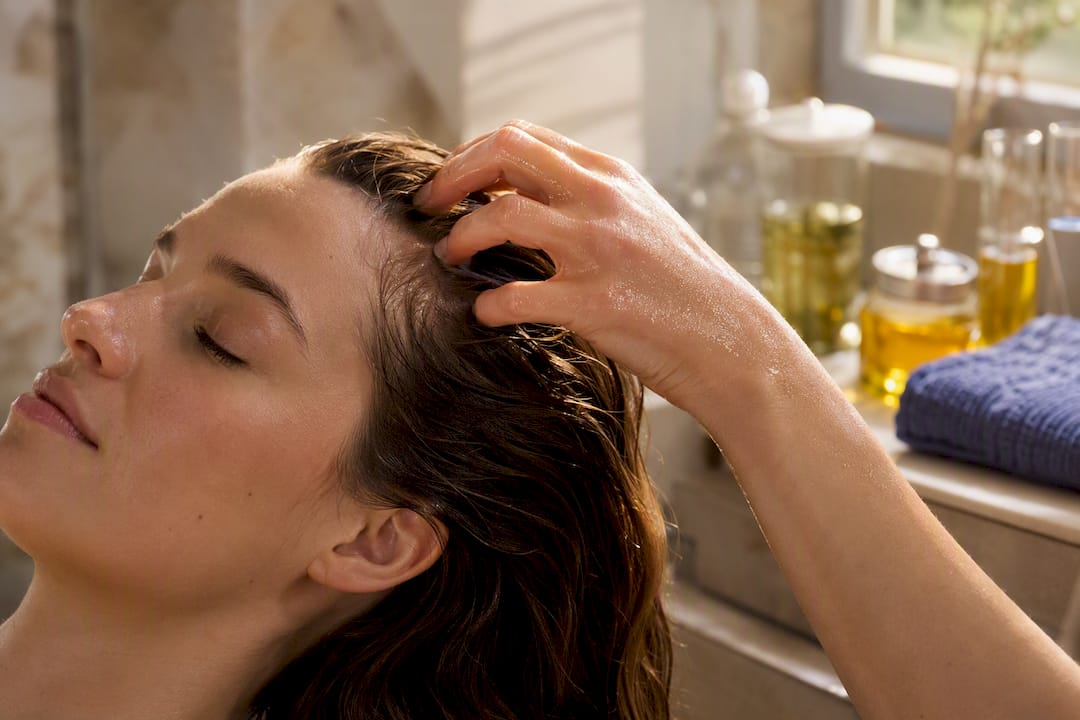
If you have diagnosed eczema, rosacea, or a known allergy, treat every new product, regardless of its label, as a candidate for a patch test before it goes anywhere near your face.
What’s the Environmental Case for Clean or Natural Beauty?
Sustainability and ingredient labeling are related but separate conversations, and conflating them leads to some odd purchasing decisions.
A “natural” ingredient sourced through unsustainable farming or wild harvesting can carry a heavier environmental footprint than a responsibly manufactured synthetic alternative. Palm oil is the clearest example: it’s entirely natural, and its unsustainable production has driven significant deforestation. Meanwhile, some lab-created ingredients require less land and water to produce at scale than their plant-derived counterparts.

Packaging, manufacturing location, and supply chain transparency tend to matter more for environmental impact than whether a formula is “clean” or “natural.” A product manufactured domestically with shorter shipping distances, recyclable packaging, and responsibly sourced botanicals covers more genuine sustainability ground than one that simply avoids a list of chemicals while shipping ingredients across multiple continents.
If sustainability is your actual priority (distinct from ingredient safety), your checklist looks different: sourcing transparency, packaging material, manufacturing footprint, and whether a brand publishes any of that information at all. A brand that’s vague on origin and specific only about what it excludes is optimizing for a marketing narrative, not necessarily for the planet.
Common Myths About Clean and Natural Beauty
A few misconceptions keep circulating, and they’re worth correcting directly.
Myth: “Clean” means scientifically tested and proven safer. In reality, clean is a brand-defined exclusion list with no standardized testing requirement behind the term itself.
Myth: If it’s natural, it can’t cause a reaction. Poison ivy, ragweed, and a long list of essential oils disprove this immediately. Natural ingredients cause allergic reactions constantly.
Myth: More ingredients excluded means a safer product. Sometimes removing a well-tested preservative just means a formula spoils faster or requires a less-studied substitute, trading one risk for another.
Myth: Organic certification means hypoallergenic. USDA organic certification verifies agricultural sourcing standards. It says nothing about how your specific skin will respond to the finished formula.
Myth: All clean brands follow the same rules. They don’t. Retailer clean programs vary enough that a product can pass one store’s standard and fail another’s, since each list reflects that company’s own risk tolerance rather than an external benchmark.
The throughline across every myth: marketing terms substitute for information when the actual ingredient list would take thirty extra seconds to read.
Do Clean and Natural Products Actually Perform Better?
Performance depends entirely on formulation quality, not which marketing category a product claims. A well-engineered conventional retinoid outperforms most natural anti-aging alternatives for measurable wrinkle reduction, because the active ingredient and delivery system have decades of formulation research behind them.
That said, natural and clean formulations have genuine strengths in specific categories. Plant oils excel at barrier support and moisture retention, and there’s real formulation reasoning behind traditional Ayurvedic ingredients like sesame and amla, which is one reason those ingredients have persisted across centuries of use rather than fading out. Clean formulations, by removing certain synthetic fragrances, also reduce a documented source of contact irritation for people with fragrance sensitivity.
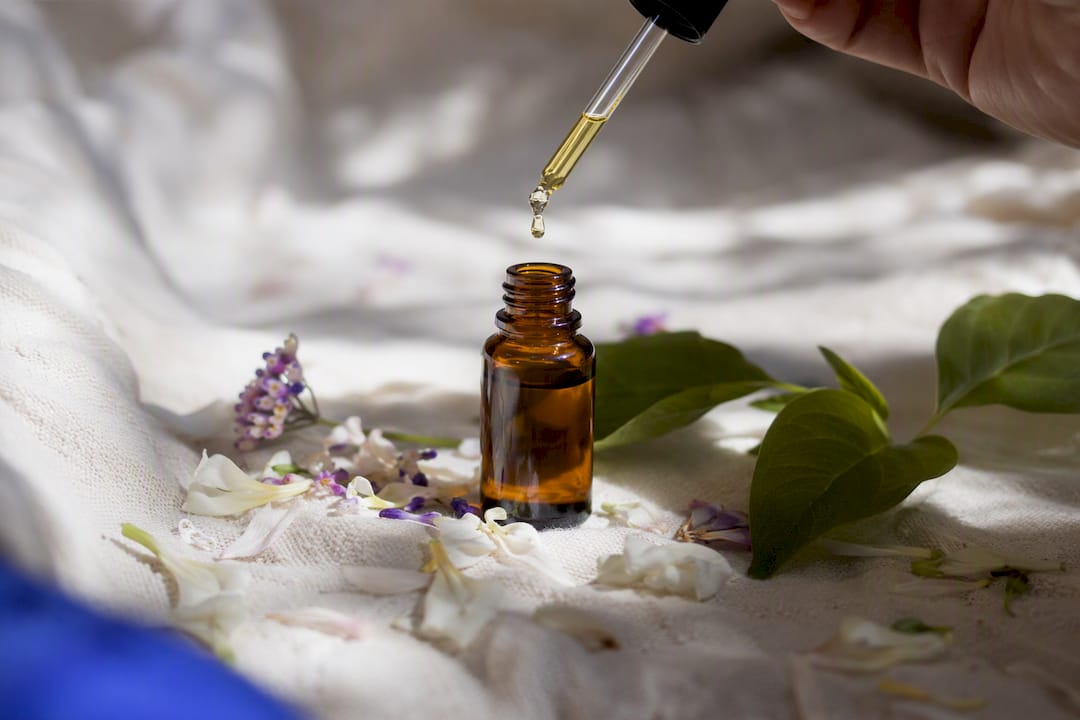
Where clean and natural formulas sometimes underperform: product stability and shelf life. Removing synthetic preservatives without an equally effective substitute can shorten a product’s usable life and increase microbial risk, according to formulation research on preservation trade-offs. A jar that separates or grows bacteria within weeks isn’t performing better just because its label reads clean.
The honest comparison isn’t clean versus natural versus conventional as categories. It’s formulation quality within each category, which is exactly why reading the INCI matters more than trusting whichever label sounds the most reassuring.
Why Ingredient Literacy Beats Every Buzzword on the Bottle
Crisanbeauty was built on a simple belief: people deserve to know what’s actually in the products they put on their skin and hair, not just what a label promises. That belief came out of a real struggle with postpartum hair loss and a search for answers that marketing language never provided.
Testing matters more than trusting a claim. Patch test new products, give a routine real time before judging it, and ask questions when a label leaves you uncertain. Ingredient literacy isn’t a barrier between you and good skincare. It’s the shortest path there.
— CRISAN
A Transparent, Plant-Based Alternative Worth Exploring
If you’ve made it this far, you already know the real work is reading the ingredient list, not chasing a label. Crisanbeauty builds every formula around that same standard: plant-based ingredients rooted in Ayurvedic tradition, manufactured in the USA, with ingredient lists you can actually check instead of a vague “natural” claim asking for your trust.
The Complete Facial Care Set reflects that approach directly, built for hydration and skin support using botanical ingredients formulated for stability, not just a marketing story. If hair thinning or scalp health is your priority instead, the brand’s Ayurvedic hair growth oil applies the same ingredient-first thinking to a different concern.
Read the label, check the INCI, and if a plant-based, U.S.-manufactured option fits what you’re looking for, explore the facial care set and see how the formulation matches what you now know to look for.
Sources
- USDA organic seal
- Federal Food, Drug, and Cosmetic Act (FDA)
- Clean cosmetics: the science behind the trend (Harvard Health Blog)
- COSMOS-standard


