


Cold-pressed oil wins for flavor, aroma, and nutrient retention. Reach for it in dressings, drizzles, and low-heat cooking. Refined oil wins for high-heat frying and recipes where you want a neutral taste, because processing strips out the compounds that would otherwise burn and smoke. Neither oil is universally “healthier.” The right choice depends on the temperature, the flavor you want, and how long you need the bottle to last.
TL;DR:
- Cold-pressed oils retain more antioxidants, polyphenols, and vitamin E, which are linked to health benefits and flavor; refinement removes many of these compounds.
- Refining increases the oil’s smoke point by removing free fatty acids and phospholipids, making it suitable for high-heat cooking like frying, while cold-pressed oils are better for raw or low-heat use.
- The main nutritional loss in refined oils occurs during deodorization, which strips volatile aromatics and bioactives, reducing the oil’s protective and antioxidant properties.
- To ensure authenticity, look for extraction temperatures below 104°F, natural sediments, and a strong aroma; detailed sourcing information indicates better quality.
- Keep cold-pressed oils stored in dark, cool places, buy smaller bottles for freshness, and use refined oils for cooking at high temperatures while reserving cold-pressed for flavor and nutrient preservation.
Table of Contents
- Cold Pressed vs Refined Oil: How Cold-Pressing Preserves Nutrients
- How Refined Oil Is Made and Why It Changes the Oil
- What Refined Oil Loses: Antioxidants, Vitamin E, and Polyphenols
- Smoke Point and Cooking: Match the Oil to the Technique
- How to Choose the Right Oil for Any Recipe
- Cold-Pressed Oil Storage: Preventing Rancidity
- Reading Labels: Spotting Real Cold-Pressed Oil
- Crisanbeauty’s Approach to Botanical Oil Sourcing
- A Balanced Two-Oil Strategy for Your Pantry
- Why Crisanbeauty Chooses Minimally Processed Oils
- Sources
- FAQ
Cold Pressed vs Refined Oil: How Cold-Pressing Preserves Nutrients
Cold-pressing is mechanical, not chemical. Producers crush seeds, nuts, or fruit under a hydraulic or screw press, and the oil separates out without added heat or solvents. No degumming, no bleaching, no deodorizing. That matters because heat is what destroys the fragile antioxidants and aromatic compounds that give unrefined oil its personality.

The tradeoff is yield. Cold-pressing extracts less oil per batch than solvent-based methods, which is part of why a bottle of cold-pressed avocado or walnut oil costs more than its refined counterpart. Raw material quality drives the final result more than in refining, since there’s no downstream processing to mask a mediocre batch of olives or seeds. A 2026 Frontiers in Nutrition review found cold-pressed oils generally retain more antioxidants and minor bioactive compounds than refined versions, though quality swings depending on how carefully the raw material was sourced and pressed.
Extra virgin olive oil, virgin coconut oil, and cold-pressed sesame and flaxseed oils are the most common examples on store shelves, each carrying a distinct aroma that refining would erase.
How Refined Oil Is Made and Why It Changes the Oil
Refining is an industrial sequence: degumming removes phospholipids, neutralization strips free fatty acids, bleaching pulls out pigments, and deodorization uses heat and steam to eliminate volatile flavor compounds. Each step exists to make the oil more stable and shelf-friendly, not to improve nutrition.
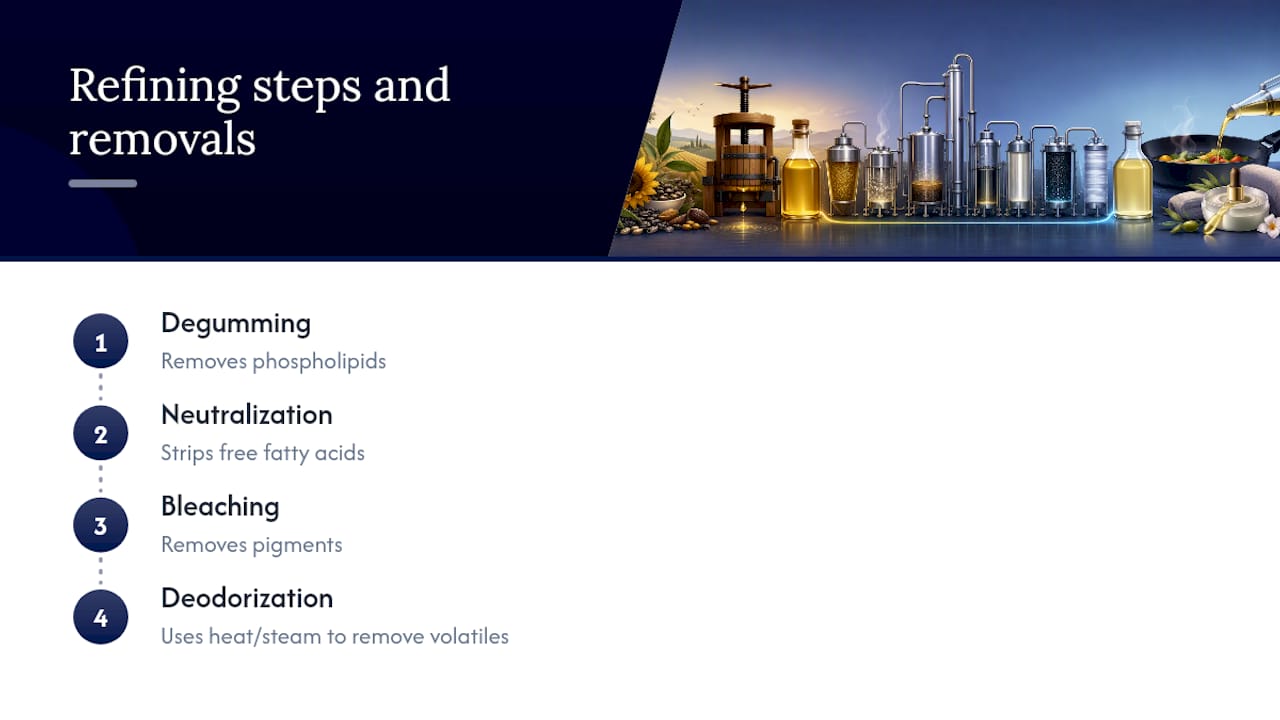
Removing free fatty acids and phospholipids is exactly why refined oil tolerates higher heat. Those compounds are the first things to break down and smoke, so stripping them out pushes the smoke point noticeably higher. Some refining methods use hexane as a solvent to extract oil from seeds like soybean or canola before the rest of the process begins. Regulatory limits on hexane residue are strict, and commercial refiners generally stay well under them, according to the same PMC review on cold-pressed oil authenticity. The bigger concern with refined oil isn’t leftover solvent. It’s what refining removes on purpose.
What Refined Oil Loses: Antioxidants, Vitamin E, and Polyphenols
The nutritional gap between cold pressed vs refined oil isn’t about fat content or calories. Both versions of, say, sunflower or olive oil carry nearly identical fatty acid ratios. What separates them is the minor compounds that never show up on a standard nutrition label.
Deodorization, the final and hottest refining step, is where most of the damage happens. Industry-facing process breakdowns note that this stage can strip out volatile aromatics along with a meaningful share of tocopherols (vitamin E) and polyphenols, according to Orggu’s refined vs cold-pressed oil explainer. Extra virgin olive oil, because it skips these steps entirely, preserves polyphenols and vitamin E at levels refined olive oil simply can’t match, per Healthline’s breakdown of cold-pressed olive oil.
Here’s what that loss actually means in practice:
- Polyphenols act as antioxidants that help protect cells from oxidative stress and are linked to anti-inflammatory activity.
- Tocopherols (vitamin E) protect the oil itself from oxidizing on the shelf, and support skin and cell health when consumed.
- Phytosterols and carotenoids contribute to the oil’s color and are associated with cardiovascular support in dietary research.
Large-scale dietary research, including the PREDIMED trials, has associated polyphenol-rich olive oil with reduced cardiovascular events in Mediterranean-diet populations, per that same Healthline overview. That’s an association from population-level data, not proof that polyphenols alone cause the benefit, but it’s a meaningful signal for anyone choosing oils with an eye on long-term heart health. Refining doesn’t just mute flavor. It quietly removes the compounds doing the most protective work, both in the bottle and in the body.
Smoke Point and Cooking: Match the Oil to the Technique
Smoke point rises after refining because the compounds that break down early, free fatty acids, phospholipids, trace water, have already been removed. That’s genuinely useful information once you know what to do with it, and largely irrelevant if you’re making a vinaigrette.
For sustained high heat like deep frying or searing at 400°F and above, refined oils hold up better and won’t turn bitter or smoky halfway through cooking. For anything under medium heat, where flavor matters more than thermal stamina, cold-pressed oil is the better call.
A rough guide for stocking your kitchen:
- Finishing and dressings: extra virgin olive oil, cold-pressed flaxseed, or walnut oil.
- Sautéing and light cooking: cold-pressed avocado oil or virgin coconut oil.
- Stir-frying at moderate-high heat: refined peanut or refined sesame oil.
- Deep frying: refined canola, refined sunflower, or refined vegetable oil.
Smoke point varies by brand and batch, not just by oil type, so check the label if you’re cooking at genuinely high heat. A refined oil sitting near the low end of its typical range won’t perform the way a marketing claim on the bottle might suggest.
How to Choose the Right Oil for Any Recipe
Run through four questions before you reach for a bottle: how hot will the pan get, do you want the oil’s flavor to show up in the final dish, how quickly will you use the bottle, and how much are you willing to spend for the difference.
- Match temperature first. If a recipe calls for deep frying or searing, default to refined. If it’s raw, dressed, or finished off-heat, default to cold-pressed.
- Weigh flavor intent. Neutral refined oil lets other ingredients lead. A grassy extra virgin olive oil or nutty walnut oil becomes part of the dish itself.
- Consider your pace of use. If a bottle will sit for months, refined oil’s longer shelf life reduces waste. If you cook often, a smaller cold-pressed bottle used up quickly avoids rancidity altogether.
- Balance cost against benefit. Pay the premium for cold-pressed where the flavor or nutrient retention actually shows up in the final dish. Save the budget refined option for high-volume frying.
A practical pantry keeps both on hand: one refined oil for heat, one cold-pressed oil for finish.
Pro Tip: Check the label for a press date or stated extraction temperature below roughly 104°F (40°C). That single detail tells you more about authenticity than any “cold-pressed” claim printed in bold on the front.
Cold-Pressed Oil Storage: Preventing Rancidity
Cold-pressed oils oxidize faster than refined oils because the same antioxidants that make them nutritious also make them chemically active once exposed to air, light, or heat. Store them in dark glass bottles, away from the stove, and buy smaller bottles you’ll finish in a few months rather than a jug that sits half-used for a year. A partner resource on preserving aroma through proper storage makes a similar point about coffee: temperature and air exposure, not time alone, drive the loss of flavor and potency. Rancid oil smells sharp, almost like crayons or old paint. Toss it if you notice that smell.

Reading Labels: Spotting Real Cold-Pressed Oil
“Cold-pressed” has no single global legal definition outside of olive oil, where “extra virgin” and “virgin” carry specific acidity and processing standards. Outside that category, the term can be loosely applied, so don’t take it at face value alone.
- Check for a stated extraction temperature. Genuine cold-pressed oil is typically pressed below about 104°F (40°C).
- Look for color variation, cloudiness, or a small amount of natural sediment, all signs of minimal filtering.
- A strong, oil-specific aroma (grassy for olive, nutty for walnut) usually signals authenticity better than the label copy.
- Ask for or look up independent lab testing on polyphenol and tocopherol content when it’s available, since that’s the most reliable indicator of a genuinely minimally processed oil, according to the PMC authenticity review.
Crisanbeauty’s Approach to Botanical Oil Sourcing
Some beauty companies formulate hair and skin products around minimally processed botanical oils, following the principle that retaining bioactives matters for topical stability and performance, not just flavor. When an oil keeps more of its natural antioxidant content, that translates into a different experience on skin and scalp. For readers curious about how this plays out in practice, our scalp oiling breakdown and nourishing scalp treatment examples walk through the topical side of this same science.
A Balanced Two-Oil Strategy for Your Pantry
Skip the idea that one oil wins outright. Stock a refined oil for heat and a cold-pressed oil for flavor, and let the recipe decide which one you reach for. Transparency about sourcing and processing matters more than whatever claim is printed largest on the label.
— CRISAN
Why Crisanbeauty Chooses Minimally Processed Oils
The same reasoning that favors cold-pressed oil in your skillet applies to what goes on your scalp and skin: less heat and fewer chemical steps mean more of the original plant’s bioactive compounds survive. Certain formulations are built around that principle, sourcing botanical oils and manufacturing products domestically rather than outsourcing to cut costs.

If you’re used to reading a cooking oil label for extraction temperature and press dates, apply that same scrutiny to what you put on your hair. Our CRISAN Oils collection is formulated from a blend of botanical ingredients rooted in generations of Ayurvedic tradition, vegan, and suited to all hair types. Browse the collection, check the product details for sourcing information, and pick the oil that matches what your hair actually needs this season.
Sources
Frontiers in Nutrition review on oil extraction, PMC review on cold-pressed authenticity, Healthline on cold-pressed olive oil, and Know Your Food’s process overview informed the claims throughout this guide.
- Frontiers in Nutrition — review on oil extraction and bioactives (2026)
- PMC review on cold-pressed oils and authenticity
- Healthline — cold-pressed olive oil overview
FAQ
Which Is Better, Refined or Cold-Pressed Oil?
Neither is universally better. Cold-pressed oil retains more antioxidants and flavor, making it ideal for dressings and low-heat cooking, while refined oil’s higher smoke point makes it the better choice for deep frying and sustained high heat.
What Are the Disadvantages of Cold-Pressed Oils?
Cold-pressed oils cost more, spoil faster once opened, and have lower smoke points that make them unsuitable for high-heat frying. Quality also varies more by batch since there’s no processing step to standardize the result.
How Unhealthy Is Refined Oil?
Refined oil isn’t inherently unhealthy in normal cooking amounts. Its main drawback is nutritional, not toxic. It loses much of the polyphenol and vitamin E content that cold-pressed oils retain, while its basic fatty acid profile stays largely the same.
What Is the Unhealthiest Oil to Cook With?
There’s no single “unhealthiest” oil, since risk depends on how an oil is used. Reusing any oil repeatedly at high heat, refined or not, degrades it and generates harmful compounds, so the frying method matters as much as the oil itself.
Does Crisanbeauty Use Cold-Pressed Oils in Its Products?
Crisanbeauty formulates around minimally processed botanical oils to preserve their natural bioactive compounds, which is central to how the CRISAN Oils collection is sourced and made in the USA.


