


Vitamin D signaling matters to hair-follicle cycling, but supplementation only helps when deficiency is present. The vitamin D receptor (VDR) is biologically required for normal hair-cycle progression, and observational studies consistently link low serum 25-hydroxyvitamin D (25[OH]D) to several non-scarring alopecias. A 2024 systematic review and meta-analysis confirmed that vitamin D deficiency is common across alopecia types and showed statistically significant associations for conditions like alopecia areata (AA) and female pattern hair loss (FPHL). Still, the evidence for supplementation reversing hair loss is limited unless true deficiency is confirmed. Here is what the science says and what you can do right now.
Three immediate steps if you are concerned about vitamin D and hair loss:
- Identify your hair-loss type first. Alopecia areata, telogen effluvium, and androgenetic alopecia each carry different vitamin D associations. A dermatologist can help you distinguish them.
- Test only when indicated. The Endocrine Society’s 2024 guidance recommends against routine 25(OH)D screening in generally healthy adults. Testing makes sense if you have active hair loss plus risk factors for deficiency (limited sun exposure, darker skin tone, malabsorption conditions, or bariatric surgery history).
- Correct deficiency under clinician supervision. If your 25(OH)D is low, a clinician-guided vitamin D3 (cholecalciferol) regimen is the appropriate next step, not self-directed megadosing.
Table of Contents
- How vitamin D and the VDR work inside your hair follicles
- What clinical studies actually show about vitamin D and hair loss
- How the evidence maps to specific hair-loss conditions
- How vitamin D status is measured and what the 2024 guidance says
- If you are deficient: supplementation, dosing, and safety
- Concrete next steps if you think vitamin D matters for your hair
- Where the evidence is still weak and what research is needed
- The bottom line: how strong is the case and what should you do
- Key Takeaways
- A note from Crisanbeauty on evidence and hair health
- Useful sources and further reading
How vitamin D and the VDR work inside your hair follicles
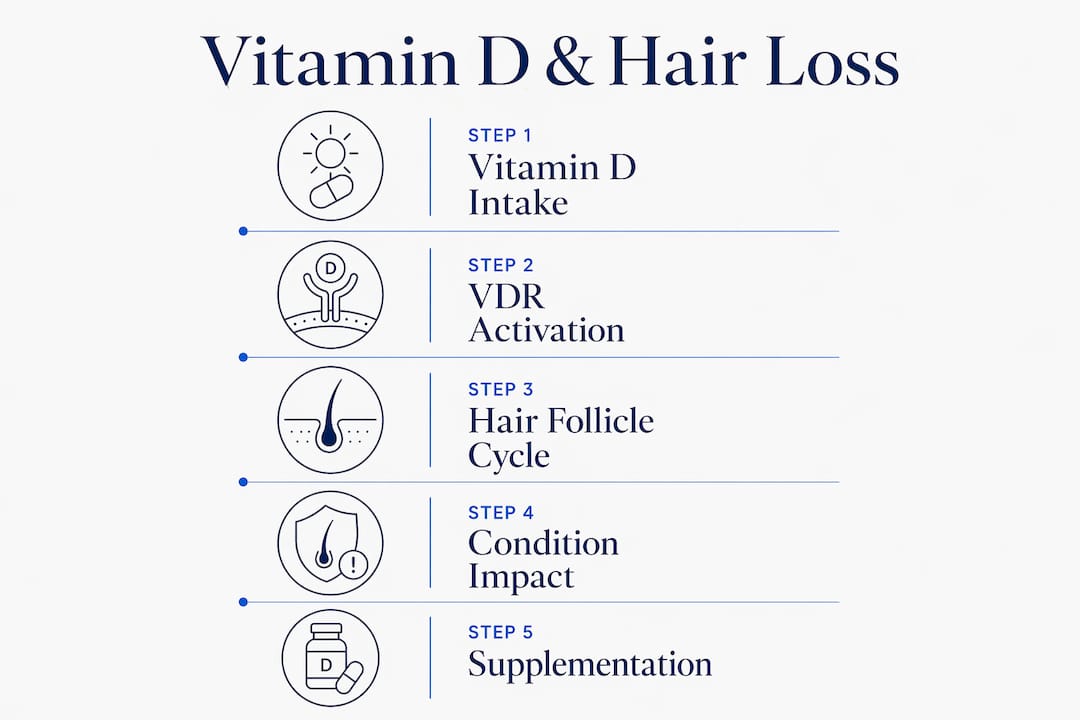
The biological case for vitamin D in hair health starts not with blood levels but with a receptor. The vitamin D receptor (VDR) is expressed in follicular keratinocytes, the epithelial cells that form the structural core of each hair follicle. When VDR function is lost, hair morphogenesis (the initial formation of follicles) proceeds normally, but postmorphogenic hair cycling stops. That distinction matters clinically: VDR absence does not prevent you from growing hair at birth, but it does prevent normal cycling afterward.
Mechanistic studies in VDR-null mice show that anagen initiation requires VDR to activate two critical signaling pathways: canonical Wnt (cWnt) and sonic hedgehog (Shh). In the absence of functional VDR, the induction of cWnt and hedgehog target genes that characterizes early anagen is dramatically reduced. The VDR physically recruits Lef1 (lymphoid enhancer factor 1) to regulatory regions of these target genes. Without VDR, Lef1 cannot bind those regions, and the anagen signal fails.
The mechanism in brief:
- VDR binds regulatory regions of cWnt and hedgehog target genes in keratinocytes
- VDR recruits Lef1 to those same regulatory regions
- Lef1-VDR cooperation activates cWnt and Shh target genes
- cWnt/Shh activation drives anagen initiation and follicle regeneration
Critically, this is a ligand-independent VDR action. The unliganded VDR (not bound to 1,25-dihydroxyvitamin D) drives this process. That explains why serum 25(OH)D alone does not fully predict follicle behavior. A person can have adequate blood levels yet have impaired VDR function at the tissue level due to receptor variants, co-regulator differences, or local metabolism. VDR coregulators such as Hairless (Hr) and Med1 further modulate whether VDR activity in skin favors epidermal differentiation or hair-cycle progression.
Animal nutritional models add another layer. Mouse models combining maternal vitamin D deficiency with low calcium develop transient noncicatricial alopecia that resolves with nutritional rescue, underscoring that calcium-vitamin D interactions during critical developmental windows can disrupt follicle cycling. This does not translate directly to adult supplementation strategies, but it reinforces that follicle biology depends on the full nutritional environment, not vitamin D alone.
Mechanism summary: VDR → Lef1 recruitment → cWnt/Hedgehog activation → anagen initiation. Disrupting any step in this chain can stall the hair cycle.
What clinical studies actually show about vitamin D and hair loss
Observational studies consistently find lower mean 25(OH)D in people with non-scarring alopecias compared with healthy controls. The pattern holds across alopecia areata, telogen effluvium, and androgenetic alopecia, though effect sizes and statistical significance vary by condition and study design.
The strongest pooled summary comes from a 2024 systematic review and meta-analysis that found vitamin D deficiency is prevalent across alopecia types, with AA and FPHL showing the most statistically significant associations in pooled analyses. The ISHRS specialty review and related case-report literature confirm inverse relationships between 25(OH)D and hair-loss severity but are equally clear that conclusive supplementation trials are lacking.
Key finding from the 2024 systematic review: AA and FPHL showed the strongest, statistically significant associations between low 25(OH)D and hair loss in pooled analyses. Deficiency prevalence was elevated across all non-scarring alopecia types studied.
| Study type | Typical sample size | Main outcome measured | Level of evidence |
|---|---|---|---|
| Case-control | Small to moderate participants | 25(OH)D difference between cases and controls | Moderate (observational) |
| Cohort/cross-sectional | Variable | Prevalence of deficiency; correlation with severity scores | Moderate (observational) |
| Randomized controlled trial (RCT) | Small participants | Hair regrowth or density after supplementation | Low to moderate (limited trials) |
| Systematic review/meta-analysis (2024) | Pooled across multiple studies | Pooled deficiency prevalence; pooled effect sizes by alopecia type | Highest available |
Important limitations across the evidence base:
- Studies use different deficiency thresholds (some use <20 ng/mL, others <30 ng/mL), making comparisons difficult
- Geographic and ethnic variation in baseline vitamin D status affects pooled results
- Most RCTs are small, short-duration, and not adequately powered to detect modest treatment effects
- Association does not equal causation; low vitamin D may be a marker of broader health or lifestyle factors rather than a direct driver of hair loss
A short review on vitamin D’s role in hair loss captures the consensus well: anti-inflammatory and immunomodulatory properties, keratinocyte proliferation control, and hair-cycle regulation are all biologically plausible links, but the field needs larger, better-designed trials before routine therapeutic use can be recommended.

How the evidence maps to specific hair-loss conditions
Understanding which alopecia type you have changes how relevant vitamin D status is to your situation.
Alopecia areata (AA)
AA carries the most consistent vitamin D signal in the literature. A hospital-based case-control study of 135 AA cases and 135 matched controls found significantly lower 25(OH)D in cases and an inverse correlation with SALT (Severity of Alopecia Tool) score: the lower the vitamin D, the more severe the hair loss. The 2024 meta-analysis confirmed this association in pooled analyses. If you have AA, discussing 25(OH)D testing with your dermatologist is reasonable, particularly if you have other deficiency risk factors.
Telogen effluvium (TE)
TE, the diffuse shedding that often follows physical or emotional stress, illness, or nutritional depletion, shows associations with lower vitamin D in observational data. The biological rationale is plausible: if VDR signaling supports anagen initiation, deficiency could contribute to prolonged telogen or delayed re-entry into the growth phase. Causality is not established, though. TE is also frequently self-limiting, which complicates interpreting any supplementation response. Testing is worth discussing with your primary care clinician if you have risk factors, but vitamin D is one item in a broader workup that should include iron, ferritin, and thyroid function.
Androgenetic alopecia (AGA, FPHL, MAGA)
The vitamin D signal in pattern hair loss is the weakest of the three. Some studies find lower 25(OH)D in AGA and FPHL cohorts versus controls, but effect sizes are smaller and results less consistent. The role of DHT in hair loss is the dominant hormonal driver in pattern hair loss, and vitamin D correction is unlikely to meaningfully alter that pathway. Correcting deficiency is still worthwhile for general health, but expectations for hair regrowth should be modest.
How vitamin D status is measured and what the 2024 guidance says
The standard clinical marker is serum 25-hydroxyvitamin D, written as 25(OH)D. This is the form your liver produces from dietary and sun-derived vitamin D, and it reflects your overall vitamin D stores. It is not the active hormone (1,25-dihydroxyvitamin D, or calcitriol), which is tightly regulated and not useful for assessing deficiency.
| Test | What it measures | Why clinicians order it |
|---|---|---|
| Serum 25(OH)D | Circulating vitamin D stores (liver-produced) | Standard marker for deficiency assessment |
| 1,25(OH)2D (calcitriol) | Active hormonal form | Not used for deficiency; ordered for specific metabolic or renal conditions |
Historical thresholds vs. 2024 guidance
The Endocrine Society’s 2011 clinical practice guideline defined deficiency as a 25(OH)D below 20 ng/mL and insufficiency as 21–29 ng/mL. Those numbers became widely used benchmarks. The 2024 Endocrine Society guidance takes a more cautious position: the guideline panel found insufficient outcome-specific trial evidence to justify a single universal target level (such as 30 ng/mL) and recommends against routine screening in generally healthy adults without clinical indications.
For hair-loss management, this means you should not chase a specific number without clinical context. A 25(OH)D of 18 ng/mL in someone with active AA and limited sun exposure is clinically meaningful. The same number in a healthy adult with no hair-loss condition and no risk factors may not warrant aggressive treatment.
When testing makes sense for hair loss:
- Active, documented hair-loss condition (AA, TE, FPHL) combined with at least one deficiency risk factor
- Limited sun exposure (indoor work, northern latitude, consistent sunscreen use)
- Darker skin tone (melanin reduces cutaneous vitamin D synthesis)
- Malabsorption conditions (Crohn’s disease, celiac disease, short bowel syndrome)
- History of bariatric surgery
- Severe or rapidly progressing AA or FPHL where nutritional contributors need to be ruled out
Pro Tip: Bring your 25(OH)D result and a clear description of your hair-loss pattern (photos help) to your dermatologist or primary care clinician. A number without clinical context rarely changes management on its own.
If you are deficient: supplementation, dosing, and safety
Vitamin D3 (cholecalciferol) is the preferred supplement form for correcting deficiency. It raises 25(OH)D levels more effectively than vitamin D2 (ergocalciferol) and is the form most commonly used in clinical correction regimens. D2 remains an alternative, particularly in prescription formulations, but D3 is the standard for long-term maintenance.
Supplementation principles:
- Dosing ranges for deficiency correction vary by baseline level, body weight, and absorption capacity; clinician-guided regimens are safer than self-directed high-dose protocols
- Common correction approaches use higher loading doses (often weekly or daily for several weeks) followed by a maintenance dose, but the exact regimen should be individualized
- Recheck 25(OH)D approximately 8–12 weeks after starting therapy to assess response
- If higher-dose therapy is used or if you have risk factors (kidney disease, granulomatous conditions like sarcoidosis, primary hyperparathyroidism), your clinician may also monitor serum calcium and renal function
Safety and interactions to know:
- Hypervitaminosis D is rare but real; it results from chronic excessive intake, not from sun exposure. Symptoms include hypercalcemia (nausea, weakness, confusion, kidney stones)
- Thiazide diuretics (commonly prescribed for blood pressure) reduce urinary calcium excretion; combining them with high-dose vitamin D increases hypercalcemia risk
- Granulomatous diseases (sarcoidosis, tuberculosis, some lymphomas) cause dysregulated vitamin D activation; supplementation in these conditions requires medical supervision
- Over-the-counter supplements vary widely in actual content versus label claims; third-party tested products reduce that uncertainty
For readers interested in a broader nutritional approach to hair support, Crisanbeauty’s Complete Hair Follicle Support supplement combines plant-based ingredients designed to support the full follicle environment, not just a single nutrient.
Pro Tip: Coordinate supplementation with your primary care clinician or dermatologist. Avoid stacking multiple high-dose vitamin D products without medical oversight, especially if you take blood pressure medications or have a chronic condition.
Concrete next steps if you think vitamin D matters for your hair
Turn the evidence into a clear sequence. Here is how to move from concern to action without overreacting or underreacting.
Action checklist:
- Document your hair-loss pattern now. Take photos in consistent lighting, note where shedding occurs (diffuse vs. patchy vs. hairline recession), and track how long it has been happening.
- Review your deficiency risk factors honestly. Limited sun, darker skin, malabsorption history, or bariatric surgery all raise the probability that your 25(OH)D is genuinely low.
- Discuss targeted 25(OH)D testing with your clinician if you have both active hair loss and at least one risk factor. Do not test “just to see” without clinical indication.
- If deficiency is confirmed, start a clinician-guided D3 regimen and schedule a follow-up test in 8–12 weeks.
- Pair nutritional correction with appropriate dermatologic care. Vitamin D is one factor in a broader workup that should address iron, ferritin, thyroid function, and, where relevant, the hormonal triggers of hair loss.
When to seek specialist care immediately:
- Rapidly progressive hair loss over weeks, not months
- Extensive or total AA (alopecia totalis or universalis)
- Scarring alopecia (scalp shows permanent follicle loss, scarring, or inflammation)
- Hair loss accompanied by systemic symptoms: fatigue, weight change, joint pain, or skin changes
A dermatologist is the right first specialist for most hair-loss conditions. Primary care can handle initial 25(OH)D testing and deficiency correction. For complex or treatment-resistant cases, a dermatologist with hair-loss expertise (trichologist or hair-specialist dermatologist) provides the most targeted care. Men seeking clinical treatment options beyond nutritional support can also explore hair regeneration treatments from clinical practitioners.
Where the evidence is still weak and what research is needed
The association between vitamin D and hair loss is real. The proof that correcting deficiency reliably reverses hair loss is not. That gap matters.
Current evidence gaps:
- Few large, placebo-controlled RCTs have tested vitamin D supplementation in well-phenotyped alopecia cohorts with stratified baseline 25(OH)D levels
- Studies use inconsistent deficiency cutoffs, making pooled effect sizes harder to interpret
- Most trials do not distinguish between people who are genuinely deficient and those who are replete, which dilutes any treatment signal
- Tissue-level VDR function, co-regulator expression, and local vitamin D metabolism are rarely measured; serum 25(OH)D is a proxy, not a direct measure of follicle-level receptor activity
- Geographic and ethnic variation in baseline vitamin D status creates heterogeneity that current meta-analyses cannot fully resolve
What would actually help:
- Adequately powered RCTs (several hundred participants minimum) stratified by baseline 25(OH)D, alopecia phenotype, and deficiency severity
- Standardized outcome measures: SALT score for AA, hair-count endpoints for TE and AGA
- Tissue biopsy studies measuring VDR expression and co-regulator activity alongside serum 25(OH)D
- Longer follow-up periods (12+ months) to capture full hair-cycle responses
The 2024 systematic review explicitly flagged heterogeneity and geographic patterns as limitations. Until larger, better-controlled trials are published, clinical decisions should lean on individual deficiency status and phenotype rather than population-level associations.
The bottom line: how strong is the case and what should you do
The biological case for vitamin D in hair health is strong. VDR is required for normal hair cycling, and the mechanism is well-characterized in both animal and human keratinocyte models. The human association data is consistent for AA and FPHL, moderate for TE, and weaker for androgenetic alopecia. What is missing is high-quality RCT evidence that supplementation broadly reverses hair loss in people who are not deficient.
Practical summary:
- VDR biology gives vitamin D a plausible and specific role in hair-follicle cycling, not just a general “nutrient support” role
- Correcting documented deficiency is clinically reasonable and supported by the association data, particularly for AA and FPHL
- Supplementing without confirmed deficiency, hoping for hair regrowth, is not supported by current trial evidence
- Vitamin D is one modifiable factor in a full diagnostic workup, not a standalone treatment for hair loss
- Pair any nutritional correction with a proper dermatologic diagnosis so you are treating the right condition
For general health, most adults benefit from adequate vitamin D status. For hair loss specifically, the evidence supports testing when indicated and treating when deficient, under clinician supervision, as part of a broader hair-health plan.
This article is general health information, not medical advice. Confirm current clinical guidelines and your individual situation with a qualified clinician before starting or changing any supplement regimen.
Key Takeaways
Vitamin D’s role in hair health is biologically specific and clinically relevant, but supplementation only makes sense when deficiency is confirmed and is part of a broader diagnostic plan.
| Point | Details |
|---|---|
| VDR drives hair cycling | The vitamin D receptor, not blood levels alone, controls anagen initiation via cWnt and hedgehog signaling in follicular keratinocytes. |
| Association is not causation | Observational studies link low 25(OH)D to AA and FPHL, but RCT evidence for supplementation reversing hair loss is limited. |
| Test when indicated | The Endocrine Society’s 2024 guidance recommends against routine screening; test only with active hair loss plus deficiency risk factors. |
| Use 25(OH)D, not calcitriol | Serum 25-hydroxyvitamin D is the correct clinical marker for deficiency; 1,25(OH)2D is not used for this purpose. |
| D3 is the preferred supplement | Vitamin D3 (cholecalciferol) corrects deficiency more effectively than D2; dosing should be clinician-guided with follow-up testing at 8–12 weeks. |
A note from Crisanbeauty on evidence and hair health
The evidence on vitamin D and hair loss reflects something Crisanbeauty has believed since the beginning: hair health is rarely about one nutrient, one product, or one fix. Crisanbeauty was founded after a personal experience with postpartum hair loss, a condition where multiple factors converge at once: hormonal shifts, nutritional depletion, stress, and disrupted sleep. Vitamin D was one piece of that puzzle, not the whole picture.
What the research confirms is that deficiency correction matters, but it works best as part of a complete approach. That means getting the right diagnosis, addressing nutritional gaps with clinician guidance, and supporting your follicles with a consistent, well-formulated routine. Crisanbeauty’s plant-based hair growth vitamins are designed to complement that thoughtful, multi-factor approach, not replace the clinical steps that come first.
The honest truth is that no supplement, including vitamin D, should be marketed as a hair-loss cure. The biology is real. The associations are real. But the clinical evidence for supplementation as a reliable standalone treatment is not there yet. Work with your clinician, get the right tests, and build a routine grounded in what the evidence actually supports.
Useful sources and further reading
The sources below are the primary references used in this article. They are listed for readers and clinicians who want to go deeper into the evidence.
- VDR and cWnt/Hedgehog signaling in keratinocytes (PMC) — The foundational mechanistic study demonstrating that the unliganded VDR is required for anagen initiation via cWnt and hedgehog pathway activation in mouse and keratinocyte models.
- 2024 systematic review and meta-analysis on vitamin D deficiency in alopecias — The most current pooled analysis; confirms deficiency prevalence across alopecia types and statistically significant associations for AA and FPHL.
- Endocrine Society 2024 guidance on vitamin D — Updated guidance recommending against routine screening in healthy adults and cautioning against single universal sufficiency targets.
- Endocrine Society 2011 clinical practice guideline — Historical context for the deficiency (<20 ng/mL) and insufficiency (21–29 ng/mL) thresholds still widely referenced in clinical practice.
- ISHRS specialty review: vitamin D deficiency and hair loss — Specialty-society case report and literature review summarizing inverse associations and the limited state of supplementation trial evidence.
- Case-control study: vitamin D in alopecia areata and SALT score correlation — Hospital-based study of 135 AA cases showing significantly lower 25(OH)D and an inverse correlation with disease severity.
- Short review: role of vitamin D in hair loss — Narrative review covering keratinocyte differentiation, immunomodulation, and hair-follicle biology; calls for more trials before routine therapeutic use.
- VDR coregulators and ligand-independent actions in skin (PMC) — Mechanistic review of VDR coactivators (Hairless/Hr, Med1) and differential roles in epidermal differentiation versus hair-cycle progression.
- Calcium and vitamin D in developmental hair follicle cycling (PMC) — Animal model study showing transient alopecia from combined vitamin D and calcium deficiency, with resolution after nutritional rescue.
- Harvard Health: vitamins, minerals, and hair loss — Clinically reviewed consumer overview placing vitamin D in context alongside other nutrients associated with hair health.
| Source type | Best used for |
|---|---|
| 2024 systematic review/meta-analysis | Pooled prevalence and effect sizes across alopecia types |
| Endocrine Society 2024 guidance | Testing decisions and sufficiency threshold interpretation |
| VDR mechanistic studies (PMC) | Understanding why VDR matters beyond blood levels |
| ISHRS specialty review | Clinical and specialty-society perspective on supplementation evidence |
| Harvard Health overview | Accessible, clinician-reviewed consumer context |


