


Dihydrotestosterone (DHT) is defined as the primary androgen responsible for pattern hair loss, working by binding to genetically sensitive hair follicles and triggering progressive miniaturization. The role of DHT in hair loss is not about having too much of this hormone. It is about how your follicles respond to it. DHT is converted from testosterone by an enzyme called 5-alpha-reductase, concentrated in the scalp’s dermal papilla cells. When DHT binds to follicles with high androgen receptor sensitivity, it shortens the active growth phase and shrinks the follicle over successive hair cycles. Understanding this process is the first step toward doing something real about it.
How does DHT affect hair follicles at the cellular level?
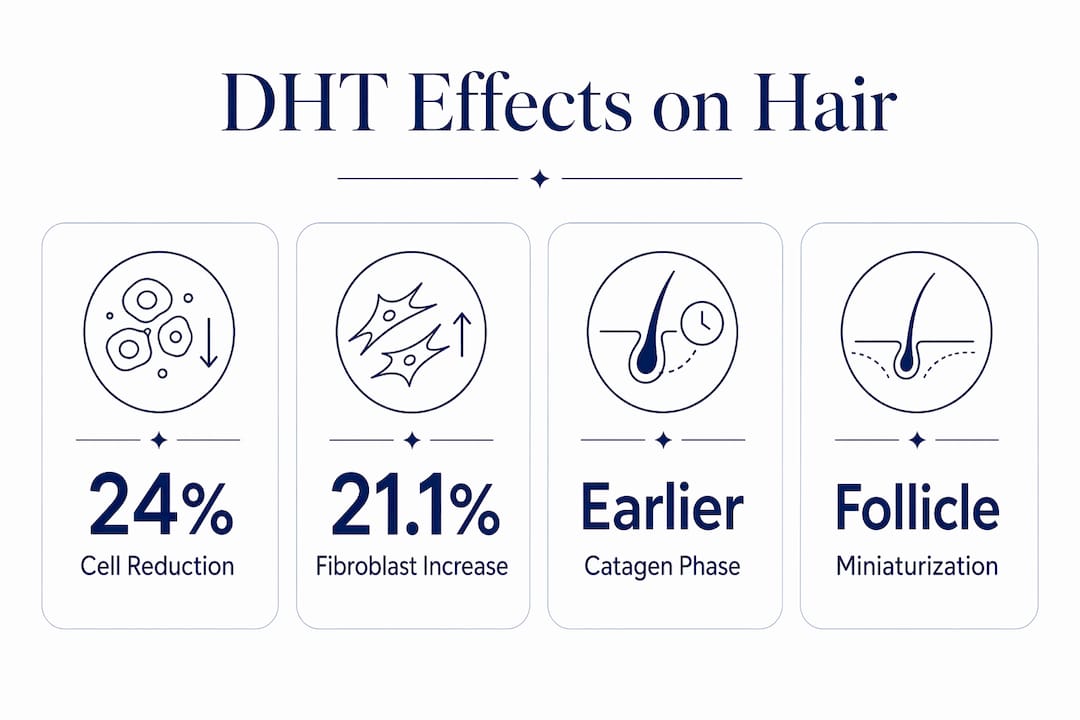
DHT disrupts hair follicle function through two measurable cellular changes. Research shows DHT causes a 24% reduction in matrix cell proliferation and a 31% increase in cell death within follicles, accelerating the regression phase of the hair cycle. That means fewer cells building the hair shaft and more cells dying off before the cycle completes.
The damage goes deeper than cell counts. DHT treatment increases dermal fibroblast proportion from 5.6% to 21.1% inside the follicular microenvironment, producing perifollicular fibrosis. Fibrosis is scar-like tissue that physically compresses the follicle during its growth phase. Once fibrosis sets in, the follicle cannot expand fully, and each new hair grows thinner and shorter than the last.
DHT also forces follicles into the catagen phase, which is the transitional rest stage, earlier than normal. This shortens the anagen phase, which is the active growth window that determines hair length and density. Over many cycles, the follicle produces only fine, colorless vellus hairs instead of the thick terminal hairs you started with.
Pro Tip: Perifollicular fibrosis is one reason early treatment matters so much. Fibrosed follicles cannot be revived. Catching miniaturization early, before fibrosis becomes permanent, gives treatments the best chance of working.
| DHT cellular effect | What it means for your hair |
|---|---|
| 24% drop in matrix cell proliferation | Fewer cells building each hair strand |
| 31% increase in follicle cell death | Hair cycle ends prematurely |
| Dermal fibroblast rise from 5.6% to 21.1% | Perifollicular fibrosis compresses the follicle |
| Early catagen entry | Active growth phase shortens each cycle |
Why do normal DHT levels still cause hair loss?
Hair loss is driven by follicle sensitivity, not by elevated DHT in your bloodstream. Genetically programmed androgen receptors on certain follicles are hyper-responsive to DHT, even at completely normal hormone concentrations. This is why a standard hormone panel often comes back normal in people with significant thinning. The problem is local, not systemic.
The scalp is not uniform. Follicles on the top and front of the scalp carry higher androgen receptor density and more 5-alpha-reductase enzyme activity than follicles on the sides and back. This explains the patterned nature of hair loss. Follicles on the sides and back of the scalp resist DHT effects due to localized genetic differences in receptor expression. That is why hair transplant surgeons use donor hair from those areas. It retains its DHT resistance even after being moved.
Miniaturization is also cumulative. Each hair cycle produces a slightly thinner, shorter hair than the one before it. Early intervention is critical because fibrosed follicles cannot be revived once the damage is permanent. Waiting to “see if it gets worse” costs you follicles you cannot get back.
Key facts about follicle sensitivity:
- Androgen receptor density varies by scalp zone, not by total DHT level
- 5-alpha-reductase activity is highest in the dermal papilla cells of susceptible follicles
- Blood tests for DHT are often inconclusive for diagnosing androgenetic alopecia
- Genetic inheritance from either parent can confer follicle sensitivity
- Miniaturization progresses silently across multiple cycles before visible thinning appears
Pro Tip: If your doctor orders a DHT blood test and it comes back normal, that result does not rule out DHT-driven hair loss. Ask specifically about follicle sensitivity and androgenetic alopecia as a clinical diagnosis.
How does DHT-related hair loss differ between men and women?
The pattern of hair loss differs significantly by sex, and women are frequently misdiagnosed or diagnosed late. Men typically lose hair in a predictable sequence: receding hairline at the temples, thinning at the crown, and eventual merging of those zones into broader baldness. The Hamilton-Norwood scale maps this progression.
Women experience diffuse thinning and a widening part rather than a receding hairline or bald crown. Volume decreases across the top of the scalp while the frontal hairline often stays intact. This diffuse pattern makes it harder to spot early and easier to dismiss as normal shedding or stress.
Women also face more overlapping causes. Conditions like polycystic ovary syndrome (PCOS) and thyroid dysfunction can amplify DHT sensitivity or cause independent hair shedding that mimics androgenetic alopecia. A thorough clinical evaluation should rule out these conditions before attributing thinning solely to DHT.
The psychosocial impact on women is real and significant. Hair carries strong cultural and personal identity weight, and diffuse thinning can affect self-confidence, social engagement, and quality of life well before it becomes clinically severe. Seeking evaluation early matters both medically and emotionally.
Signs that warrant a clinical evaluation for women:
- Noticeably wider part line over several months
- Increased shedding when washing or brushing
- Scalp becoming more visible under bright light
- Reduced ponytail circumference
- Family history of hair thinning on either parent’s side
What treatments target DHT to slow or reverse hair thinning?
The two most established pharmaceutical options are finasteride and dutasteride, both of which work by blocking 5-alpha-reductase. Finasteride reduces DHT by 60–70%, with visible hair improvements starting at 3–6 months and peak results at 6–12 months. It primarily inhibits the Type II 5-alpha-reductase enzyme. Dutasteride inhibits both Type I and Type II enzymes, reducing DHT by over 90%. Dutasteride is used off-label when finasteride produces insufficient results, though it carries a broader side-effect profile.
Neither drug is a cure. Reducing DHT modifies follicle cycling but does not eliminate androgenetic alopecia. Stopping treatment typically reverses the gains within 6–12 months. This is a long-term maintenance commitment, not a short course.
Minoxidil is the most common adjunctive treatment. It works through a different mechanism, improving blood flow to the follicle and extending the anagen phase, making it a useful complement to DHT-blocking therapy rather than a replacement. Topical minoxidil is available without a prescription; oral minoxidil requires one.
Addressing perifollicular inflammation is an emerging priority. Chronic inflammation and fibrosis actively accelerate follicle miniaturization alongside DHT effects. Anti-inflammatory adjuncts, including certain topical treatments, may improve outcomes when combined with pharmaceutical DHT inhibitors.
A practical treatment sequence for women:
- Get a clinical diagnosis from a dermatologist to confirm androgenetic alopecia and rule out other causes
- Discuss finasteride or spironolactone with your doctor, as spironolactone is often preferred for women due to its anti-androgen profile
- Add topical minoxidil to extend the anagen phase and support follicle blood flow
- Incorporate scalp care targeting inflammation to reduce fibrosis risk
- Commit to a minimum of 12 months before evaluating results, since hair cycles are slow
For women interested in advanced scalp devices, LED hair strengthening technology has emerged as a complementary option that some use alongside pharmaceutical treatments to support scalp health.
What lifestyle and scalp strategies support DHT treatment?
Scalp health directly affects how well DHT treatments perform. A compromised scalp environment, marked by inflammation, poor circulation, and product buildup, limits nutrient delivery to follicles and worsens fibrosis. Addressing these factors gives pharmaceutical treatments a better environment to work in.
Scalp massage is one of the most accessible tools available. Regular mechanical stimulation increases blood flow to the dermal papilla, which is the follicle’s nutrient supply hub. Improved microcirculation supports hair growth by delivering oxygen and growth factors directly to the follicle base. Even four minutes of daily massage shows measurable effects on scalp circulation.
Plant-based anti-inflammatory ingredients support follicle health and combat the micro-inflammation that accelerates DHT-related miniaturization. Botanicals like amla, bhringraj, and neem, which are central to Ayurvedic hair care traditions, have demonstrated anti-inflammatory and scalp-conditioning properties. These ingredients work as complements to pharmaceutical DHT inhibitors, not replacements.
Nutrition and stress management also matter. Deficiencies in iron, zinc, and vitamin D are associated with increased hair shedding and can compound DHT-related thinning. Chronic stress elevates cortisol, which disrupts the hair cycle independently of DHT. Managing both factors creates a more stable hormonal environment for your follicles.
Pro Tip: Apply a nourishing hair oil to your scalp before massage sessions. The oil reduces friction, allows deeper pressure, and delivers botanical actives directly to the follicle zone where DHT activity is highest.
Key Takeaways
DHT causes hair loss by binding to genetically sensitive follicles, triggering miniaturization through fibrosis and shortened growth cycles, making early intervention the single most effective strategy.
| Point | Details |
|---|---|
| Follicle sensitivity drives hair loss | Normal DHT levels still cause thinning when androgen receptors are genetically hyper-responsive. |
| Fibrosis is the point of no return | DHT-induced perifollicular fibrosis permanently restricts follicle growth; treat before it sets in. |
| Women present differently | Diffuse thinning and a widening part are the female pattern, not a receding hairline. |
| Treatments require long-term commitment | Finasteride and dutasteride modify DHT but do not cure alopecia; stopping reverses gains. |
| Scalp care amplifies results | Anti-inflammatory plant-based ingredients and scalp massage improve the environment for DHT treatments. |
What I’ve learned after years of watching women struggle with this
The most damaging misconception I see is the belief that if your hormone test is normal, DHT is not your problem. That logic sends women in circles for years. Androgenetic alopecia is a follicle-level condition. The blood test does not see what is happening inside the dermal papilla of your scalp.
The second thing I have learned is that women wait too long. Thinning is gradual and easy to rationalize. By the time a widening part becomes undeniable, follicle miniaturization has been progressing for years. The follicles that have fibrosed are gone. The ones that haven’t are still treatable. That window matters enormously.
I also want to be honest about the emotional weight of this. Hair loss in women is not a vanity issue. It affects how you show up in the world, how you feel in photos, how you interact with people. That is real, and it deserves to be taken seriously by clinicians and by the people in your life.
What gives me confidence is that the science is clearer than ever. We know the mechanism. We know the treatments that work. We know that scalp health, inflammation control, and early action all move the needle. You do not need to accept progressive thinning as inevitable. You need the right information and the right support, starting now.
— CRISAN
Crisanbeauty’s plant-based approach to thinning hair
If you are managing DHT-related hair thinning, what you put on your scalp every day matters as much as what you take internally. Crisanbeauty’s Ayurvedic Hair Growth Oil is formulated with generations-tested botanical ingredients designed to nourish the scalp, reduce inflammation, and support follicle health from the outside in.
Every product Crisanbeauty makes is manufactured in the USA using plant-based ingredients rooted in Ayurvedic tradition. The oil works as a complement to medical DHT treatments, not a substitute, giving your scalp the anti-inflammatory and circulatory support that pharmaceuticals alone cannot provide. For women who want a complete approach to thinning hair, Crisanbeauty’s hair growth oil for fuller hair is a practical, gentle starting point built for sensitive scalps and long-term use.
FAQ
What is the role of DHT in hair loss?
DHT binds to androgen receptors on genetically sensitive hair follicles, triggering miniaturization by shortening the growth phase and inducing perifollicular fibrosis. This progressive process produces thinner, shorter hairs with each cycle until follicle function ceases.
Can DHT-related hair loss be reversed?
Partial reversal is possible with early treatment using 5-alpha-reductase inhibitors like finasteride, which reduces DHT by 60–70% and allows some follicles to recover. Fibrosed follicles cannot be revived, which is why early intervention produces the best outcomes.
Why do women experience diffuse thinning instead of bald patches?
Women’s DHT-related hair loss presents as diffuse thinning and a widening part because female hormonal patterns and follicle distribution differ from men’s. The frontal hairline typically remains intact while overall density and volume decrease across the top of the scalp.
Does a normal DHT blood test rule out androgenetic alopecia?
No. Hair loss depends on follicle sensitivity, not elevated systemic DHT levels. A normal hormone panel does not rule out androgenetic alopecia, and clinical diagnosis should be based on scalp examination and patient history rather than blood work alone.
How long does it take to see results from DHT-blocking treatments?
Finasteride typically produces visible improvement starting at 3–6 months, with peak results at 6–12 months of consistent use. Results reverse within months of stopping treatment, confirming that DHT suppression is a maintenance strategy rather than a one-time fix.


