


Clinical trials show saw palmetto for hair loss produces measurable, modest gains in hair count and density for some people, especially with standardized extracts taken consistently for at least three to six months. The effect is real but smaller and slower than prescription options like finasteride, though saw palmetto tends to be better tolerated. It works best as one piece of a broader hair-wellness routine, not a stand-alone cure.
Finasteride is FDA-indicated for men only. Women who are or may become pregnant must not handle crushed or broken finasteride tablets, due to the risk of harm to a male fetus. It can also cause sexual side effects (reduced libido, erectile dysfunction) in a minority of men, which usually resolve after stopping treatment. Discuss these risks with a physician before starting.
TL;DR:
- Standardized saw palmetto extracts taken consistently for at least three to six months can produce modest improvements in hair count and density.
- The strongest clinical evidence shows a 180-day trial achieving a 283% greater increase in terminal hair count compared to placebo.
- Broader enzyme inhibition by saw palmetto suggests it may help where finasteride’s narrower target does not fully apply, but it remains supporting rather than primary treatment.
- Results generally become meaningful after about 12 weeks, with more significant gains appearing closer to six months of regular use.
- Products with proper extraction methods, standardized dosing, and third-party testing offer the best chance of replicating clinical benefits.
Table of Contents
- What Do Clinical Studies Say About Saw Palmetto for Hair?
- How Does Saw Palmetto Work on Hair Follicles?
- Oral vs. Topical Saw Palmetto: Dosage and Timeline
- Is Saw Palmetto Safe? Side Effects and Interactions
- What Should You Look for in a Saw Palmetto Product?
- How Do You Fit Saw Palmetto Into a Hair-Wellness Routine?
- CRISAN’s Practical Perspective on Botanical Hair Support
- Our Take: What the Research Actually Supports
- Where CRISAN Fits Into Your Hair-Growth Routine
- Sources
- FAQ
What Do Clinical Studies Say About Saw Palmetto for Hair?
The strongest data point comes from a 180-day randomized, double-blind, placebo-controlled trial testing a proprietary saw palmetto fatty-acid extract. Participants using the active extract gained a mean of +18.6 in terminal hair count, while the placebo group lost 10.1, a difference the researchers called roughly 283% greater improvement, with total hair density rising 25.1 points versus a 12.2-point drop on placebo (p < 0.001). That is a meaningful separation between drug and placebo, the kind statisticians take seriously.
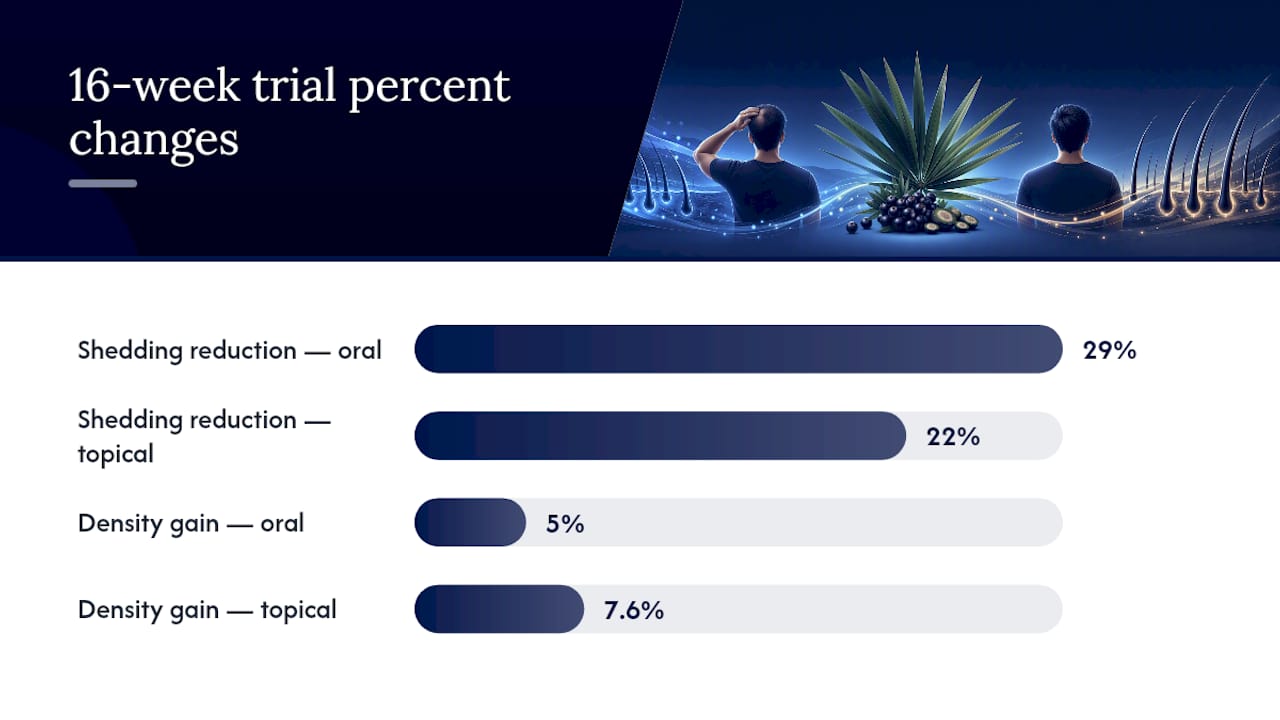
A shorter trial adds a second data point. A 16-week randomized, placebo-controlled study of 80 subjects using a standardized saw palmetto oil found oral treatment cut hair fall by up to 29%, while topical application reduced shedding by about 22%. Hair density climbed roughly 5% with oral use and about 7.6% with topical use, with several endpoints reaching statistical significance (p < 0.01 to p < 0.001). These numbers are smaller than the 180-day trial’s, which makes sense: four months of treatment simply hasn’t caught up to six months yet.
Zoom out to the systematic review level, and the picture gets more cautious. A review pooling nine clinical articles covering 381 patients found consistent but modest improvements in hair count, density, and patient satisfaction across small RCTs and cohort studies. The reviewers were candid about the catch: most studies were small, used different formulations, and followed patients for a limited time, which makes it hard to say any single dose or extract is the definitive winner.
A few patterns worth flagging:
- Men with androgenetic alopecia and women navigating menopausal hair thinning both showed benefit in subgroup analyses, though the response wasn’t uniform across every participant.
- The one notable head-to-head comparison against finasteride found saw palmetto came out behind the prescription drug on hair-count outcomes, reinforcing that natural extracts play a supporting role rather than a replacement one.
- Several studies tested saw palmetto blended with other ingredients (biotin, amino acids, vitamins), which muddies exactly how much credit saw palmetto itself deserves.
Saw palmetto’s 180-day trial produced a 283% greater improvement in hair count compared to placebo (+18.6 vs. −10.1, p < 0.001), the single most cited number in this research area and a useful benchmark when comparing other formulations.
None of this means saw palmetto is a guaranteed fix. It means the better-designed trials keep landing on the same conclusion: modest, real, and slow.
How Does Saw Palmetto Work on Hair Follicles?
The leading theory centers on dihydrotestosterone, or DHT, the hormone byproduct that shrinks hair follicles in androgenetic alopecia. Saw palmetto extracts inhibit the enzyme 5-alpha reductase, which converts testosterone into DHT. Less DHT reaching the follicle theoretically means less miniaturization over time, the same target finasteride pursues from a different angle.
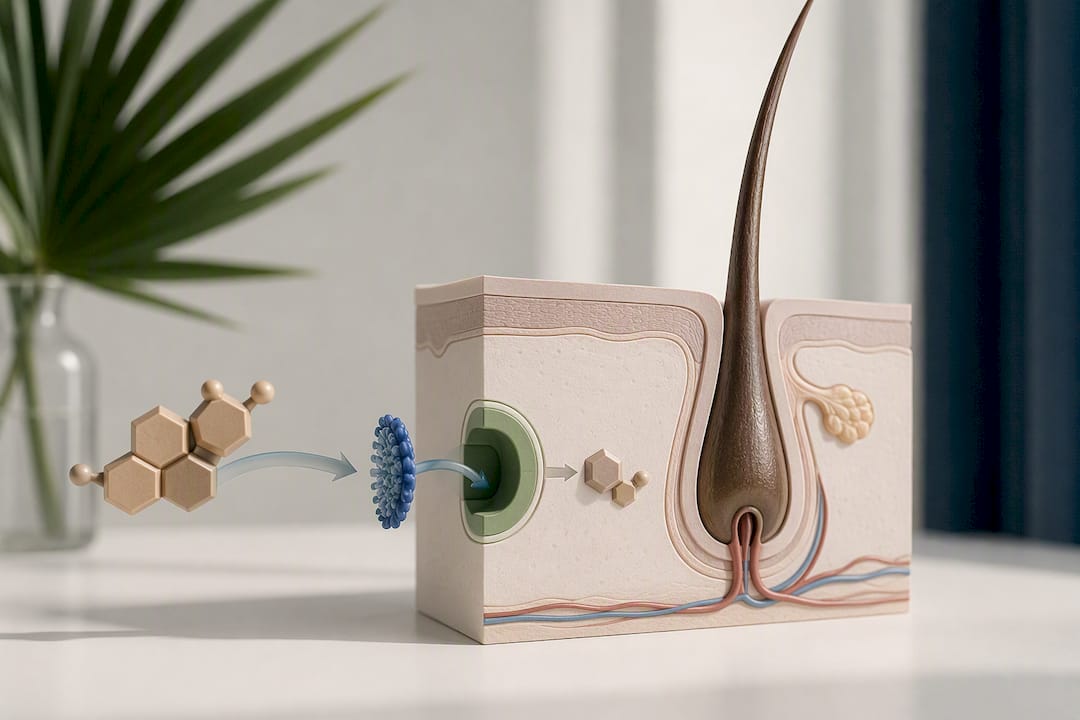
The mechanism differs from finasteride in an important way. Finasteride competitively blocks the enzyme, mainly the type II form. Saw palmetto appears to work through a noncompetitive, or allosteric, path, and some proprietary extracts show activity against both type I and type II 5-alpha reductase, with lab measurements showing inhibition at concentrations below 0.39 micrograms per milliliter in certain formulations. That broader enzyme coverage is one reason researchers think saw palmetto might help even where finasteride’s narrower target doesn’t fully apply.
Beyond DHT, ex vivo lab work points to a few supporting actions:
- Prolonging the anagen, or active growth, phase of the hair cycle in follicle tissue samples.
- Reducing oxidative stress markers around the follicle, which may protect against the kind of cellular damage that accelerates thinning.
- Interacting with fatty-acid receptors in a way that appears to calm inflammatory signaling near the follicle base.
None of these lab findings prove saw palmetto reverses hair loss on their own. They explain why the clinical trial results aren’t a fluke: there’s a coherent biological story behind the numbers, even if it’s not as forceful as a pharmaceutical DHT blocker.
Oral vs. Topical Saw Palmetto: Dosage and Timeline
Trials have tested saw palmetto in a few distinct formats, and the format matters as much as the dose.
- Oral standardized extracts. Most studied doses fall in the 100 to 320 milligram range daily, often as lipidosterolic extracts, which concentrate the fatty acids and sterols believed to drive the 5-alpha reductase effect.
- Topical lotions and serums. These use percent-concentration formulations applied directly to the scalp, with the 16-week trial’s topical arm delivering results comparable to, though not identical to, its oral counterpart.
- Combination products. Many trial formulations pair saw palmetto with biotin, zinc, or amino acids, which likely helps overall hair health but makes it harder to isolate saw palmetto’s individual contribution.
On timeline, don’t expect early results. The 16-week trial captured meaningful reductions in shedding and modest density gains, but the 180-day trial’s numbers were considerably larger. That pattern suggests three months is close to the minimum before you can judge anything, and six months is where the more convincing gains show up. If you’re evaluating a saw palmetto product, commit to at least 12 weeks before drawing conclusions, and don’t be surprised if the real payoff arrives closer to the 24 to 26 week mark.
One caution bears repeating: because so many studied products combine saw palmetto with other actives, it’s fair to say the research supports saw palmetto-containing regimens more confidently than it supports saw palmetto in total isolation.
Is Saw Palmetto Safe? Side Effects and Interactions
The safety profile across trials looks reassuring on the surface. Reported side effects skew mild: occasional digestive upset, bloating, or headache, and serious adverse events were uncommon in the studies reviewed. That said, mild does not mean irrelevant, especially given how saw palmetto actually works.
Because saw palmetto is a systemic hormonal modulator, a few groups need to pay closer attention:
- People taking anticoagulant or antiplatelet medications, since saw palmetto has been associated with bleeding risk in isolated case reports and warrants caution alongside blood thinners.
- Anyone on other hormone-affecting medications, including hormonal contraceptives or hormone replacement therapy, where interaction effects aren’t fully mapped out.
- People who are pregnant, breastfeeding, or actively trying to conceive, given saw palmetto’s action on androgen pathways.
- Anyone scheduled for surgery in the near term, since bleeding-risk supplements are typically paused beforehand.
Pro Tip: Keep a simple log of any new symptom in the first four weeks, dated and specific (“Day 12: mild stomach upset after taking with breakfast”). If you bring that log to a doctor or pharmacist, they can actually assess whether it’s related to saw palmetto or something else entirely, instead of guessing from memory weeks later.
If you take any prescription medication regularly, loop in your healthcare provider before starting saw palmetto, particularly if that medication touches blood clotting or hormone levels. The systematic review of saw palmetto in alopecia noted that longer-term safety data beyond six to twelve months is still thin, which is one more reason to keep a clinician in the loop rather than self-managing indefinitely.
What Should You Look for in a Saw Palmetto Product?
Not all saw palmetto products are built the same, and that gap explains why some formulations show up in clinical trials while generic capsules on a drugstore shelf never get studied at all.
Extraction method matters more than most labels admit. Supercritical CO2 extraction and cryogenic milling preserve the free fatty acids and sterol content that appear to drive 5-alpha reductase inhibition, while older solvent-based extraction methods tend to degrade those active lipids. Proprietary complexes referenced in trial literature, including formulations like ActiLipid4Hair, are built around a specific bioactive lipid signature correlated with measurable enzyme inhibition in lab testing, which is a very different standard than “contains saw palmetto” on an ingredient list.
Before buying, check for:
- A labeled extract percentage or standardized fatty-acid profile, not just “saw palmetto powder.”
- Third-party testing or a certificate of analysis confirming potency and purity.
- Manufacturing under Good Manufacturing Practice (GMP) standards.
- Published clinical evidence tied to that exact formulation, not a generic reference to saw palmetto studies in general.
| What to check | Why it matters |
|---|---|
| Dose per serving | Trial-backed ranges run 100 to 320 mg oral; underdosed products likely underperform |
| Extract type | Lipidosterolic or standardized fatty-acid extracts are what trials actually tested |
| Third-party certificate | Confirms potency matches the label instead of relying on marketing claims |
| Clinical evidence for that formulation | Generic “saw palmetto” citations don’t guarantee your specific product behaves the same way |
How Do You Fit Saw Palmetto Into a Hair-Wellness Routine?
Saw palmetto tends to suit people with early to moderate androgenetic alopecia who want a gentler, plant-based option before or alongside more intensive treatment, and people who can’t tolerate finasteride’s side-effect profile. If you’re dealing with rapid or severe shedding, or you want the strongest available data, prescription options deserve priority, and saw palmetto works better as a complement than a substitute.
If you decide to try it, a few steps keep expectations realistic:
- Choose a standardized product with a labeled extract type and dose, not a vague “proprietary blend.”
- Pair it with other evidence-backed topical care, including minoxidil if a dermatologist recommends it, rather than expecting one ingredient to do everything.
- Track progress with baseline photos and periodic hair counts, since perception often lags behind or overstates actual change.
Pro Tip: Set a calendar reminder for week 12 and week 24 to take the same photo, same lighting, same angle. If you see no change by month six and shedding continues, that’s the signal to book a dermatology referral rather than switch products and restart the clock.
CRISAN’s Practical Perspective on Botanical Hair Support
CRISAN Beauty was built after our founder’s own postpartum hair loss made her realize how few honest, plant-based options existed between “do nothing” and “go straight to prescription drugs.” That gap shaped how we approach scalp-nourishing botanicals today.
Our formulations draw on Ayurvedic tradition and blends of botanical ingredients, manufactured with an emphasis on ingredient transparency rather than vague “clinically proven” claims. We look at the same kind of evidence covered in this guide, standardized extracts, documented mechanisms, realistic timelines, and try to build products that respect what the research actually shows instead of what sells fastest. That means clear labeling and honest expectations about what botanical support can and can’t do on its own.
Our Take: What the Research Actually Supports
The trial data supports a specific, bounded claim: saw palmetto helps some people some of the time, modestly, and slowly. That’s a real finding, not a marketing footnote, but it’s a different claim than what a lot of supplement copy implies.
Where conventional advice falls short is the framing. Too many product pages treat saw palmetto as interchangeable with finasteride, when the one head-to-head comparison in this research showed the prescription drug outperforming it. Too few explain that extraction method and standardization determine whether you’re buying something close to what was tested, or something close to it in name only.
If we had to prioritize one thing for readers, it’s this: stop asking “does saw palmetto work” and start asking “does my saw palmetto match what a trial actually tested.” A standardized, well-documented extract taken consistently for six months is a reasonable bet for early thinning. A vague capsule from an unlabeled blend, taken for three weeks and abandoned, is not a fair test of the ingredient at all.
— CRISAN
Where CRISAN Fits Into Your Hair-Growth Routine
If the evidence above tells you anything, it’s that consistency and formulation quality matter more than any single ingredient claim. That’s exactly where CRISAN Oils come in for readers who want a topical, plant-based step to pair with a longer-term routine, formulated from generations of Ayurvedic tradition rather than a single trendy extract.
For readers building an oral component into their routine, our Vitamins & Supplements line is worth a look, especially if you’re the kind of person who wants a scalp-to-follicle approach rather than a single product acting alone. If you’d rather commit to a full routine from the start, the Hair Growth Duo (Oil + Vitamins) bundles a topical oil with a daily vitamin, which mirrors the oral-plus-topical pattern that performed best in the 16-week trial discussed earlier. Our products are vegan, made for all hair types, and manufactured domestically. Visit the CRISAN Oils collection to find the formulation that matches where you are in your routine.
FAQ
Does Saw Palmetto Really Grow Hair?
Clinical trials show saw palmetto can improve hair count and density, particularly with standardized extracts used consistently for three to six months. The 180-day trial found a 283% greater improvement in terminal hair count over placebo, though results vary by formulation and individual.
Is There a Downside to Taking Saw Palmetto?
The main downsides are mild digestive upset in some users and the fact that, as a hormonal modulator, it can interact with anticoagulants and hormone-based medications. It should generally be avoided during pregnancy, breastfeeding, or while trying to conceive, and anyone on prescription medication should check with a doctor first.
Is Pumpkin Seed Oil Better Than Saw Palmetto for Hair?
Pumpkin seed oil and saw palmetto both work through DHT-related pathways, but the trials in this guide focused specifically on saw palmetto extracts, showing measurable gains in hair count and reduced shedding. Neither has been directly compared head-to-head in the research covered here, so “better” depends on which formulation and dose you’re evaluating.
How Do You Block DHT and Regrow Hair Naturally?
Saw palmetto is one of the more studied natural DHT blockers, working by inhibiting 5-alpha reductase through a noncompetitive mechanism rather than the competitive path finasteride uses. Pairing a standardized extract with evidence-backed topical care and consistent tracking over several months gives the most realistic shot at natural DHT reduction.
How Long Before Saw Palmetto Shows Results for Thinning Hair?
Trial data suggests meaningful changes start around 12 to 16 weeks, with the larger gains reported at the 180-day mark. Judging saw palmetto’s effectiveness before three months is premature based on how the clinical evidence actually unfolded.


