



SAFER OILING
Skip the measuring with a prepared botanical blend
Essential oils are concentrated and require careful dilution. If you prefer a ready-to-use routine, CRISAN provides a finished botanical blend without at-home measuring.
- No DIY dilution calculations for each treatment
- A convenient full-size bottle for repeat routines
- Clearer, simpler use than mixing concentrated oils yourself
Full-size 16 oz bottle · Ayurvedic-inspired botanical formula · Made in the USA
Questions about this routine
Can I apply undiluted essential oil to my scalp?
It is generally safer not to apply concentrated essential oils directly. Dilute correctly, follow professional guidance, and patch-test first.
Is CRISAN Hair Oil already prepared for use?
CRISAN is sold as a finished hair-oil product. Follow the directions on the product page rather than adding concentrated essential oils to it.
Why choose a finished blend instead of DIY mixing?
A finished product is simpler and removes the need to calculate dilution percentages or measure multiple ingredients for every application.
Build consistency into your hair-oiling routine
The CRISAN 16 oz bottle is made for repeat treatments—not a one-time fix.
See the 16 oz CRISAN OilThat works out to roughly 6 drops of essential oil per 1 oz (30 mL) of carrier oil.
One important note before you go further: if you are pregnant, nursing, or mixing oils for a child under 10, stop here and read the safety section first. Dilution rules change significantly for those groups.
Key Takeaways
Safe, consistent dilution is the single most important factor in getting results from essential oils for hair without causing scalp irritation or follicle damage.
| Point | Details |
|---|---|
| Start at 1% for leave-on use | Use 6 drops of essential oil per 30 mL of carrier oil as your adult starting point. |
| Total drops cover all oils combined | If blending rosemary and peppermint together, their drops must not exceed your target count. |
| Patch-test every new blend | Apply to the inner forearm, wait 24–48 hours, and check for redness or irritation before scalp use. |
| Match carrier oil to hair type | Light oils (jojoba, grapeseed) suit leave-on blends; heavier oils (castor) work best as pre-wash treatments. |
| Crisanbeauty offers a pre-blended option | The CRISAN Ayurvedic Hair Growth Oil is formulated at a safe concentration, ready to use without additional essential oils. |
Table of Contents
- How to dilute essential oils for hair: formula and drop calculator
- What dilution percentage should you use for each application?
- Which carrier oils work best for your hair type and goals?
- How to patch-test and what to do if you have a reaction
- What does the evidence actually say about essential oils and hair?
- Why Crisanbeauty favors conservative dilutions
- CRISAN Ayurvedic Hair Growth Oil: a ready-made option
- Sources
How to dilute essential oils for hair: formula and drop calculator
The math is simple. Multiply your target dilution percentage by the total volume of your blend in milliliters, then convert to drops. One milliliter of essential oil contains approximately 20 drops, so the formula looks like this:
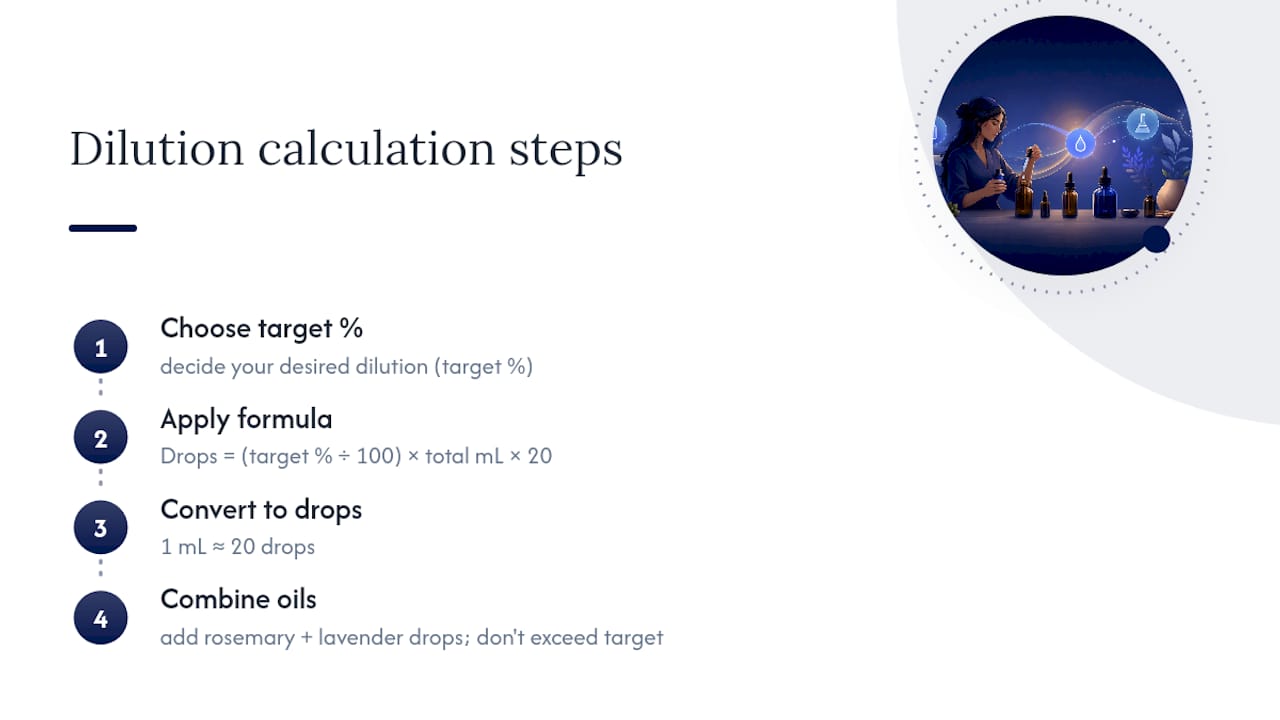
Drops needed = (target % ÷ 100) × total mL × 20
If you are blending rosemary and lavender together, their drops are added together and must not exceed your target count.
Conversion table: drops per volume
| Volume | 0.5% | 1% | 2% |
|---|---|---|---|
| 15 mL (½ oz) | 2 drops | 3 drops | 6 drops |
| 30 mL (1 oz) | 3 drops | 6 drops | 12 drops |
| 30 mL (1 oz) | 6 drops | 12 drops | 24 drops |
| — | 10 drops | 20 drops | 6 drops |
These numbers align with standard aromatherapy dilution math and the widely referenced conversion of 20 drops per mL.
Step-by-step mixing checklist
- Choose a clean, dry bottle. Amber or dark glass is best. Avoid plastic, which can degrade with certain essential oils.
- Calculate your drops using the formula above before you open anything.
- Add the essential oil(s) first. Drop them directly into the empty bottle.
- Pour in the carrier oil to your target volume. Cap and gently roll the bottle between your palms to blend.
- Label the bottle immediately. Write the ingredients, dilution percentage, date mixed, and intended use (scalp massage, pre-wash, etc.).
- Shake or roll before each use. Oils can separate slightly over time.
What dilution percentage should you use for each application?
The right percentage depends on how long the oil stays on your scalp and how often you apply it. A rinse-out treatment can tolerate a slightly higher concentration than a blend you leave on overnight. Broken or irritated skin lowers the threshold further, because damaged skin absorbs more.
Contraindications to know before you mix:
- Broken or inflamed skin. Skip essential oils entirely until the skin heals. Absorption increases sharply through compromised skin, raising irritation risk.
- Active scalp dermatitis or psoriasis. Certain oils (especially peppermint and tea tree) can aggravate flares. Get clearance from a dermatologist first.
- Pregnancy and nursing. Many essential oils carry documented risks during pregnancy. Rosemary, peppermint, and tea tree are among those flagged for caution. Do not use without guidance from your OB or midwife.
- Infants and children under 10. Standard adult dilutions are too concentrated for young children. Peppermint in particular should not be used on children under 6 due to menthol’s effect on breathing.
- Eye proximity. Never apply any essential oil blend near the eyes or on the face without specific guidance for that use.
For safe plant-based scalp treatment options that are already formulated for these considerations, Crisanbeauty’s educational resources are a helpful starting point.
Which carrier oils work best for your hair type and goals?
The carrier oil you choose affects how the blend feels, how well it penetrates, and whether it rinses out cleanly. Lighter oils absorb faster and leave less residue; heavier oils coat the strand and work better as pre-wash treatments.
- Jojoba oil. Technically a liquid wax, jojoba closely mimics the scalp’s natural sebum. It absorbs without greasiness and suits most hair types, including oily scalps. A reliable all-purpose base for leave-on blends.
- Grapeseed oil. Very light and nearly odorless. It rinses out easily, making it a good choice for fine or low-porosity hair that tends to feel weighed down.
- Fractionated coconut oil. Stays liquid at room temperature, unlike standard coconut oil. It penetrates the hair shaft well and has a long shelf life, around 12 months or more when stored correctly.
- Argan oil. Rich in vitamin E and fatty acids. Works well for dry, color-treated, or high-porosity hair. Slightly heavier than grapeseed but still absorbs without heavy residue.
- Castor oil. Thick and viscous, with a reputation for supporting scalp circulation. Because of its weight, it is best used as a pre-wash treatment rather than a leave-on. Mixing it with a lighter carrier makes it much easier to apply and distribute evenly.
- Sweet almond oil. A mid-weight oil with a mild, nutty scent. Good for normal to dry hair and scalps. Note: avoid if you have a tree nut allergy.
This makes the mixture pourable, helps it distribute evenly through the hair, and keeps your dilution math consistent across the whole batch.*
For a deeper look at how botanical oils support hair loss concerns, Crisanbeauty’s journal covers the evidence behind specific plant-based ingredients.
Rosemary, peppermint, lavender, and tea tree: what to know before you add them
These four essential oils appear in most hair-focused blends. Each has a different functional profile and a different set of cautions.
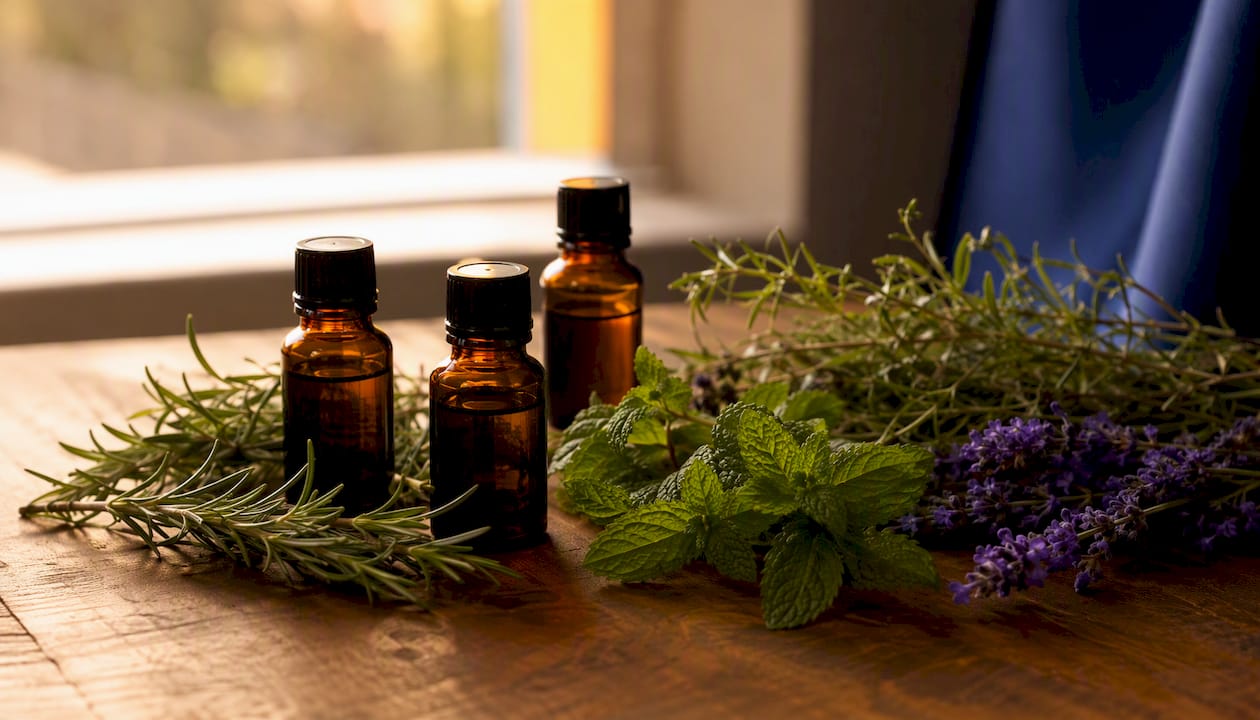
Rosemary essential oil is the most studied for hair applications. People use it for scalp stimulation and to support thicker-looking hair over time. It has a sharp, herbal scent. The main caution: it is a potent oil that can cause scalp irritation at higher concentrations, and it should be avoided during pregnancy. The Cleveland Clinic notes that rosemary may support hair health through antioxidant and anti-inflammatory effects, but recommends diluting it in a carrier and massaging it in consistently rather than applying it at high concentrations.
Peppermint essential oil produces a noticeable cooling sensation on the scalp, which many people associate with circulation. It is commonly used in pre-wash scalp treatments. The NCCIH cautions that peppermint can cause skin irritation and should always be diluted for topical use. Keep it away from children under 6, and avoid applying it near the face or nose.
Lavender essential oil has a mild, floral scent and is often chosen for its calming properties. It is one of the gentler options for scalp use and is sometimes included in blends for sensitive scalps. Even so, dilute it properly. Lavender can cause contact dermatitis in some people, and it carries a photosensitivity risk if you apply it and then go into direct sunlight.
Tea tree essential oil is antimicrobial and is frequently used for flaky or congested scalps. It has a medicinal, camphor-like scent. Tea tree is one of the more irritating essential oils if used undiluted or at too high a concentration. It should not be used on children under 6, and it is not safe for internal use under any circumstances.
When you combine oils, the drop counts add up. The total stays at 6. Never exceed your target dilution just because you are adding a second oil.
How to patch-test and what to do if you have a reaction
A patch test takes less than five minutes and can prevent a painful scalp reaction. Do it every time you try a new essential oil or a new blend, even if you have used the individual oils before.
- Mix a small test amount at your intended dilution in your chosen carrier oil. Use about 2–3 drops of the blend total.
- Apply to the inner forearm or behind the ear, where skin is thin and reactive.
- Wait 24–48 hours. Do not wash the area during that window.
- Check for redness, itching, swelling, or a burning sensation. If none appear, the blend is likely safe for scalp use at that concentration.
- Document what you tested. Write down the oils, the dilution, and the date so you can track any delayed reactions.
If you experience burning, stinging, or a spreading rash: wash the area immediately with soap and water to remove the oil. Do not try to rinse with water alone, since oil and water do not mix well. Apply a plain, fragrance-free moisturizer to soothe the skin. Stop using the blend entirely.
Seek medical attention if you notice severe burning that does not subside after washing, a rash that spreads beyond the application site, swelling, hives, or any difficulty breathing. Eye exposure from accidental contact requires immediate flushing with clean water for at least 15 minutes, followed by a call to Poison Control (1-800-222-1222) or a visit to urgent care.
Caregivers mixing oils for older children should patch-test on themselves first, then on a small area of the child’s skin at a reduced concentration before any scalp application.
How to store your blends and how long they last
Diluted blends do not last forever. The carrier oil sets the shelf life, and heat, light, and air are the main enemies.
- Use amber or dark glass bottles. Clear glass and plastic both allow light to degrade the oils faster.
- Store in a cool, dark place. A bathroom cabinet away from the shower works. Avoid windowsills and anywhere near heat sources.
- Cap tightly after every use. Oxygen causes oxidation, which speeds up rancidity.
- Shelf life by carrier: Light oils like jojoba, grapeseed, and fractionated coconut oil typically last 6–12 months in a diluted blend. Argan oil is similar. Castor oil tends to last longer due to its high ricinoleic acid content, but blends containing it should still be used within 12 months.
- Signs of rancidity: A sour, crayon-like, or “off” smell is the clearest sign. Discard the blend if you notice it. Rancid oil applied to the scalp can cause irritation and does not deliver the benefits of a fresh blend.
- Label every bottle with the full ingredient list, dilution percentage, date mixed, and intended use. This matters especially if you make multiple blends or share them.
What does the evidence actually say about essential oils and hair?
The clinical picture for essential oils and hair health is promising in places, but it is not settled science. Understanding what the studies actually show helps you set realistic expectations.
Rosemary oil has the strongest human trial data. A randomized trial published on PubMed found that rosemary oil produced hair growth outcomes comparable to 2% minoxidil in a small study conducted over several months. The results are encouraging, but the trial was small and results varied among participants. A PMC review of essential oils and skin and hair applications found that these oils show biologically relevant activity (anti-inflammatory, antimicrobial, circulation effects) while noting that clinical evidence across the field is heterogeneous and further research is needed.
Peppermint’s mechanism is better understood at the physiological level. PMC research on essential oil mechanisms describes how menthol-containing oils may increase local scalp circulation and potentially stimulate follicles, based on animal studies and small human trials. The effect sizes in humans vary, and no essential oil has been approved by the FDA to treat hair loss.
The consistent message from dermatologists: results from essential oil scalp treatments take weeks to months of regular use to become visible, if they appear at all. The Cleveland Clinic recommends daily or several-times-weekly scalp massage with a diluted oil, and cautions that over-concentrating the blend can damage follicles and paradoxically worsen shedding. More is not better.
Application technique matters as much as the oil itself. Research on topical treatments and scalp application supports 3–5 minutes of circular scalp massage as the delivery method most likely to move active compounds toward the follicle. The massage, not just the oil, appears to be part of the mechanism. For broader context on scalp nourishing herbs that complement essential oil use, Crisanbeauty’s journal covers the botanical evidence in plain language.
The science behind healthy hair growth also points to the role of consistent circulation and follicle health over time, reinforcing why both dilution and technique matter together.
Why Crisanbeauty favors conservative dilutions
There is a tendency in DIY hair care to assume that more essential oil means faster results. The evidence does not support that. What the data consistently shows is that conservative dilutions applied regularly, with proper massage technique, outperform high-concentration applications that irritate the scalp and disrupt the follicle environment.
At Crisanbeauty, we lean toward the lower end of recommended ranges, especially for first-time users and anyone with a history of scalp sensitivity. It is the approach that keeps you in the routine long enough to see results.
One thing worth flagging: if you are using a pre-blended botanical product, adding extra essential oils on top of it can unbalance the formulation. Pre-blended products are tested at specific concentrations. Adding more essential oil changes the ratio and can push the total above a safe threshold without you realizing it. Always check the label and, when in doubt, contact the brand directly before modifying a ready-made product.
CRISAN Ayurvedic Hair Growth Oil: a ready-made option
Mixing your own blends gives you control, but it also requires precision. If you want the benefits of a multi-botanical hair oil without the measuring and math, the CRISAN Ayurvedic Hair Growth Oil is formulated at a safe, ready-to-use concentration. No additional essential oils needed.
The oil is designed for thinning hair and scalp health, drawing on Ayurvedic botanical ingredients and manufactured in the USA. It is intended to be used as directed on the label, applied to the scalp with massage, consistently over time. Because it is already blended to a tested concentration, you get the benefit of a multi-ingredient formula without the risk of over-diluting or over-concentrating. For readers who want to explore the full product or check current availability, the CRISAN hair growth oil page has complete details on ingredients, usage directions, and how to order.
Sources
- How To Use Rosemary Oil for Hair Growth
- PubMed entry (randomized trial on rosemary oil vs minoxidil)
- PMC review article related to essential oils and skin/hair
- Peppermint oil: NCCIH health information
- Essential Oil Dilution for Hair Oil and Scalp Use | CleaningRatio
This article is general information, not a substitute for advice from a qualified doctor. Consult a qualified healthcare professional about your own circumstances before acting on anything here.
Skip the DIY measuring?
Choose a ready-to-use 55-oil hair ritual
CRISAN 16 oz Hair Oil combines essential and carrier oils in a finished cosmetic formula, so you do not have to build a blend from individual bottles. Follow the product directions, patch test first and do not add extra essential oils to the bottle.


