



WET, DAMP OR DRY?
Use your oil at the right moment
For deep pre-wash care, apply CRISAN oil to dry hair. To seal moisture, use a very small amount on damp lengths. For shine, smooth a trace over dry ends.
- Full-size 16 oz bottle for consistent routines
- Use as a pre-shampoo or overnight treatment
- Adjust the amount for fine, curly, coily or thick hair
Full-size 16 oz bottle · Ayurvedic-inspired botanical formula · Made in the USA
Questions about this routine
Should I use CRISAN Hair Oil on wet or dry hair?
Use it on dry hair for a pre-shampoo or overnight treatment. On damp hair, start with a very small amount through the lengths and ends to help seal in moisture.
How much should I apply?
Start conservatively. Fine or short hair needs much less than long, thick or coily hair. You can always add more, but using too much at once may make hair feel heavy.
Is the 16 oz bottle only for thick hair?
No. The larger size is designed for people who oil consistently, share within a household, or have long or thick hair. Fine hair users simply use a smaller amount per application.
Build consistency into your hair-oiling routine
The CRISAN 16 oz bottle is made for repeat treatments—not a one-time fix.
See the 16 oz CRISAN OilUse oil on dry hair when your goal is finishing shine or frizz control, and on damp (towel-dried) hair when you want to seal in moisture after a shower. Wet, dripping hair is the one condition to avoid, since water blocks absorption and most of the oil just slides off before it can work. That distinction comes straight from pro stylists cited in Glamour, and it lines up with what Healthline reports about oil’s real job: cutting friction and breakage, not soaking into strands that are already saturated with water. Crisanbeauty builds its Ayurvedic oiling routines around this same logic.
Two quick moves to try today:
- Daily styling fix: rub a dime-size amount between your palms and smooth it over dry ends for instant shine without weighing hair down.
- Pre-wash treatment: massage oil into dry hair and scalp 30 minutes to overnight before you shampoo, for deeper conditioning.
Key Takeaways
Apply oil to dry hair for finishing and frizz control, to damp hair for sealing in moisture, and reserve dry, pre-wash applications for deep conditioning and protection.
| Point | Details |
|---|---|
| Match timing to goal | Use dry hair for finishing and pre-wash treatments, damp hair for sealing moisture after washing. |
| Skip dripping wet hair | Water blocks oil absorption, so oil mostly sits on the surface and slides off. |
| Adjust by hair type | Fine or oily hair needs less oil and less frequency; dry or coarse hair tolerates more, more often. |
| Fix flat or greasy results | Cut the amount in half and move application farther from the scalp before abandoning oil entirely. |
| Choose formula by need | Crisanbeauty’s Ayurvedic hair oil suits pre-wash and overnight treatments for dry or thinning hair. |
Table of Contents
- When Should You Apply Hair Oil Wet or Dry?
- Why Wet, Damp, and Dry Hair Respond Differently to Oil
- What Hair Type Determines the Best Oil Timing?
- Which Oils Work Best on Wet Versus Dry Hair?
- How to Apply Hair Oil Step by Step
- Fixing Greasy, Flat, or Buildup-Prone Hair
- How Ayurvedic Tradition Shapes Crisanbeauty’s Oiling Advice
- What This Guide Gets Right That Most Advice Misses
- Which Crisanbeauty Oil Matches Your Routine?
- Frequently Asked Questions
- Sources
When Should You Apply Hair Oil Wet or Dry?
The timing question really comes down to what you’re trying to fix. Pre-shampoo treatments call for dry hair, since the goal is to let oil coat and protect the shaft before shampoo strips natural oils away. Sealing moisture after a wash calls for damp, towel-dried hair, which is when a light coat of oil traps water already in the strand. Finishing and frizz control, by contrast, work best on dry hair, right before or after styling.
Here’s how that breaks down by goal:
- Pre-wash protection: dry hair, applied 30 to 60 minutes before shampooing (or left overnight for coarse or damaged hair).
- Moisture sealing: damp, towel-dried hair, right after washing and before you detangle.
- Frizz control and shine: dry hair, applied post-styling or midday as a touch-up.
- Overnight nourishment: dry hair before bed, best for dry or coarse textures that need intensive repair.
Fine or oily hair usually needs oil no more than two to three times a week, while dry or coarse hair tolerates daily light applications without looking greasy. Preventive Medicine Daily recommends matching frequency to how fast your scalp produces its own oil, not a fixed schedule.
Pro Tip: Never apply oil right before high heat styling unless the formula is specifically heat-protective. Standard oils can scorch under a flat iron or blow dryer, leaving hair brittle instead of shiny.
Why Wet, Damp, and Dry Hair Respond Differently to Oil
Hair strands swell and their outer cuticle lifts when wet, which sounds like it should help oil sink in. It does the opposite. Water fills the spaces oil molecules would otherwise occupy, so oil applied to soaking hair mostly sits on the surface and slides off, according to stylists cited by Glamour. Dry hair has no water competing for space, letting oil coat the cuticle directly and lock down flyaways. Damp hair sits in between: enough surface moisture remains that oil can seal it in, without the excess water blocking contact.
Each state has a trade off:
- Wet: minimal absorption, high risk of the oil just rinsing back out or leaving hair limp.
- Damp: good for sealing existing moisture, moderate frizz control, low risk of buildup if you use a light hand.
- Dry: best surface coating for shine and frizz, but too much product here reads as instantly greasy.
Absorption matters most when you want deep conditioning before a wash. A surface seal matters most when you’re locking in moisture you already have or fighting flyaways in humid weather.
What Hair Type Determines the Best Oil Timing?
Your hair type changes both when to oil and how much to use, more than any single rule ever will.
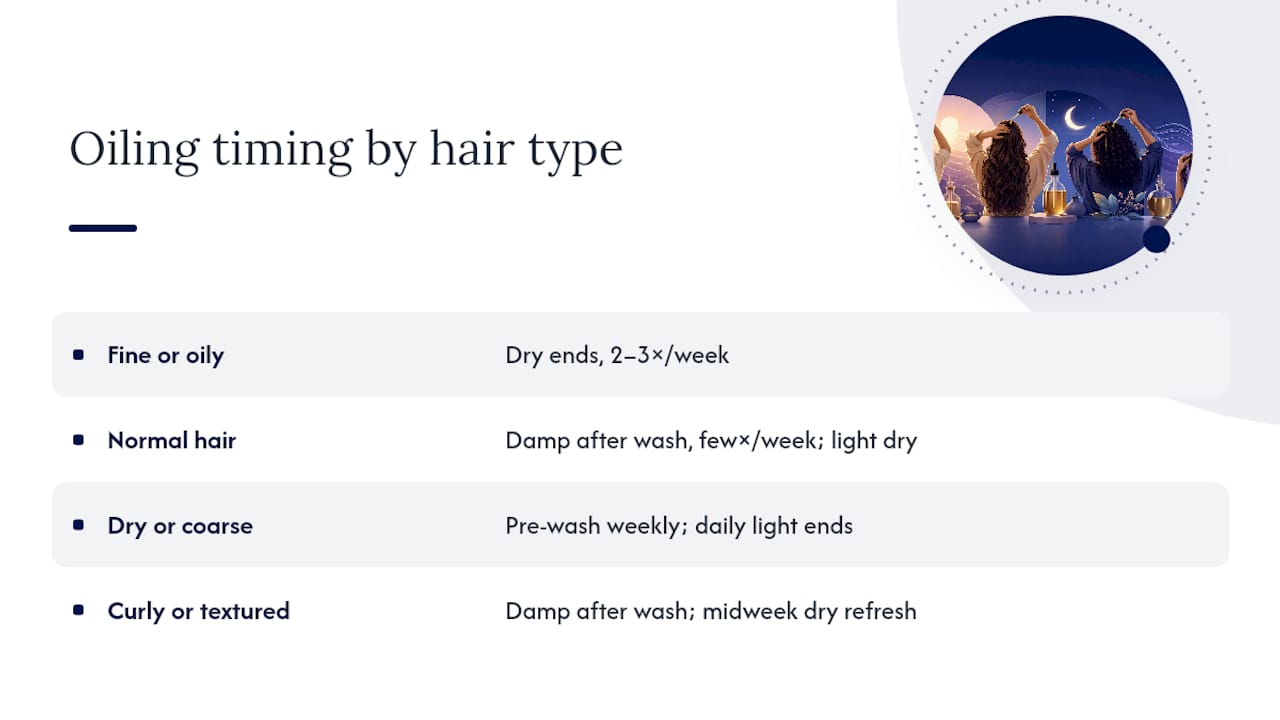
Fine or oily hair does best with a light touch on dry ends only, two to three times a week, since oil applied to the scalp or wet strands amplifies natural oil production and flattens volume fast. If hair looks limp after oiling, you likely used too much or applied it too close to the roots.

Normal hair has more flexibility: damp application after washing a few times a week keeps moisture locked in, while a light dry application handles occasional frizz.
Dry or coarse hair tolerates the most oil and benefits from both worlds: a pre-wash dry-hair treatment weekly, plus daily light coats on dry ends for ongoing softness. Healthline notes that this hair type sees the most benefit from oiling overall, since it starts with less natural moisture to begin with.
Curly or textured hair usually responds best to damp application right after a wash and conditioner, sealing in the water curls need to define without weighing down the pattern. A midweek dry refresh on ends helps control frizz between wash days.

If any hair type starts looking flat or stringy, cut your amount in half before you cut oil out entirely.
Which Oils Work Best on Wet Versus Dry Hair?
Oil weight matters just as much as timing. Light oils like argan and jojoba mimic the scalp’s natural sebum, absorb fast, and work well as finishing oils on fine or normal dry hair without leaving residue. Heavier oils like coconut and olive sit longer on the strand, which makes them better suited to pre-wash treatments or overnight conditioning on thick, dry, or coarse hair, according to Healthline. Applying a heavy oil to fine, wet hair is one of the fastest routes to a flat, greasy look, since the strand simply cannot carry that much weight.
Crisanbeauty’s hair strengthening oil formulas are built with this weight logic in mind, pairing lighter botanical oils for daily use with richer blends for deeper treatments.
Pro Tip: If you’re combining oil with a leave-in conditioner, apply the leave-in first on damp hair, then a light oil on top to seal it in. Layering it the other way traps the leave-in underneath and blocks it from working.
How to Apply Hair Oil Step by Step
- Pre-wash treatment: part dry hair into sections, apply oil to scalp and lengths, massage for two to three minutes, then leave on for 30 minutes to overnight before shampooing.
- Damp post-wash seal: towel-dry hair until it’s no longer dripping, then smooth a small amount from mid-lengths to ends, avoiding the scalp.
- Dry finishing: rub oil between your palms and press it lightly over dry ends and flyaways.
Use two to three drops for short or fine hair, four to six for medium length, and six to ten for long or coarse hair, per Preventive Medicine Daily. Scalp application works well for dry or coarse hair overnight but should stay off oily scalps outside of a weekly pre-wash session.
Fixing Greasy, Flat, or Buildup-Prone Hair
Greasy or flat hair after oiling almost always means too much product or oil applied too close to the roots. Cut the amount in half and move application farther down the strand. Buildup that leaves hair dull or hard to style calls for a clarifying shampoo once every one to two weeks to reset the scalp. If you notice increased dandruff or scalp irritation, oil may be trapping debris rather than nourishing skin. Acibadem Hospitals Group notes that overuse, especially heavier oils left overnight, can worsen buildup or irritation in sensitive scalps.
- Greasy roots: reduce amount, apply lower on the shaft.
- Persistent buildup: clarify weekly, cut oiling frequency in half.
- Scalp irritation or dandruff: stop scalp application and patch-test a smaller amount before resuming.
See a dermatologist if irritation, flaking, or hair loss persists beyond two to three weeks of adjustment.
How Ayurvedic Tradition Shapes Crisanbeauty’s Oiling Advice
Ayurvedic oiling practices have recommended pre-wash and overnight treatments for generations, well before modern stylists arrived at similar conclusions through trial and observation. Crisanbeauty’s founder built the brand’s approach around that tradition after facing postpartum hair loss and finding most modern products offered shortcuts instead of real routines. Family-owned and made in the USA, Crisanbeauty leans on plant-based formulas rather than synthetic fillers.
- Family-owned and women-led, with a community of more than 1.3 million followers built on hair care education.
- Every product manufactured in the USA using selected botanical ingredients.
- Ayurvedic-inspired pre-wash and overnight oiling methods, adapted for modern hair types and routines.
Oiling isn’t a shortcut to healthier hair. It’s a routine, built the same way generations before us built theirs: consistent, matched to your hair, and never rushed.
What This Guide Gets Right That Most Advice Misses
Most articles on this topic treat “wet or dry” as a single universal rule, when the honest answer depends entirely on what you’re solving for. That’s the gap in the conventional advice: it tells you what to do, not why, so readers apply the same technique to fine hair and coarse hair and wonder why one leaves them flat and the other leaves them dry.
The stylist consensus in Glamour and the practical breakdown from Healthline both point to the same underlying truth: oil’s job is reducing friction and sealing what moisture you already have, not manufacturing moisture out of nowhere. That reframes the whole decision. Once you know your hair type’s actual need, whether that’s protection before washing or a surface seal after, the wet versus dry question answers itself.
Prioritize hair type and goal over any single rule you read online. A coarse-hair reader following fine-hair advice will end up disappointed, and vice versa. Start there, and the timing follows.
Which Crisanbeauty Oil Matches Your Routine?
Once you know whether you need a pre-wash treatment or a light finishing coat, matching the right formula matters more than chasing a trend. Crisanbeauty’s Ayurvedic hair growth oil is built as a pre-wash and overnight treatment for dry, coarse, or thinning hair, using plant-based ingredients rather than synthetic fillers.

It’s formulated to work with the timing this guide covers rather than against it: apply it to dry hair before washing, or use a lighter hand on damp lengths if you’re sealing moisture instead of deep conditioning. Every batch is manufactured in the USA, and the formula draws from the same Ayurvedic tradition that shaped Crisanbeauty’s original routines. If your hair runs fine or oily, the brand’s lighter formulation for fuller-looking hair is worth a look instead. Pick the option that matches your hair type from the sections above, then apply it at the timing that fits your goal.
Frequently Asked Questions
Should I put hair oil on wet or dry hair for the best results? It depends on your goal: dry hair for finishing and pre-wash treatments, damp hair for sealing in moisture right after washing.
Can I apply hair oil every day? Fine or oily hair usually looks best with oil two to three times a week, while dry or coarse hair can often handle a light daily application.
Does hair oil protect against heat styling damage? Only if the formula is specifically heat-protective. Standard oils can scorch under high heat and should be applied after styling instead.
How much hair oil should I use? Two to three drops for short or fine hair, four to six for medium length, and six to ten for long or coarse hair, adjusted based on how your hair responds.
Sources
- How to Use Hair Oil the Right Way, According to Pro Hairstylists | Glamour
- Hair Oiling Benefits, Choosing Oil, and How to Do It
- How to Use Hair Oils the Right Way: Step-by-Step for Best Results
- Hair Oil: An evidence-based guide for patients | Acibadem Hospitals Group


