


Jojoba and squalane are the safest, most effective face oils for gua sha because they mimic your skin’s natural sebum, giving your tool the slip it needs without clogging pores. If your skin runs dry or mature, rosehip, argan, or marula add more nourishment for the same glide. Skip coconut oil and heavily fragranced blends. The right oil isn’t a luxury add-on to gua sha. It’s what keeps the practice from damaging the skin it’s supposed to help.
TL;DR:
- Jojoba and squalane oils are ideal for gua sha because they mimic skin’s sebum, offering slip without clogging pores or causing reactivity.
- Lighter oils like jojoba and squalane are best for quick morning routines, while richer options like rosehip and argan suit slower, nourishing nightly sessions.
- Avoid heavily comedogenic oils such as coconut oil and multi-ingredient blends that increase the risk of breakouts and unpredictable reactions.
- Proper application includes applying 3 to 6 drops on damp skin, warming the oil, and following a specific lymphatic drainage movement from neck upward.
- Post-session cleansing with gentle, non-stripping products prevents breakouts caused by leftover oil and debris, ensuring skin health with regular, correct cleaning.
Table of Contents
- Why Oil Matters for Face Oil Gua Sha Practice
- Best Face Oils for Gua Sha by Skin Type and Goal
- How to Apply Face Oil for Gua Sha, Step by Step
- What to Avoid: Comedogenicity, Actives, and Patch Tests
- CRISAN’s Approach to Plant-Based Facial Oils
- The Right Way to Move a Gua Sha Tool Across Oiled Skin
- Why Oil Beats Dry Gua Sha or Other Products
- How to Cleanse Skin Properly After Oil-Based Gua Sha
- Storing Face Oils So They Stay Effective and Safe
- Side Effects and Risks of Gua Sha With Oil
- Daily Micro-Routine or Weekly Ritual: Deciding Your Gua Sha Frequency
- Try CRISAN Oils for Your Gua Sha Routine
- Sources
- FAQ
Why Oil Matters for Face Oil Gua Sha Practice
Dragging a smooth stone or metal tool across dry skin doesn’t just feel unpleasant. It stretches and tugs the skin, which can worsen the puffiness and dullness you’re trying to fix in the first place. Oil creates a buffer layer that lets the tool glide instead of catch, and that buffer matters more than most people realize when they’re standing in front of a mirror with a new gua sha stone.
Not all slip is created equal, though. Oils that closely resemble human sebum, like jojoba and squalane, tend to be accepted by skin with lower reactivity than oils your skin doesn’t recognize as easily. That’s a real advantage when you’re pressing a tool repeatedly over the same patch of cheek or jawline.
Texture matters just as much as chemistry:
- Lightweight oils (squalane, jojoba) work best for quick morning de-puffing sessions.
- Richer oils (rosehip, marula) suit slower, nightly sculpting routines where you want added nourishment.
- Thicker, waxier oils can create too much drag, forcing you to press harder than you should.
Comedogenic rating matters here too. Dermatology-informed guidance points to oils rated 0 to 2 on the comedogenic scale, like jojoba and squalane, as the safer picks for facial gua sha, since tool work spreads product across more skin for longer contact than a simple massage-in application.
Best Face Oils for Gua Sha by Skin Type and Goal
Choosing a face oil for gua sha comes down to matching the oil’s weight and nutrient profile to what your skin actually needs, not to whatever bottle has the prettiest packaging. Here’s how the most recommended options break down.
- Jojoba oil is the closest botanical match to human sebum, which is why it’s a default recommendation for oily, combination, and normal skin. It absorbs steadily without leaving a heavy film, so you get consistent glide from your first stroke to your last.
- Squalane (derived from olives or sugarcane) is even lighter than jojoba and disappears into skin fast. It’s a strong pick if you want to do gua sha in the morning and head straight into makeup, since it’s non-greasy and low-reactivity.
- Rosehip oil brings vitamin A precursors and essential fatty acids that support barrier repair, making it a favorite for mature or dry skin looking for elasticity support during nightly sessions.
- Argan oil pairs antioxidants with a slightly heavier feel than squalane, which some dry-skinned users prefer for longer, slower gua sha sessions focused on sculpting rather than de-puffing.
- Marula oil carries a gentle, fatty-acid-rich profile that tends to sit well on reactive or sensitive skin, especially when paired with a fragrance-free formulation.
- Grapeseed or hemp seed oil works for oily and acne-prone skin thanks to a high linoleic-acid content, which behaves differently on skin than the oleic-acid-heavy oils that can feel too rich for breakout-prone faces.
Pro Tip: Stick to single-ingredient or minimal-ingredient oils whenever possible. Specialized “gua sha blends” can be convenient, but combining several botanicals in one bottle raises your odds of a fragrance or plant-sensitivity reaction compared to a plain carrier oil, and that makes it harder to pinpoint what caused a breakout if one shows up.
How to Apply Face Oil for Gua Sha, Step by Step
Getting the amount and timing right is what separates a smooth session from one where the tool keeps catching on dry patches.
- Cleanse your face first. Oil applied over makeup or sunscreen residue traps debris against skin instead of letting the tool move freely.
- Apply 3 to 6 drops onto slightly damp skin. Damp skin holds oil better than bone dry skin, which helps the product spread evenly.
- Warm the oil between your palms for a few seconds, then press it into your face. Warming thins the oil slightly and improves absorption.
- Wait about 30 seconds before starting. This short pause lets the oil settle into the skin’s surface for controlled, even slip rather than sitting on top of it.
- Work the tool in this order: clavicle, neck, jawline, cheeks, under-eye, temple. Always stroke outward and upward, following the direction lymph naturally drains.
- Use light pressure, holding the tool at roughly a 15 to 30 degree angle against skin, and repeat 3 to 5 passes per area.
A few things to keep in mind as you go:
- If you feel the tool tugging or catching, add one more drop rather than pushing harder.
- Clean your gua sha tool with soap and water after every session.
- Finish with a moisturizer if your skin still feels like it needs it once the oil has absorbed.
What to Avoid: Comedogenicity, Actives, and Patch Tests
Some of the most common gua sha complaints, like sudden breakouts along the jaw or forehead, trace back to oil choice rather than the tool itself. Coconut oil sits at a 4 on the comedogenic scale, and practitioner write-ups consistently flag it as too pore-clogging for facial use, even though it’s a fine body oil.
A few other rules worth following before you pick up your tool:
- Don’t mechanically press oil into skin that already has fresh vitamin C serum or a strong retinoid layered underneath. Gua sha increases product penetration, and that can intensify irritation from active ingredients.
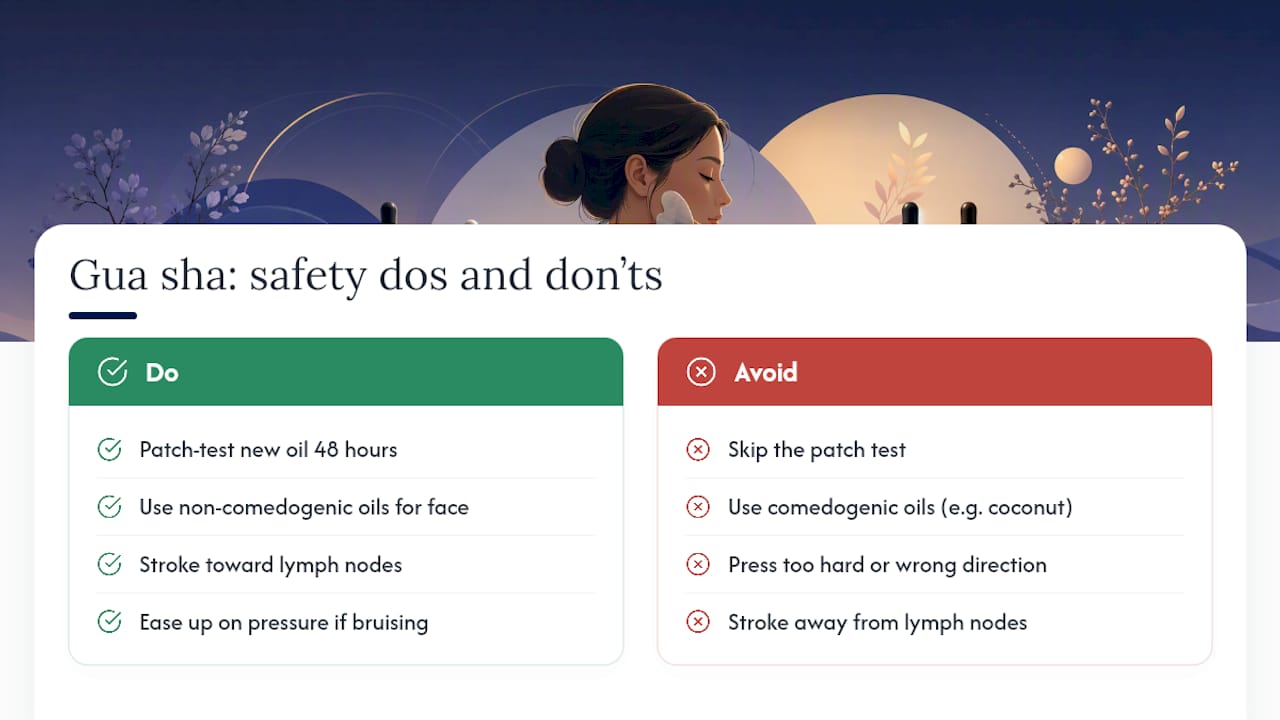
- Patch-test any new oil on your inner forearm and watch it for 48 hours before bringing it near your face.
- Skip gua sha entirely on visibly inflamed, broken, or actively breaking-out skin. Mechanical pressure on compromised skin barrier can spread bacteria or worsen redness.
- If breakouts or irritation persist after switching oils, check in with a dermatologist rather than troubleshooting further on your own.
CRISAN’s Approach to Plant-Based Facial Oils
Crisanbeauty is a family-owned, women-led company built on generations of Ayurvedic tradition and formulated with cold-pressed botanical ingredients, a processing method that helps preserve the fatty-acid and antioxidant profiles that make plant oils useful for skin in the first place. Every product is manufactured in the USA.
That emphasis on simple, transparent formulation lines up directly with the predictable-reaction advice in this guide: the fewer botanicals stacked into one bottle, the easier it is to know exactly what your skin is reacting to.
The Right Way to Move a Gua Sha Tool Across Oiled Skin
Direction isn’t a minor detail in gua sha. It’s the difference between a technique that supports lymphatic drainage and one that just moves oil around your face for no real benefit.
Lymph vessels drain toward the collarbone, so every stroke should move in that general direction, never away from it. Start at the base of your neck and clavicle to “open the drain,” then work upward: jawline first, then cheeks, then the delicate under-eye area, finishing at the temples. This bottom-to-top order matters because pushing fluid toward an already congested area just backs it up further.

Angle the tool low against your skin, closer to flat than upright, and pull rather than scrape. A 15 to 30 degree angle keeps pressure even across the tool’s edge instead of concentrating it on one corner. Use 3 to 5 slow passes per zone rather than a dozen quick ones. Speed doesn’t move lymph fluid any faster; consistent, gentle pressure does.
Under-eye strokes deserve extra care. Use the smallest curve of your tool, apply almost no pressure, and always sweep outward toward the temple, never toward the nose. This is the thinnest skin on your face, and it’s the area most likely to bruise if you get direction or pressure wrong.
Finish each side with one long stroke from jaw to ear to collarbone, sweeping any lingering puffiness toward the lymph nodes that can actually process it.
Why Oil Beats Dry Gua Sha or Other Products
Dry gua sha, done with no lubricant at all, forces you to either use so little pressure that the tool barely does anything, or push hard enough that you risk dragging and micro-tearing the skin’s surface. Neither outcome serves the goal of gentle lymphatic stimulation. Oil lubricates skin during the mechanical movement of gua sha, which is why nearly every practitioner guide treats it as a requirement rather than an optional extra.
Compared to using a water-based serum or gel under your tool, oil holds its slip longer. Serums tend to absorb or evaporate within a minute or two, right when you need consistent glide for a full five-zone sequence. Oil stays workable across your entire session, so you’re not stopping halfway through to reapply.
There’s also a nutrient-delivery angle that dry gua sha simply can’t offer. A vitamin-rich oil like rosehip, worked in during the massage itself, gets more contact time and gentle pressure than it would from a quick pat-in application. That combination of mechanical stimulation and topical nourishment is the actual reason gua sha with oil outperforms either method used alone.
How to Cleanse Skin Properly After Oil-Based Gua Sha
Leftover oil sitting on skin overnight, especially combined with the dead skin cells and light dirt your tool just moved around, is a common source of breakouts that people wrongly blame on gua sha itself. Cleansing afterward isn’t optional if you’re doing this more than once a week.
Start with a gentle, non-stripping cleanser rather than a harsh foaming one. Harsh cleansers strip too much oil at once, which can trigger a rebound of excess oil production, undoing some of the balance you just worked for. If you did a heavier oil session at night, consider a two-step cleanse: an oil-based or micellar cleanser first to break down the facial oil, followed by a gentle water-based cleanser to remove any remaining residue.
Pay particular attention to the jawline and hairline, two areas where oil tends to pool and get trapped against skin overnight if you don’t wash it fully. Lukewarm water works better than hot, since hot water can strip your skin’s natural barrier on top of whatever the cleanser already removed.
If you’re doing quick morning de-puffing sessions before makeup, a light cleanse or toner pass is usually enough since you’re using less oil and the contact time is shorter. Save the double cleanse for your richer nighttime sessions.
Storing Face Oils So They Stay Effective and Safe
Plant oils degrade. Heat, light, and air all speed up oxidation, and an oxidized oil doesn’t just lose its benefits, it can also become mildly irritating to skin that tolerated it fine when it was fresh.
Keep your gua sha oil in a cool, dark spot, away from a sunny bathroom windowsill or the steam of a shower. A bathroom cabinet or bedroom drawer works better than the ledge next to your sink. Dark glass bottles with dropper tops help too, since they limit both light exposure and the air that gets in every time you open the bottle.
Most single-ingredient facial oils last somewhere between six months and a year once opened, though lighter oils like squalane tend to hold up longer than more delicate ones like rosehip, which oxidizes faster due to its higher unsaturated fat content. If an oil starts smelling faintly rancid or sharp instead of neutral or lightly nutty, that’s your sign to replace it, even if the bottle isn’t empty yet.
Avoid dipping fingers directly into a wide-mouth jar of facial oil. Introducing bacteria into the product shortens its usable life and increases the odds of a skin reaction down the line.
Side Effects and Risks of Gua Sha With Oil
Most side effects from oil-based gua sha trace back to one of three causes: the wrong oil for your skin type, too much pressure, or skipping the patch test. Breakouts are the most common complaint, usually from a comedogenic oil like coconut sitting on skin for an extended massage session rather than a quick daytime moisturizer application.
Bruising is the second most reported issue, particularly around the delicate under-eye area, and it almost always comes from pressing too hard or moving the tool in the wrong direction. If you notice small red or purple marks after a session, ease up on pressure significantly at your next attempt and confirm you’re stroking toward the lymph nodes, not away from them.
Contact irritation or a rash can happen with any oil, even a generally well-tolerated one like jojoba, if your individual skin doesn’t agree with it. This is exactly why the patch test matters: 48 hours on your inner forearm will show you redness, itching, or bumps before you ever bring a new oil near your face.
If you have active acne, rosacea, or another inflammatory skin condition, mechanical pressure from gua sha can sometimes aggravate the area rather than help it. Pause the practice on flare-up days and check with a dermatologist if irritation continues past a week or two.
Daily Micro-Routine or Weekly Ritual: Deciding Your Gua Sha Frequency
A quick 3 minute gua sha session with a lightweight oil like squalane fits neatly into a morning routine and mostly targets de-puffing before you head out the door. Weekly sessions call for a different mindset entirely: slower strokes, a richer oil like rosehip, and more focus on sculpting and long-term skin support rather than a fast fix.
Track your skin over a few weeks rather than judging results after one session. If puffiness returns fast, you probably need daily light sessions. If you’re chasing firmness or tone, weekly deeper sessions with a nourishing oil tend to show more change over time.
— CRISAN
Try CRISAN Oils for Your Gua Sha Routine
Crisanbeauty formulates its facial oils around the same principle this guide has walked through: plant-based ingredients, minimal unnecessary additions, and a manufacturing process rooted in transparency rather than trend-chasing. Every product is made in the USA, which matters if you’d rather not guess where your skincare comes from.

If your skin runs oily or combination, a lighter option makes sense for daily de-puffing sessions before you head into your morning. If you’re managing dryness or early signs of aging, a richer, more nourishing formula suits slower, nightly sculpting work better. The CRISAN Oils collection is where to start comparing options by feel and finish rather than picking blind. Pair your gua sha oil choice with the same warming and massage technique used in scalp oil application, and if you want a richer nighttime option built for mature or dry skin, the anti-aging facial oil is worth a look. Browse the collection and pick the oil that matches your skin’s actual needs, not just whatever’s trending this week.
Sources
- Facial Oil for Gua Sha: Personalization Tool to Find My Best Match - TheWellthieone
- Perfect Your Gua Sha Practice With These Facial Oils | Wellness Hub - iHerb
- Gua Sha Face Oil - Achieve Silky, Radiant Skin – Atelier Silente
FAQ
What Face Oils Should I Use With Gua Sha?
Jojoba and squalane are the top picks because they closely match your skin’s natural sebum and provide reliable slip without clogging pores. For drier or mature skin, rosehip, argan, or marula offer more nourishment while still giving your tool enough glide to work smoothly.
What Should I Put on My Face Before Gua Sha?
Cleanse your skin first, then apply 3 to 6 drops of your chosen face oil to slightly damp skin. Warm the oil between your palms before applying it, and wait about 30 seconds so it settles before you start using your tool.
Can Gua Sha Be Used Without Oil?
Technically yes, but it’s not recommended for facial gua sha. Oil lubricates the skin during the mechanical movement of the tool, and skipping it raises your risk of dragging, tugging, and micro-irritation, especially around delicate areas like the under-eye.
What Oils Should I Avoid for Gua Sha?
Skip coconut oil and other heavily comedogenic oils, since they’re more likely to clog pores after extended tool contact. Heavily fragranced or multi-botanical blends are also worth avoiding if you want predictable, easy-to-troubleshoot skin reactions.
Does CRISAN Make a Face Oil Suitable for Gua Sha?
Yes. Crisanbeauty’s facial oil line is formulated with cold-pressed botanical ingredients and made in the USA, following the same minimal-ingredient approach this guide recommends for predictable skin reactions. Current prices and available sizes are listed on the CRISAN Oils collection page.


