


Hair density is defined as the number of hair follicles per square centimeter of scalp, and it directly determines how full your hair looks. Most adults have between 100,000 and 150,000 total follicles on their scalp, though normal density varies by ethnicity: Caucasian adults typically fall in the 65–105 hairs/cm² range, while African and East Asian populations average 50–80 hairs/cm². That variation is completely normal. What matters most is understanding your own baseline, because hair density meaning shifts depending on your genetics, age, and scalp health. Knowing where you stand helps you choose the right products, spot early changes, and build a care routine that actually works for your hair type.
What is hair density and how do you measure it at home?
The ponytail circumference test is the most practical home method for gauging your hair density. Gather all your hair into a low ponytail at the nape of your neck, then measure the circumference with a soft tape measure. Under 2 inches signals low density, 2–3 inches indicates medium density, and over 4 inches points to high density. This test works best on clean, dry hair with no styling products.

A few common mistakes can throw off your results. Product buildup causes hair to clump together, making density look lower than it actually is. Scalp inflammation or scaling at the hair base, sometimes called peripilar signs, can also distort what you see. Wash and style consistently before any photographic assessment to avoid these clumping illusions.
Photographic tracking is the second method worth adding to your routine. Take a photo of the same parted section every six months, under the same lighting, at the same time of day. Consistent conditions over time give you far more useful data than a single snapshot compared against a population average.
One more concept worth knowing: follicular units versus total hair count. Each follicular unit contains 1–4 individual hairs. Follicular unit density stays stable even when your total hair count fluctuates due to shedding cycles. Tracking units rather than individual strands prevents unnecessary panic during normal seasonal shedding.
- Use a soft tape measure, not a ruler, for the ponytail test
- Always test on clean, dry hair with no dry shampoo or texture spray
- Photograph the crown and the donor area at the back of the scalp separately
- Repeat every six months, not every week, to see meaningful trends
Pro Tip: The donor area at the back of your scalp resists androgenetic loss better than the crown. Comparing both areas in your photos helps you tell the difference between temporary shedding and actual follicle loss.
What is the difference between hair density and hair thickness?
Hair density and hair thickness are two separate measurements that together shape how your hair looks. Density counts how many follicles you have per square centimeter. Thickness, also called hair caliber, measures the diameter of each individual strand in microns. Healthy adult hair averages 70–75 microns in diameter, with the full range spanning 17–181 microns across different hair types.
The combination of the two creates your hair’s visual fullness. You can have a high follicle count but fine strands, which gives you lots of hair that still looks flat. You can also have thick strands but fewer follicles, which creates a look of fullness even though your density is technically lower. Neither situation is a problem on its own. The issue arises when both start declining at the same time.
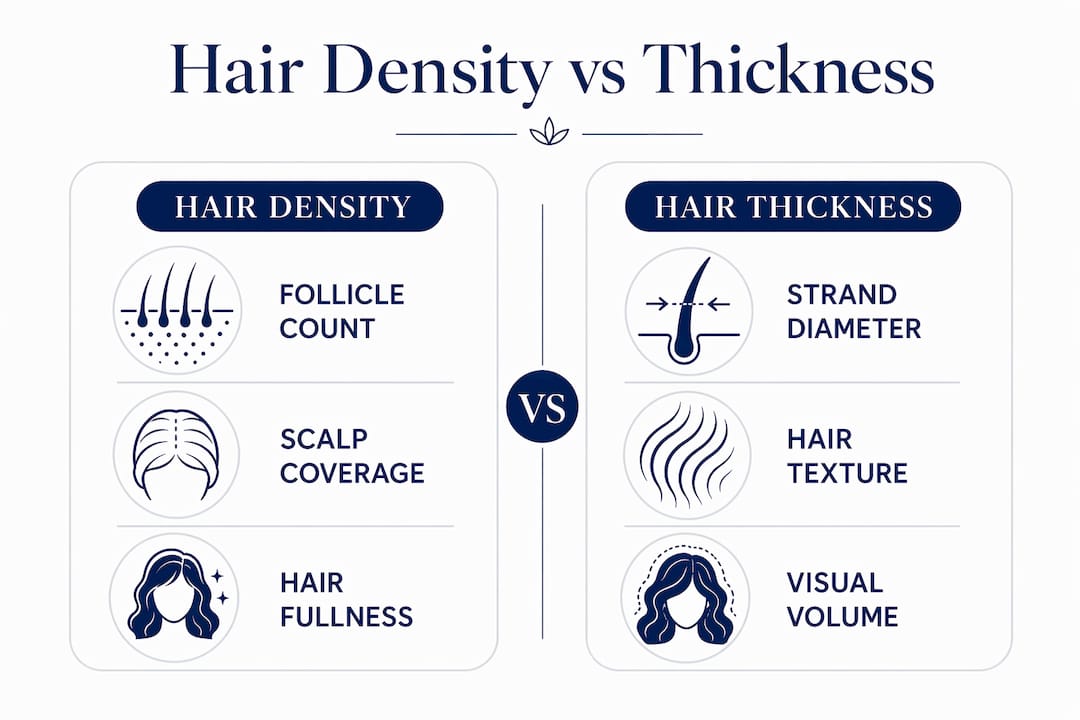
Here is the critical distinction for anyone watching for early hair loss: hair caliber drops before density decreases visibly in pattern hair loss. Miniaturization shrinks strand diameter before follicles stop producing terminal hairs altogether. That means thinning strands are an earlier warning sign than a visible reduction in follicle count.
| Feature | Hair density | Hair thickness |
|---|---|---|
| What it measures | Follicles per cm² of scalp | Strand diameter in microns |
| Normal range | 50–105 hairs/cm² depending on ethnicity | 17–181 microns; average 70–75 microns |
| Effect on appearance | Determines how many strands are present | Affects how substantial each strand looks |
| Changes first in hair loss | Decreases later in pattern loss | Decreases earlier (miniaturization) |
| How to assess at home | Ponytail circumference test | Strand feel; clinical trichoscopy for precision |
Pro Tip: Run a single strand between your fingers. If you can barely feel it, your caliber is likely fine. If it feels wiry or coarse, your caliber is high. Knowing both your density and your caliber helps you pick the right product weight every time.
What factors affect hair density?
Genetics set your starting point. Your follicle count is largely determined before you are born, and ethnicity plays a measurable role in the ranges you will naturally fall within. That said, genetics are not destiny. Several other factors push density up or down throughout your life.
Age is the most consistent factor. Follicle miniaturization accelerates after your mid-30s, particularly in people with a genetic predisposition to androgenetic alopecia. Hormonal shifts, including postpartum changes, menopause, and thyroid imbalances, can trigger sudden shedding that reduces apparent density quickly. These changes are often temporary, but they can become permanent without early attention.
Scalp health has a direct impact on how dense your hair appears. Chronic inflammation, seborrheic dermatitis, and product buildup all create conditions where follicles underperform. A clean, well-circulated scalp supports follicle function. Nutrition matters too. Deficiencies in iron, zinc, biotin, and protein are linked to reduced follicle output. Nutritional hair support is one of the most overlooked levers for maintaining density over time.
- Genetics: Sets your natural follicle count and density range
- Age: Miniaturization increases after the mid-30s, reducing visible density
- Hormones: Postpartum, thyroid, and menopause-related shifts trigger shedding
- Scalp health: Inflammation and buildup suppress follicle output
- Nutrition: Iron, zinc, biotin, and protein deficiencies reduce hair production
- Stress: Telogen effluvium (stress-triggered shedding) temporarily lowers density
Tracking your personal baseline matters more than comparing yourself to a population average. Genetics and ethnicity cause wide variation, so a number that signals concern for one person is completely normal for another. Your trend over time tells a more useful story than any single measurement.
Practical hair care tips by density type
Your density type should drive your product choices. Using the wrong weight of product for your density is one of the most common reasons hair looks flat, greasy, or over-dried, even when you are using quality ingredients.
Low density hair care
Low density hair needs lightweight products that do not weigh strands down. Volumizing shampoos and conditioners with a thin consistency work best. Apply conditioner from mid-length to ends only, never at the root. Dry shampoo used sparingly at the roots can add lift between washes. Avoid heavy creams, butters, and oils applied directly to the scalp, as they accelerate buildup and make fine hair look limp. For styling tips that maximize a fuller look, blow-drying with a round brush while lifting at the root adds visible volume without product weight.
- Choose a volumizing, sulfate-free shampoo
- Apply conditioner only from mid-shaft to ends
- Use a lightweight leave-in spray, not a cream
- Blow-dry upside down or with a diffuser for root lift
- Clarify your scalp every 2–3 weeks to prevent buildup
Medium density hair care
Medium density hair is the most forgiving. You can use a wider range of product weights without visible negative effects. Focus on maintaining scalp health and hydration balance. A weekly scalp massage with a lightweight oil supports circulation without overloading the follicles.
High density hair care
High density hair can handle heavier creams, deep conditioners, and richer oils without going flat. The main challenge is ensuring moisture reaches every strand. Section your hair during conditioning to coat it evenly. Detangling from ends to roots prevents breakage in thick, dense hair. Heavier styling creams and leave-in conditioners work well here because the volume of hair absorbs them without weighing the style down.
If you are concerned about thinning, regardless of your current density type, addressing it early gives you the best outcome. Density loss is far easier to slow than to reverse.
Key Takeaways
Hair density, defined as follicles per square centimeter, determines hair fullness and responds to genetics, age, hormones, scalp health, and nutrition, making personal baseline tracking the most reliable measure of hair health.
| Point | Details |
|---|---|
| Hair density definition | Density counts follicles per cm²; normal adult ranges vary by ethnicity from 50–105 hairs/cm². |
| Density vs. thickness | Thickness (caliber) drops before density in pattern loss, making strand fineness an earlier warning sign. |
| Home measurement | The ponytail test under 2 inches signals low density; track every six months under consistent conditions. |
| Key influencing factors | Genetics, age, hormones, scalp health, and nutrition all affect how many follicles actively produce hair. |
| Product matching | Low density needs lightweight formulas; high density benefits from richer creams and deep conditioners. |
What I have learned about density that most articles get wrong
Most people come to us at Crisanbeauty convinced their hair is thinning because it looks flat or limp. Nine times out of ten, the real culprit is not a drop in follicle count. It is a loss of strand caliber combined with the wrong products making it worse.
The biggest misconception I see is that people treat density as a fixed number they either have or do not have. Density is dynamic. It responds to what you feed your body, how you treat your scalp, and whether you catch early changes before they become permanent. The women in our community who maintain the healthiest hair are not the ones with the highest natural density. They are the ones who track their baseline consistently and adjust early.
The second thing I want to push back on: comparing yourself to a population average is almost useless. Your follicle count at 25 is your personal benchmark. That is the number to protect, not some chart range from a dermatology study.
Early miniaturization, where strands get finer before they disappear, is the window where plant-based Ayurvedic ingredients can do real work. Waiting until you see visible scalp through your hair means you have already lost significant ground. Start paying attention to strand texture now, not just volume.
— CRISAN
Crisanbeauty’s approach to low-density and thinning hair
If your ponytail test or photo tracking shows your density is dropping, the right product choice matters more than most people realize.
Crisanbeauty’s Ayurvedic Hair Growth Oil for Thinning Hair is formulated with lightweight botanical ingredients that support follicle health without weighing fine or low-density hair down. Every ingredient is plant-based, manufactured in the USA, and rooted in Ayurvedic tradition. The oil is designed to nourish the scalp environment where follicle miniaturization begins, giving your existing follicles the best conditions to stay active. For a broader look at options, the hair growth oil collection covers formulas suited to different density types and hair goals.
FAQ
What is hair density in simple terms?
Hair density is the number of hair follicles growing per square centimeter of your scalp. It determines how full or sparse your hair looks overall.
How do I know if I have low hair density?
Wrap your hair in a ponytail and measure the circumference. A measurement under 2 inches indicates low density; 2–3 inches is medium, and over 4 inches is high.
Is hair density the same as hair thickness?
No. Density counts how many follicles you have per square centimeter. Thickness measures the diameter of each individual strand in microns. Both affect how full your hair looks, but they change independently.
What are the early signs of low hair density?
Strands that feel finer than they used to, a wider part line, and a scalp that becomes more visible under bright light are all early signs. Strand caliber typically drops before follicle count visibly decreases.
Can you improve hair density naturally?
You can support the conditions that keep existing follicles active. Scalp health, nutrition, and lightweight botanical oils all play a role. Density loss caused by permanent follicle damage is harder to reverse, which is why early attention matters most.


