


Botanical oils for hair loss are plant-derived substances that can stimulate hair follicles, improve scalp health, and reduce breakage when selected and applied correctly. The term “botanical oil” covers both carrier oils, such as coconut, argan, and castor, and essential oils, such as rosemary and peppermint. These two categories work differently, and mixing them up is one of the most common reasons people see no results. The clinical case for plant-based oils is stronger than most people realize. Rosemary essential oil holds the strongest single human clinical trial backing among botanical ingredients for hair growth, and kukui nut oil has been confirmed in randomized, double-blind trials to activate follicle growth pathways directly.
What are the most effective botanical oils for hair loss?
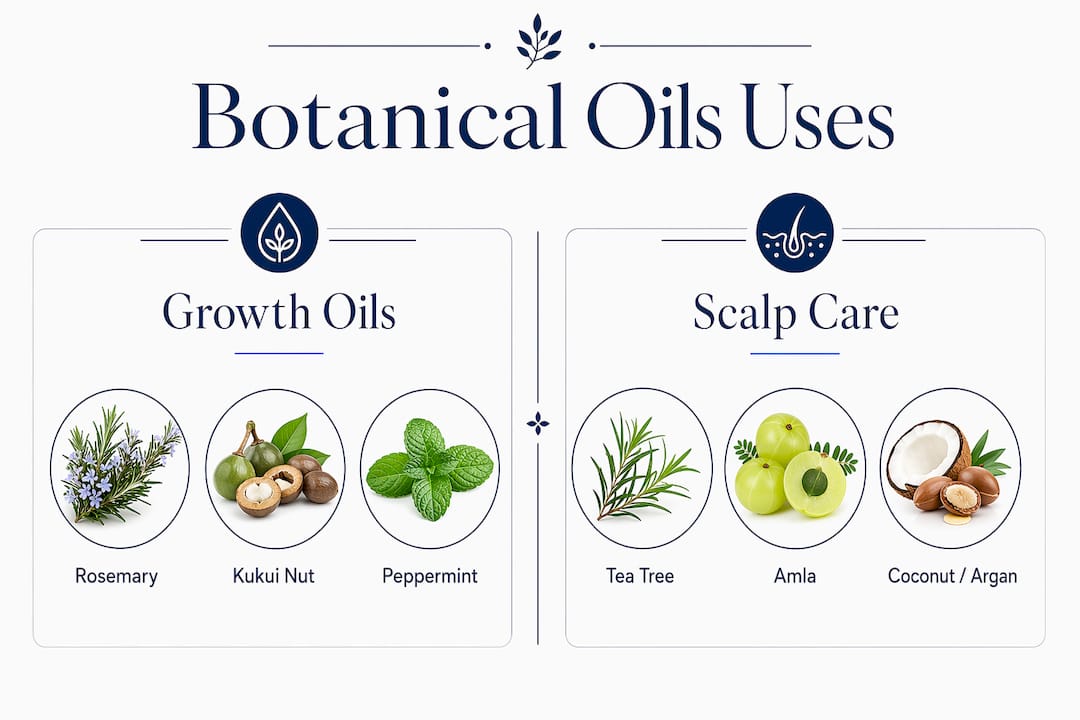
Not all plant oils do the same job. The clearest distinction is between oils that actively stimulate new follicle activity and oils that protect and strengthen existing hair.
Rosemary oil is the standout for regrowth. A six-month clinical trial found that rosemary oil matched 2% minoxidil in hair growth outcomes, with participants reporting less scalp itching than those using minoxidil. That result matters because it positions rosemary as a clinically credible option, not just a folk remedy.

Kukui nut oil works through a specific biological mechanism. Randomized double-blind trials confirmed that kukui nut oil activates the Nrf2/ARE-AKR1C family-PGF2α signaling axis, a pathway that directly triggers follicle growth. This is one of the few botanical oils with a documented molecular mechanism behind its effects.
Peppermint oil increases circulation to the scalp, which creates a better environment for follicle activity. It works best as a supporting ingredient alongside a primary growth oil like rosemary.
Tea tree oil does not directly stimulate regrowth. Clinical trials show its value lies in antimicrobial and anti-inflammatory effects that improve scalp conditions, which in turn support hair retention.
Amla oil, rooted in Ayurvedic tradition, functions as a long-term scalp wellness oil. It is a steady helper rather than an immediate growth accelerator, making it well suited for maintenance routines.
Coconut and argan oils belong in a different category entirely. These oils prevent protein loss and hydrate the scalp but do not regrow hair. They reduce breakage and improve shine, which makes thinning hair look and feel healthier.
| Oil | Primary function | Best use |
|---|---|---|
| Rosemary | Follicle stimulation | Scalp massage, pre-wash treatment |
| Kukui nut | Follicle pathway activation | Scalp serum, blended with carrier oil |
| Peppermint | Circulation boost | Added to carrier oil for scalp massage |
| Tea tree | Scalp condition management | Dandruff and inflammation control |
| Amla | Long-term scalp wellness | Regular scalp nourishment |
| Coconut | Protein loss prevention | Pre-wash soak, strand conditioning |
| Argan | Hydration and shine | Leave-in strand treatment |
Pro Tip: Separate your oils by goal. Use rosemary or kukui nut oil on your scalp for growth stimulation, and use coconut or argan on your strands for strength and shine. Mixing all oils together dilutes the effect of each.
How to safely apply botanical oils for hair loss treatment
Preparation is where most people go wrong. Undiluted essential oils cause contact dermatitis and should never be applied directly to the scalp. Every essential oil, including rosemary, peppermint, and tea tree, must be diluted in a carrier oil before use.
The standard dilution ratio is 2–3 drops of essential oil per tablespoon of carrier oil. Good carrier oils include jojoba, which closely mimics scalp sebum; sweet almond, which absorbs quickly; and castor oil, which adds thickness and is traditionally used to support hair density. For a complete hair oiling routine, follow these steps:
- Patch test first. Apply a small amount of your diluted blend to the inside of your wrist. Wait 24 hours. If you see redness, itching, or swelling, adjust the dilution or switch the carrier oil.
- Section your hair. Divide hair into four sections so you can apply oil directly to the scalp, not just the surface of your hair.
- Apply with fingertips. Use your fingertips to place small amounts of oil along each part. Do not pour oil onto your hair.
- Massage for 5–10 minutes. Use circular motions with light pressure. This increases blood flow to the follicles and helps the oil absorb.
- Leave on for at least 30 minutes. For deeper conditioning, leave the oil on overnight with a shower cap and wash it out in the morning.
- Wash thoroughly. Use a gentle, sulfate-free shampoo to remove oil buildup without stripping the scalp.
Aim for two to three applications per week. Daily use is not more effective and can lead to buildup.
Pro Tip: Use botanical oils as a pre-wash treatment rather than a leave-in product. Applying oil before shampooing protects strands from hygral fatigue (swelling caused by water absorption) and makes the oil easier to wash out without residue.
For people exploring hair restoration services alongside topical treatments, a consistent oiling routine can complement professional protocols by keeping the scalp environment healthy between sessions.
How do botanical oils compare to pharmaceutical hair loss treatments?
Botanical oils and pharmaceutical treatments like minoxidil work through different mechanisms, and the comparison is more nuanced than most people expect.
Rosemary oil’s clinical performance against 2% minoxidil is the most cited data point in this space. Both produced similar growth outcomes after 6 months, but rosemary users reported less scalp itching. That is a meaningful quality-of-life difference for people who struggle with minoxidil’s side effects.
The key limitation of botanical oils is their scope. They work best for hair loss driven by scalp inflammation, poor circulation, nutritional deficiency, or stress. For androgenetic alopecia (pattern baldness driven by DHT sensitivity), botanical oils can support the scalp environment but are not a replacement for treatments that address the hormonal root cause. People managing thinning hair treatments with a clinician should view botanical oils as a supportive layer, not a standalone solution.
Timeframe expectations are where most people lose patience. Visible results from botanical oils typically require at least 6 months of consistent use. Many people stop after 6–8 weeks, which is far too early to assess effectiveness. Pharmaceuticals often show results faster, but they also carry more side effects and require ongoing use to maintain gains.
Botanical oils offer real advantages in the areas of scalp health and hair strength. They reduce breakage, hydrate the scalp, and create a better environment for follicle activity. These benefits are cumulative, meaning the longer you use them correctly, the more noticeable the improvement.
Common mistakes when using botanical oils for hair loss
The most damaging mistake is applying undiluted essential oils directly to the scalp. This causes irritation, chemical burns, and can actually increase shedding by inflaming the follicles. Always dilute.
The second most common mistake is using too much oil. Excessive oil clogs follicles and irritates the scalp, which can worsen shedding and trigger dandruff. A few drops per section is enough. More oil does not mean faster results.
Other mistakes to avoid:
- Inconsistent routine. Applying oil once a week for a month, then stopping for two weeks, resets your progress. Consistency over months is what drives results.
- Skipping the patch test. Scalp sensitivity varies widely. What works for someone else may cause a reaction for you.
- Expecting pharmaceutical speed. Botanical oils work gradually. If you are not seeing results after 8 weeks, that is normal. Reassess at 6 months.
- Ignoring underlying causes. Hair loss from thyroid conditions, iron deficiency, or hormonal imbalance will not resolve with oils alone. If shedding is sudden or severe, consult a dermatologist.
Pro Tip: If you notice increased shedding, scalp redness, or persistent itching after starting an oil routine, stop use immediately and let your scalp recover for one week before reintroducing a more diluted blend. Irritation is a signal, not something to push through.
Successful hair loss management combines botanical oils with lifestyle factors. Diet, stress management, and sleep quality all affect the hair growth cycle. Oils are one part of a broader strategy, not the whole answer.
Key Takeaways
Botanical oils for hair loss work best when you match the right oil to the right goal, dilute properly, and commit to at least 6 months of consistent use.
| Point | Details |
|---|---|
| Rosemary leads for regrowth | Clinical trials show rosemary oil matches 2% minoxidil after 6 months with fewer side effects. |
| Kukui nut oil has a proven mechanism | Randomized trials confirmed it activates the Nrf2/ARE follicle growth pathway directly. |
| Dilution is non-negotiable | All essential oils must be diluted in a carrier oil to prevent contact dermatitis and scalp damage. |
| Oils support, not replace, medical treatment | For hormonal or genetic hair loss, botanical oils work best alongside professional care. |
| Consistency drives results | Visible improvement requires at least 6 months of regular use, not weeks. |
What I’ve learned from years of working with botanical oils
When I started Crisanbeauty after my own postpartum hair loss, I tried everything. I went through phases of applying too much oil, mixing too many ingredients, and expecting results in a few weeks. None of that worked.
What actually worked was simplifying. I picked two or three oils with clear evidence behind them, diluted them properly, and applied them consistently for months. The results were not dramatic overnight, but they were real and they lasted.
The piece of advice I give most often is this: separate your oils by function. Use a growth-stimulating oil like rosemary on your scalp, and use a conditioning oil like argan or coconut on your strands. People who blend everything together are usually disappointed because no single oil is doing its job well.
I also think the Ayurvedic approach to hair care gets this right in a way that Western routines often miss. Ayurvedic tradition treats hair health as a long-term practice, not a quick fix. Amla, brahmi, and similar herbs are used consistently over years, not weeks. That mindset shift is the most important thing you can bring to a botanical oil routine.
The honest truth is that botanical oils are not magic. They work within a system. Your diet, your stress levels, your sleep, and your scalp hygiene all affect whether those oils can do their job. When everything works together, the results are genuinely worth the patience.
— CRISAN
Crisanbeauty’s plant-based solutions for thinning hair
Crisanbeauty builds every product around the same principle this article covers: the right botanical ingredients, properly formulated, used consistently.
The Ayurvedic Hair Growth Oil brings together plant-based ingredients rooted in Ayurvedic tradition, formulated specifically for thinning hair and scalp health. For people who want to support their routine from the inside out, the hair growth vitamins deliver vegan daily nutrition to strengthen hair at the follicle level. The Scalp Detox Hair Mask rounds out a complete routine by clearing buildup and creating a clean scalp environment where oils can work effectively. All products are manufactured in the USA using carefully selected botanical ingredients.
FAQ
What is the best botanical oil for hair regrowth?
Rosemary essential oil has the strongest clinical evidence for hair regrowth, matching 2% minoxidil in a six-month trial. Kukui nut oil is a close second, with randomized trials confirming it activates follicle growth pathways directly.
How long does it take for botanical oils to work on hair loss?
Visible results typically require at least 6 months of consistent use. Most people stop too early, which is why they report no improvement.
Can you apply essential oils directly to your scalp?
No. Undiluted essential oils cause contact dermatitis and scalp irritation. Always dilute 2–3 drops of essential oil in one tablespoon of carrier oil before applying to the scalp.
Do botanical oils work for pattern baldness?
Botanical oils can improve the scalp environment and reduce breakage, but they do not address the hormonal root cause of androgenetic alopecia. They work best as a supportive treatment alongside professional care for pattern hair loss.
How often should you oil your scalp for hair loss?
Two to three times per week is the recommended frequency. Daily application can cause follicle-clogging buildup and increase scalp irritation rather than improving results.


