


For barrier repair and non-reactive, scent-free moisturizing, cosmetic-grade mineral oil is a solid pick, particularly for sensitive or acne-prone skin. For nutrient-rich hair strengthening, specific plant oils win, with coconut oil standing out for its ability to reduce protein loss. Choose based on your goal, not on which category sounds more natural.
TL;DR:
- Mineral oil provides a stable, odorless occlusive layer that is ideal for sensitive or reactive skin, but it does not penetrate or strengthen hair strands.
- Coconut oil has demonstrated the ability to reduce hair protein loss, making it effective for nourishing and repairing damaged hair.
- Mineral oil is highly refined from petroleum and considered safe for topical use, but unrefined industrial-grade oils may contain harmful contaminants.
- Natural plant oils vary considerably in behavior, nutritional content, and sustainability, with some requiring refrigeration to prevent rancidity and others offering specific skin and hair benefits.
- Long-term use of mineral oil is generally safe and stable, whereas prolonged application of certain plant oils can impact barrier function depending on their fatty acid composition.
Table of Contents
- Mineral Oil vs Natural Oil: Quick Comparison
- What Are Mineral Oil and Natural Oil Made Of?
- Does Mineral Oil or Natural Oil Work Better on Skin and Hair?
- Is Mineral Oil Safe to Use? What the Label Should Tell You
- Which Oil Is Better for the Planet: Mineral or Natural?
- How Do You Choose Between Mineral Oil and Natural Oil?
- Mineral Oil vs Natural Esters in Industrial Fluids
- What Happens to Skin and Hair With Long-Term Use of Each Oil?
- Shelf Life and Storage: A Practical Difference Most People Miss
- Which Oil Costs Less: Mineral or Plant-Based?
- Are You More Likely to React to Mineral Oil or a Natural Oil?
- Why CRISAN Builds Around Plant Oils, Not Mineral Oil
- A Plant-Based Alternative for Your Hair and Skin Routine
- Sources
Mineral Oil vs Natural Oil: Quick Comparison
Mineral oil comes from refined petroleum. Natural oils come from plants, extracted from seeds, nuts, or fruit and made mostly of triglycerides. That single difference in origin explains almost everything else about how these two oil categories behave on skin and hair.
Mineral oil sits on top of skin and hair, forming a physical barrier that slows moisture loss, a key benefit explained in detail by face oil care experts. It does not absorb into deeper layers. Plant oils vary widely: some, like coconut oil, penetrate the hair shaft; others, like sunflower or argan oil, mostly condition the surface while delivering vitamin E and fatty acids.
Here is the quick breakdown:
- Best for sensitive, non-reactive occlusion: cosmetic-grade mineral oil (odorless, low comedogenicity, very stable)
- Best for hair protein protection: coconut oil (the only common oil shown in controlled studies to reduce protein loss)
- Best for antioxidant-rich body or face nourishment: plant oils like argan, jojoba, or rosehip
- Most buildup-prone on fine or low-porosity hair: heavier mineral oil layers left on without proper washing
- Most shelf-stable, cheapest option: mineral oil, which does not oxidize or turn rancid
- Most variable in scent, texture, and sustainability: natural oils, which differ oil to oil
Neither category is universally “better.” They solve different problems, and the smartest routines usually use both with intention rather than picking a side out of loyalty to a label.
What Are Mineral Oil and Natural Oil Made Of?
Cosmetic-grade mineral oil is a highly refined, colorless, odorless liquid derived from petroleum. On ingredient labels it often appears as “paraffinum liquidum,” “white mineral oil,” or simply “mineral oil, USP.” The refining process strips out the impurities found in industrial-grade petroleum products, leaving a chemically inert liquid that does not react with skin proteins or oxidize over time.
Natural plant oils are triglycerides: three fatty acid chains attached to a glycerol backbone. The specific fatty acids in that structure determine how an oil behaves. Short, unsaturated chains with smaller molecular size, like the lauric acid in coconut oil, can slip between the proteins of the hair shaft. Longer or more saturated chains, like those in many mineral oil alternatives such as sunflower or sweet almond oil, tend to stay on the surface instead of absorbing in.
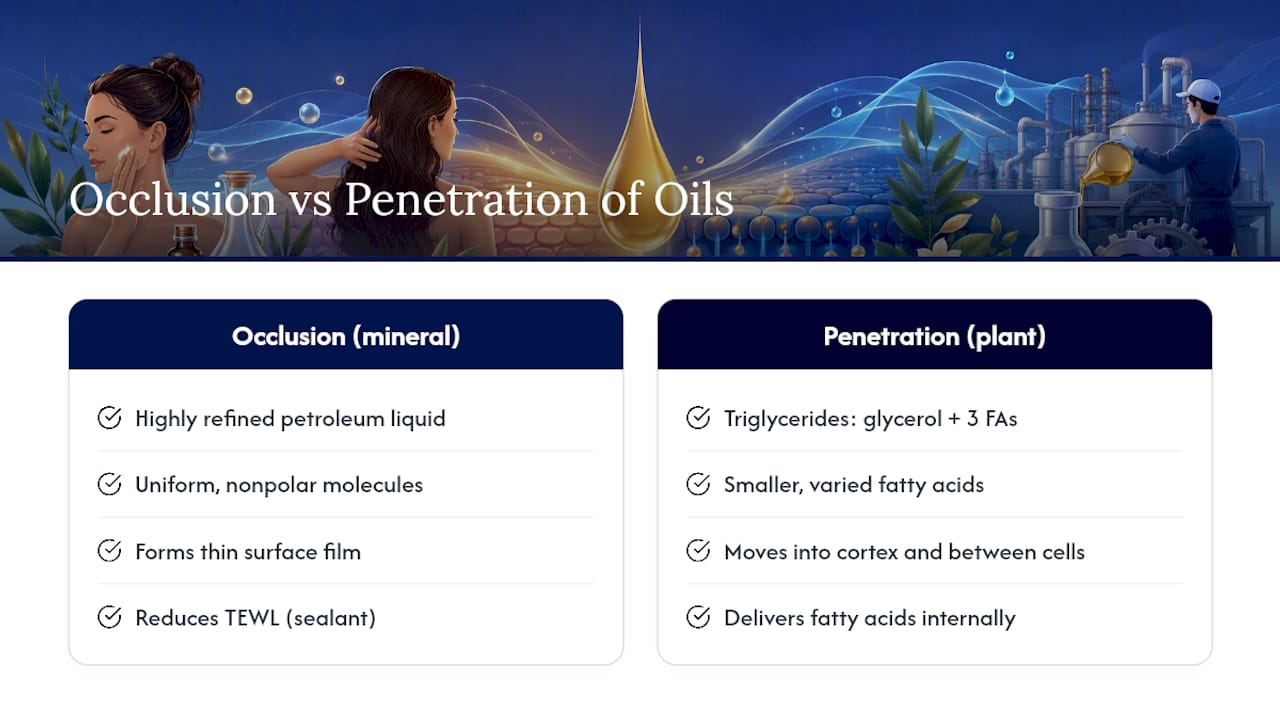
That mechanical difference is the whole story behind occlusion versus penetration. Occlusion means forming a thin film on the surface that slows transepidermal water loss (TEWL), the rate at which moisture evaporates from skin. Mineral oil is exceptionally good at this because its molecules are uniform and nonpolar, so they spread evenly and resist breaking down. Penetration means an oil’s molecules are small and structured enough to move into the hair cortex or between skin cells, delivering fatty acids where they can do more than sit on top.
This is also where the ingredient story gets more specific than most comparisons bother to go. A breakdown of common hair oil ingredients shows why formulators rarely rely on a single oil. Combining a penetrating oil with a lighter sealant can protect the hair shaft internally while still adding shine, without loading the hair down the way a heavy mineral oil layer can.
One more term worth knowing if you’ve seen “natural esters” mentioned in unrelated contexts: outside cosmetics, plant-derived esters are used as industrial fluids, most notably in electrical transformers. The chemistry is different from what is in your moisturizer, but the underlying idea, plant-based triglycerides replacing petroleum products, is the same pattern showing up in a completely different industry.
Does Mineral Oil or Natural Oil Work Better on Skin and Hair?
The research here is more specific than most beauty articles let on, and the findings cut against a common assumption that “natural” automatically means “more effective.”
A PubMed-indexed controlled study tested mineral oil, sunflower oil, and coconut oil for their effect on hair protein loss when applied before or after washing. Coconut oil reduced protein loss. Mineral oil and sunflower oil did not. That is not a marketing claim, it is a measured outcome, and it means coconut oil’s benefit is specific to its molecular structure, not to being “natural” in a general sense.
On the skin side, a 2012 review of mineral oil and the skin barrier found that cosmetic-grade mineral oil reduces TEWL and improves stratum corneum hydration in comparison testing, often outperforming many vegetable oils on pure occlusive function. Mineral oil’s reliability here is precisely why pediatric and sensitive-skin formulas have leaned on it for generations: it does almost nothing chemically, which is the point.
So why does mineral oil add shine and softness to hair without actually strengthening it? Because it coats the shaft rather than entering it. That surface lubrication reduces friction between strands, which cuts down on visible frizz and split-end snagging, but it does nothing to reinforce the internal protein structure that gives hair its strength. If your goal is genuinely reducing breakage, not just smoothing the look of it, you need an oil that gets inside the strand.
Comedogenicity, or how likely an oil is to clog pores, follows its own logic that does not map neatly onto “natural versus synthetic.” Cosmetic-grade mineral oil generally carries a low comedogenic rating and is used in sensitive-skin products precisely because it doesn’t react or trigger breakouts. Plant oils vary considerably. Coconut oil sits higher on the comedogenic scale for many people, while oils like argan or jojoba tend to run lower, and individual skin chemistry still plays a role no chart can fully predict. If you’re managing acne-prone skin, checking which oils are considered non-comedogenic before switching products saves a lot of trial and error.
Here is how that translates into routine choices:
- Damp-skin application: occlusives like mineral oil work best sealed over slightly damp skin, trapping existing moisture rather than just sitting on dry surface cells.
- Pre-wash hair oiling: penetrating oils like coconut oil do more good applied before shampooing, since they can work into the shaft while hair is intact and undamaged by heat or manipulation.
- Leave-on lubrication: lighter oils applied post-wash on damp or dry hair mainly manage frizz and shine, not structural repair.
- Removal matters: mineral oil’s staying power is a strength for barrier repair and a liability for hair, since it needs a proper clarifying wash to avoid buildup on strands or scalp.
Pro Tip: If you use a heavier oil for scalp massage or pre-wash treatment, work a small amount through mid-lengths only after checking your roots aren’t already oily. Buildup usually starts at the scalp, not the ends, and a single clarifying wash a week is often enough to reset it.
Is Mineral Oil Safe to Use? What the Label Should Tell You
Cosmetic-grade mineral oil is not the same substance that raised cancer concerns decades ago, and the distinction comes down entirely to refinement. Unrefined or lightly refined industrial mineral oils can contain polycyclic aromatic hydrocarbons (PAHs), compounds linked to carcinogenicity. Cosmetic and pharmaceutical-grade mineral oil goes through extensive purification specifically to remove those contaminants, and consumer health resources confirm that the highly refined version used in skincare is considered safe for topical use.
That said, “safe on skin” is not the same as “safe in every application,” and a few practical cautions matter:
Oral use of mineral oil, most commonly as a laxative, carries a real aspiration risk if it is inhaled into the lungs rather than swallowed properly, and clinical safety summaries note that repeated oral use can interfere with absorption of fat-soluble vitamins. Mineral oil should never be put directly in the ear canal without a clinician’s guidance, since it can mask underlying infection or cause complications in a perforated eardrum. For infants, topical mineral oil is generally considered low-risk when it is cosmetic grade, but any oral or ear use in a baby should go through a pediatrician first, not a home remedy.
When you’re checking a label, look for wording like “white mineral oil,” “paraffinum liquidum,” or a “USP” designation, which signals pharmaceutical-grade purification. If a product doesn’t specify grade or purity, or it’s positioned for industrial rather than cosmetic use, that’s a reason to ask questions rather than assume it’s the same as what’s in your lotion.
Which Oil Is Better for the Planet: Mineral or Natural?
Mineral oil comes from petroleum, a nonrenewable resource, and its biodegradability is limited compared to plant-based alternatives. That’s a straightforward trade-off: reliable, cheap, and stable, but tied to an extraction industry with its own well-documented environmental costs.
Natural oils are renewable in principle, but “plant-based” doesn’t automatically mean sustainable. Palm and coconut oil sourcing carry their own deforestation and labor concerns depending on where and how they’re farmed, and processing methods (cold-pressed versus solvent-extracted) change both the environmental footprint and the final product’s quality. Certifications and transparent sourcing matter more than the word “natural” on a label.
Industrial applications add an interesting wrinkle: natural esters used as insulating fluids in transformers tend to offer better spill safety and biodegradability than mineral transformer oils, a genuine environmental advantage in that specific context, as technical literature on insulating fluids lays out. If you’re a shopper rather than an engineer, the practical takeaway is simpler: look for brands that disclose sourcing, seek third-party certifications where available, and don’t assume packaging claims equal supply-chain reality.
How Do You Choose Between Mineral Oil and Natural Oil?
Three quick questions get you most of the way to the right answer:
- Is your goal sealing in moisture, or feeding the skin or hair something new? Sealing favors mineral oil or a light plant occlusive. Feeding favors a penetrating oil chosen for its specific fatty acid profile.
- Is your skin reactive, acne-prone, or very sensitive? If yes, cosmetic-grade mineral oil’s low comedogenicity and chemical inertness make it a safer starting point than experimenting across several plant oils.
- Are you treating hair damage or just managing frizz? Damage repair calls for a proven penetrating oil like coconut oil. Frizz management can be handled with almost any light oil, natural or mineral.
For barrier repair, apply a small amount to slightly damp skin right after cleansing, while pores are still open and surface moisture is present to trap. A little goes further than most people expect. Using too much mineral oil at once is the most common reason people report a greasy, “sitting on skin” feel rather than absorption they can’t feel at all.
For hair, the timing question matters more than most routines account for. Applying a penetrating oil like coconut oil before washing gives it time to work into the shaft while hair is undisturbed; using it as a post-wash leave-on mostly adds surface shine instead. If you’re unsure which fits your hair type or texture, a wet-versus-dry application guide breaks down the difference by hair type in more detail than a blanket rule ever could.
Always patch-test a new oil, natural or mineral, on the inner forearm for 24 to 48 hours before applying it to your face or scalp, especially if you have a history of sensitive skin or contact dermatitis. Once you’ve settled on a routine, using it two to three times a week is typically enough for most hair types to see a benefit without tipping into buildup, though low-porosity hair often needs a lighter hand than other textures.
Pro Tip: Check whether a plant oil is labeled “cold-pressed” or “refined.” Cold-pressed oils retain more of their natural nutrients and scent but oxidize faster; refined oils last longer on the shelf but lose some of the antioxidant content that made you choose a plant oil in the first place.
Mineral Oil vs Natural Esters in Industrial Fluids
If you’ve run across mineral oil versus natural oil in a completely different context, comparisons of insulating fluids in electrical transformers, the underlying logic is oddly similar to the skincare version, just with higher stakes.
Mineral transformer oils have been the industry default for decades because they’re cheap, well understood, and compatible with existing equipment. Natural esters, derived from vegetable oils, are increasingly used as alternatives because they typically have higher fire points and better biodegradability, which matters enormously in a spill or fire scenario involving high-voltage equipment.
The trade-offs are real on both sides. Natural esters often cost more and require compatibility testing with existing gaskets, seals, and insulation materials before a switch is made. Moisture tolerance also differs between the two fluid types, which affects long-term equipment maintenance schedules. Utilities and manufacturers weigh fire safety, environmental regulation, and total cost of ownership when choosing, not just the sticker price of the fluid itself.
For most readers, the practical takeaway is simple: this is a case where “natural” has a genuine, measurable safety advantage in a specialized application, but the decision involves engineering constraints that have nothing to do with the skincare and hair questions most people are actually asking. Don’t let a fire-safety data point about transformers change your mind about a facial moisturizer. They’re not the same conversation, even though they share a name.
What Happens to Skin and Hair With Long-Term Use of Each Oil?
Daily mineral oil use over months or years is generally well tolerated because the oil doesn’t chemically interact with skin. It doesn’t oxidize into irritating byproducts the way some unstable plant oils can if stored poorly. The main long-term risk isn’t damage, it’s dependence on external occlusion without addressing why skin needs it in the first place, such as an underlying barrier issue or dehydration that a humectant ingredient would treat more directly.
Long-term plant oil use behaves differently depending on the oil. Oils rich in linoleic acid, like rapeseed or sunflower, tend to support the skin’s own barrier lipids over time. Oils higher in oleic acid, like olive oil, can be more disruptive to barrier function with heavy, continuous use on already-compromised skin. For hair, sustained use of a penetrating oil like coconut oil appears cumulative in a good way: each wash cycle that includes a pre-wash treatment continues protecting the shaft from the protein loss that repeated washing and heat styling otherwise cause.
The real long-term consideration for both oil types is less about damage and more about diminishing returns from overuse. Piling on more oil doesn’t equal more benefit past a certain point for either category, and heavier layering, especially with mineral oil, is more likely to trap dirt, sweat, and product residue against the skin or scalp over time than to deliver additional hydration.
Shelf Life and Storage: A Practical Difference Most People Miss
Mineral oil’s chemical stability is one of its most underrated advantages, and it’s rarely mentioned outside safety data sheets. Because it doesn’t contain the double bonds that make plant oils vulnerable to oxidation, mineral oil can sit on a shelf for years without turning rancid, changing smell, or losing its texture. That’s a meaningful practical benefit if you’re buying in bulk or don’t use a product daily.
Plant oils are a different story, and treating every “natural oil” as shelf-stable is one of the more common mistakes people make. Oils high in polyunsaturated fatty acids, like flaxseed or grapeseed, go rancid faster and often need refrigeration or dark, airtight packaging to last more than a few months once opened. More stable plant oils, like coconut or jojoba, hold up considerably longer at room temperature, but even those benefit from being kept away from direct light and heat.

Rancid oil isn’t just less effective, it can actively irritate skin with the byproducts of oxidation, so a plant oil that smells “off” compared to when you bought it should be replaced rather than used up. If sustainable use matters to you, buying plant oils in smaller quantities you’ll actually finish within a few months usually beats stockpiling a large bottle that degrades before you’re halfway through it.
Which Oil Costs Less: Mineral or Plant-Based?
Mineral oil is almost always the cheapest option on the shelf, and its price stays remarkably consistent because petroleum refining at that grade is a mature, high-volume industry with predictable supply chains. That affordability is part of why it shows up in so many drugstore lotions and baby care products.
Natural oils span a much wider price range. Common oils like sunflower or coconut oil stay relatively affordable because they’re produced at scale for both food and cosmetic industries. Specialty oils like argan, marula, or rosehip cost significantly more, driven by lower yields per plant, more labor-intensive extraction, and smaller supply chains, particularly for cold-pressed or organic-certified versions.
Accessibility follows a similar pattern. Mineral oil is available in essentially every pharmacy and grocery store without exception. Mainstream plant oils like coconut and olive oil are just as easy to find, but more specialized botanical oils sometimes require a specialty retailer or online order, which adds a small convenience cost on top of the product price itself. If budget is the deciding factor and your goal is basic occlusion, mineral oil is hard to beat on pure economics. If you’re chasing a specific nutritive benefit that only a particular plant oil delivers, the added cost is often the price of that specific fatty acid profile, not just marketing markup.
Are You More Likely to React to Mineral Oil or a Natural Oil?
This is where a lot of assumptions run backward. Cosmetic-grade mineral oil is one of the least allergenic substances used in skincare, precisely because it’s chemically inert and doesn’t contain the plant proteins or aromatic compounds that trigger most allergic reactions. True mineral oil allergies are rare.
Natural oils carry meaningfully higher allergy and sensitivity risk, simply because they’re complex biological substances with dozens of compounds beyond the primary fatty acids, including proteins, terpenes, and trace nut or seed residues. Someone with a tree nut allergy needs to be cautious with oils like almond or walnut oil, even though the refining process removes most allergenic protein for many people. Essential oil additives blended into “natural” formulations are a far more common irritation source than the base plant oil itself.
That doesn’t make natural oils dangerous, most people use them without any reaction at all, but it does mean the “natural equals gentler” assumption doesn’t hold up under scrutiny. If you have known allergies, patch-testing matters more with plant oils than with mineral oil, and reading full ingredient lists (not just the headline oil) is worth the extra minute.
Why CRISAN Builds Around Plant Oils, Not Mineral Oil
CRISAN started from a personal problem: postpartum hair loss that generic solutions weren’t solving. That experience shaped a formulation philosophy rooted in Ayurvedic tradition, where specific plant oils are chosen for what they actually do to the hair shaft and scalp, not just how they feel going on.
Mineral oil’s low reactivity has real merit, and this article doesn’t pretend otherwise. But for hair strengthening specifically, the evidence points toward penetrating plant oils, particularly coconut oil, doing something mineral oil simply cannot: getting inside the strand to reduce protein loss. That is the standard CRISAN formulates against: nutrient density, lightweight textures that resist buildup on the scalp, and ingredients sourced with enough transparency that a customer can ask what’s in the bottle and get a straight answer.
Every ingredient choice starts from the same question: does this oil do something measurable, or is it there to sound good on a label? That distinction guides formulation more than any trend does.
— CRISAN
A Plant-Based Alternative for Your Hair and Skin Routine
If mineral oil’s occlusive strength isn’t what you’re after, and you want an oil that actually nourishes rather than just seals, a plant-based lineup can be built around exactly that gap. Where mineral oil sits on the surface, these formulas are designed around fatty acid profiles that support strand and skin health directly.

For thinning or weakened hair, the Ayurvedic hair growth oil combines botanical oils selected for scalp nourishment without the heavy buildup that comes from over-relying on mineral oil layers. If you’re managing daily facial dryness or looking for a lighter routine overall, the complete facial care set pairs botanical oils with hydration-focused actives suited to skin that reacts poorly to heavier occlusives.
- Thinning hair or postpartum shedding: the Ayurvedic growth oil targets scalp nourishment, not just surface shine.
- Daily facial hydration without heaviness: the facial care set uses lighter, plant-derived textures.
- Full-body dryness or rough texture: pairing a body scrub and facial oil set addresses both exfoliation and oil replenishment in one routine.
Explore the full range at Crisanbeauty and pick the formula that matches what your hair or skin is actually asking for, not just what’s cheapest on the shelf.
Sources
- Effect of mineral oil, sunflower oil, and coconut oil on prevention of hair damage
- Mineral oil and skin barrier: review and perspective (PubMed entry)
- Mineral oil: Cancer risk, benefits, and how to use
- Chapter: Mineral and vegetable oils in hair care and technical fluids (book chapter DOI)


