


Estrogen helps keep scalp hair in the active growth phase and influences hair caliber by acting on follicular estrogen receptors and local aromatase activity. This is not a simple on/off switch. The role of estrogen in hair growth depends on receptor subtype, local enzyme expression, and where you are in your hormonal life stage. Research published in PubMed Central and the International Journal of Molecular Sciences confirms the hair follicle is an estrogen-sensitive tissue, and Crisanbeauty draws on that science to help you understand what is actually happening at the scalp level.
Here is what matters most right now:
- Estrogen prolongs anagen (the active growth phase), which is why hair often looks its thickest during pregnancy.
- Postpartum estrogen drop triggers a wave of shedding that typically peaks 2–4 months after delivery and usually resolves within 6–12 months.
- Perimenopause often comes first. Many people notice hair texture and caliber changes years before their last period, not at menopause itself.
- See a clinician if shedding is rapid, patchy, or accompanied by scalp scarring, virilization, or other systemic symptoms.
Table of Contents
- How does the hair growth cycle control hair density?
- How does estrogen act directly on the hair follicle?
- How estrogen changes across your life stages
- What clinical hair loss patterns are linked to estrogen changes?
- What tests and specialists should you consider?
- What treatments does the evidence support?
- Practical self-care that supports hormone-related hair health
- What does the research actually say, and where does it conflict?
- How estrogen modulates growth factors and cytokines in the hair cycle
- How do estrone and estriol compare to 17β-estradiol for hair?
- How do synthetic estrogens and endocrine disruptors affect hair health?
- Key Takeaways
- What Crisanbeauty believes about estrogen and hair health
- Authoritative references and further reading
How does the hair growth cycle control hair density?
Every strand on your scalp is cycling independently through three phases, and the proportion of follicles in each phase at any given moment determines how much hair you see and how much you shed.
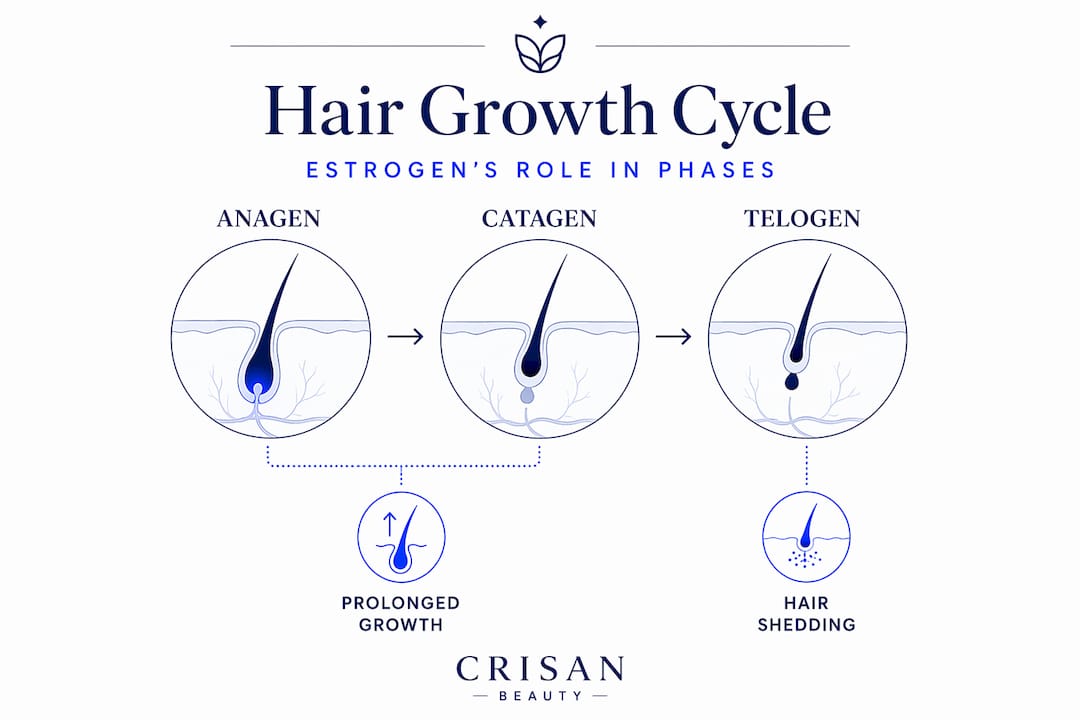
Anagen is the active growth phase, lasting roughly 2–7 years on the scalp. The longer a follicle stays in anagen, the longer and denser the hair. Catagen is a brief transitional phase, lasting about 2–3 weeks, during which the follicle shrinks and detaches from its blood supply. Telogen is the resting phase, lasting around 3 months, after which the old hair sheds and a new anagen cycle begins.
The dermal papilla sits at the base of the follicle and signals the matrix cells above it to proliferate. The bulge region, partway up the follicle, houses stem cells that re-enter the cycle at each new anagen. When hormonal or nutritional signals disrupt this timing, you get either telogen prolongation (more hairs resting and shedding) or anagen shortening (hairs that never reach their full length).
Statistic callout: On a healthy scalp, most follicles are in the anagen phase at any given time. When that proportion drops notably, visible thinning follows.
Pro Tip: If you are seeing diffuse shedding across the whole scalp with no bald patches, that pattern points to telogen prolongation, often triggered by a hormonal shift, nutritional gap, or physical stress two to three months earlier. Patchy loss or a receding frontal line suggests a different mechanism and warrants a dermatology referral.
How does estrogen act directly on the hair follicle?
The follicle does not just respond to circulating estrogen levels. It has its own local hormone-processing machinery, and that local environment often matters more than what a blood test shows.
The principal mechanisms include:
- Estrogen receptor signaling. Follicle cells express both ERα and ERβ, with ERβ appearing to be the dominant subtype in human scalp tissue. The G-protein coupled estrogen receptor (GPER) adds a third signaling pathway that can produce rapid, non-genomic effects.
- Local aromatase activity. Aromatase converts androgens (including testosterone) into estrogens directly within the follicle. High local aromatase expression in the scalp partially explains why some people maintain good hair density even when serum estradiol is low.
- Androgen metabolism modulation. Estrogen competes with androgens for local enzyme activity, effectively reducing the amount of dihydrotestosterone (DHT) available to miniaturize follicles. You can read more about DHT’s role in hair loss in Crisanbeauty’s dedicated guide.
- Wnt/β-catenin pathway. Estrogen supports this key anagen-promoting signaling cascade, which drives matrix cell proliferation and keeps follicles in the growth phase.
- IGF-1 and vascular support. Estrogen upregulates IGF-1 expression in dermal papilla cells, which in turn promotes follicle cell proliferation and boosts VEGF, improving microcirculation and nutrient delivery to actively growing follicles.
There is a long-standing controversy in the literature about whether 17β-estradiol stimulates or inhibits hair growth. Animal and organ-culture studies show variable results depending on dose, receptor expression, and experimental conditions, and they frequently contradict human clinical observations. The practical takeaway: prioritize human clinical data when making treatment decisions, and treat animal-model findings as hypothesis-generating rather than conclusive.
Statistic callout: Two people with identical serum estradiol levels can have very different scalp responses because local aromatase expression and receptor sensitivity vary between individuals, as documented in PMC review data.
Pro Tip: If your blood estrogen looks “normal” but your hair is still thinning, local scalp biology may be the issue. A dermatologist can assess follicle miniaturization patterns that a hormone panel alone will not reveal.
How estrogen changes across your life stages
Estrogen’s effects on hair are not static. They shift with every major hormonal transition, and knowing the typical timeline helps you interpret what your hair is doing right now.
Puberty brings rising estradiol, which generally supports the anagen phase and contributes to the fuller hair many people experience in their teens and twenties. The hormonal environment is relatively favorable for scalp hair at this stage.
Pregnancy is when estrogen’s anagen-prolonging effect is most visible. During pregnancy, the anagen-to-telogen ratio shifts so that fewer hairs enter the resting phase, hair diameter increases, and shedding slows noticeably. Many people describe their hair as the thickest it has ever been during the second and third trimesters.
Postpartum is the correction. Estrogen drops sharply after delivery, and the follicles that were held in anagen during pregnancy all enter telogen at roughly the same time. The result is telogen effluvium, a diffuse shedding wave that typically peaks 2–4 months after delivery and resolves within 6–12 months for most people. Prolactin, which rises during breastfeeding, adds another layer of complexity by influencing telogen timing independently of estrogen.
Perimenopause is often when the first subtle changes appear, sometimes years before the final menstrual period. Hair caliber decreases, texture shifts, and density begins to drop. Declining estrogen during this transition is associated with reduced hair density, reduced caliber, and changes in follicular metabolic and vascular function. Progesterone also falls during perimenopause, which matters because progesterone at the follicle level can decrease the conversion of testosterone into DHT.
Menopause compounds the picture. Estrogen levels fall further, but serum androgens may not rise. Instead, sex hormone-binding globulin (SHBG) falls, which increases the free androgen index and exposes follicles to more biologically active testosterone and DHT. The result is female-pattern hair loss that can look androgen-driven even when total androgen levels appear normal on a standard panel.
What clinical hair loss patterns are linked to estrogen changes?
Understanding which pattern you are dealing with shapes both the diagnosis and the treatment path.
Telogen effluvium (TE) presents as diffuse shedding across the whole scalp, usually triggered by a hormonal event (postpartum, stopping oral contraceptives, rapid weight loss) two to three months before the shedding peaks. It is typically self-limiting when the trigger resolves. The evidence linking TE to estrogen change is strong and well-documented in human clinical literature.
Female-pattern hair loss (FPHL) follows a different distribution, with thinning concentrated at the crown and frontal scalp while the hairline is often preserved. It tends to be progressive rather than episodic. Postmenopausal androgen/estrogen imbalance is a well-established contributor, though FPHL is multifactorial and not purely hormonal. Human clinical trial evidence for hormonal treatments in FPHL exists but remains limited in scale.
Scarring alopecias (such as lichen planopilaris or frontal fibrosing alopecia) involve permanent follicle destruction and present with scalp inflammation, scaling, or a receding hairline with a distinct border. These are not primarily estrogen-driven, but they can co-occur with hormonal changes and require urgent dermatology referral. If you notice scalp redness, pain, or a hairline that is receding with a sharp edge, do not wait.
Statistic callout: FPHL affects an estimated 50% of women over their lifetime, making it the most common form of hair loss in women, with prevalence rising significantly after menopause.
What tests and specialists should you consider?
A targeted diagnostic workup saves time and avoids unnecessary treatment. The goal is to rule out correctable causes before attributing hair loss purely to hormonal aging.
Recommended initial labs:
- Complete blood count (CBC) and ferritin. Iron deficiency is one of the most common and most treatable causes of diffuse hair shedding. Ferritin below 30 ng/mL is frequently cited as a threshold associated with hair loss, even when hemoglobin is normal.
- TSH and free T4. Both hypothyroidism and hyperthyroidism can cause diffuse shedding that mimics hormonal hair loss.
- Sex hormone panel. Total and free testosterone, DHEA-S, and SHBG help identify androgen excess or the elevated free androgen index seen in postmenopausal FPHL.
- Estradiol and FSH. Useful for confirming perimenopausal or menopausal status and contextualizing the hormonal picture.
- Basic metabolic panel. Screens for systemic issues (kidney, liver, glucose regulation) that can affect hair indirectly.
When to refer:
- Dermatology: any scarring pattern, patchy loss, or FPHL that is not responding to first-line measures after 6 months.
- Endocrinology: rapid virilization (deepening voice, clitoral enlargement, rapid androgen-driven hair loss), suspected PCOS, or complex thyroid/adrenal findings.
Typical observation windows before changing a treatment plan run 3–6 months, because the hair cycle itself takes that long to reflect any intervention. Understanding what triggers hormonal hair loss can help you frame these conversations with your clinician.
Pro Tip: Document your hair loss with standardized photos (overhead, frontal, and temporal views in consistent lighting) before your first appointment. The Sinclair or Ludwig scale gives clinicians a baseline to measure against. Good photos also support insurance pre-authorization for treatments like PRP or LLLT.
What treatments does the evidence support?
The table below summarizes the main options discussed in the clinical literature. Evidence strength reflects the quality and volume of human data available.
| Treatment | Efficacy summary | Typical timeline to response | Key risks / contraindications | Evidence strength |
|---|---|---|---|---|
| Topical minoxidil (2–5%) | Prolongs anagen, increases follicle size; first-line for FPHL | 3–6 months for initial response; 12 months for full effect | Scalp irritation, initial shedding; avoid in pregnancy | Strong (multiple RCTs) |
| HRT (systemic estradiol) | Variable outcomes; some improvement in hair density and caliber reported | 3–6 months for measurable change | Thromboembolism, breast cancer risk; requires physician oversight | Moderate (small trials, observational) |
| Topical estradiol + minoxidil | Pilot RCT data show improved frontal hairline and plucking strength vs. minoxidil alone | 3–6 months | Local absorption; not for use in pregnancy or breastfeeding | Limited (single pilot RCT) |
| Spironolactone (anti-androgen) | Reduces free androgen activity at the follicle; useful in FPHL with androgen component | 6–12 months | Teratogenic; requires contraception in women of childbearing age; electrolyte monitoring | Moderate |
| Oral contraceptives | Low-androgen formulations can reduce androgenic hair loss; high-androgen progestins can worsen it | 3–6 months | Thromboembolism risk; not suitable for all patients | Moderate |
| PRP (platelet-rich plasma) | Growth factor delivery to dermal papilla; improvements in density reported | 3–6 months (series of sessions) | Injection discomfort; variable protocols | Limited to moderate |
| LLLT (low-level laser therapy) | Photobiomodulation supports follicle metabolism; modest density improvements | 4–6 months of consistent use | Generally well tolerated; device quality varies | Limited to moderate |
| Hair transplant | Permanent redistribution of donor follicles; does not address underlying hormonal cause | Visible results at 9–12 months | Surgical risks; requires stable donor area | Strong for surgical outcome; does not treat cause |
| Nutritional correction | Correcting iron, protein, or vitamin D deficiency removes a key shedding trigger | 3–6 months after correction | None significant | Moderate (observational) |
Statistic callout: A 2023 IJWD clinical evaluation reported improvements in frontal thinning and plucking strength after estradiol-based hormonal therapy at 3–6 months, but sample sizes were small and long-term effects remain to be established in larger trials.
Safety note: Spironolactone is teratogenic and must be paired with reliable contraception in anyone who could become pregnant. Topical estradiol formulations carry systemic absorption risk and are not appropriate during pregnancy or breastfeeding. Always discuss these options with a physician before starting.
Practical self-care that supports hormone-related hair health
Medical treatment and self-care work best together. These steps are low-risk, evidence-backed, and worth starting now regardless of where you are in your diagnostic process.
- Optimize protein intake. Hair is primarily keratin. Inadequate dietary protein directly limits follicle output. Aim for at least 0.8 g per kilogram of body weight daily, and higher if you are very active.
- Address iron and ferritin. Get your ferritin tested before supplementing. Excess iron carries its own risks, so targeted correction based on lab values is safer than blanket supplementation.
- Support scalp microcirculation. Regular gentle scalp massage and avoiding tight hairstyles that create traction both support blood flow to follicles. Crisanbeauty’s plant-based hair growth oil for thinning hair is formulated with Ayurvedic botanicals that complement scalp care routines.
- Avoid harsh chemical processing during active shedding. Bleach, relaxers, and high-heat styling do not cause hormonal hair loss, but they weaken already-compromised shafts and increase breakage.
- Moderate calorie restriction. Crash dieting is a well-documented trigger for telogen effluvium. Gradual, sustainable calorie adjustments are far less disruptive to the hair cycle.
- Vitamin D. Low vitamin D is associated with hair loss in observational studies. A simple blood test tells you whether correction is warranted.
Cosmetic improvements from self-care measures typically take 3–6 months to become visible, mirroring the hair cycle’s own timeline. Do not judge a routine before that window has passed.
Pro Tip: Pair self-care with any medical treatment from day one, not after. Nutritional gaps and scalp health issues can blunt the response to minoxidil or HRT. Fixing the basics first gives every other intervention a better chance.
What does the research actually say, and where does it conflict?
The estrogen-and-hair literature is genuinely complicated, and understanding why helps you weigh treatment advice more critically.
Key research-backed points:
- The stimulatory/inhibitory paradox is real. Studies on estrogens and human scalp hair growth document that 17β-estradiol can appear stimulatory in some contexts and inhibitory in others. The difference comes down to receptor subtype (ERα vs. ERβ), local aromatase expression, dose, and whether the model is human tissue, rodent, or organ culture.
- Animal models diverge from human observations. Rodent follicle cycling differs structurally from human cycling. Results from mouse models should not be directly applied to clinical decision-making.
- Frontal improvements may appear before parietal ones. Pilot evaluation data suggest topical or systemic estrogenic interventions may show frontal-line improvements earlier than parietal areas, which has implications for how and where you assess treatment response.
- Small trial sizes limit generalizability. Most human HRT-and-hair studies involve small cohorts and short follow-up periods. Clinically meaningful conclusions require larger, longer trials.
- Local biology often overrides systemic levels. Two patients with identical serum estradiol can have very different scalp responses because of differences in local aromatase expression and receptor sensitivity.
Statistic callout: The apparent contradiction of estrogen being both stimulatory and inhibitory reflects receptor-subtype effects, dose-response relationships, and site-specific enzyme expression, as documented across peer-reviewed analyses.
The practical implication: when a clinician or product makes a confident, sweeping claim about estrogen and hair, ask which model the evidence comes from. Human clinical data, even when limited, outweighs animal or organ-culture findings for treatment decisions.
How estrogen modulates growth factors and cytokines in the hair cycle
Beyond the Wnt/β-catenin pathway, estrogen influences the hair cycle through a broader network of growth factors and cytokines that regulate follicle behavior at each phase.

IGF-1 is one of the most important. Dermal papilla cells synthesize IGF-1, which promotes matrix keratinocyte proliferation and delays catagen onset through PI3K/Akt and MAPK/ERK signaling. Estrogen supports IGF-1 expression in these cells, and in androgenetic alopecia, DHT suppresses IGF-1, contributing to follicle miniaturization. This estrogen-IGF-1-DHT triangle partly explains why the hormonal balance at the follicle level, not just circulating estrogen, determines outcome.
VEGF (vascular endothelial growth factor) is upregulated by both estrogen and IGF-1, driving angiogenesis around the follicle and improving nutrient delivery during anagen. Reduced VEGF activity during estrogen decline may contribute to the vascular and metabolic follicle changes seen in perimenopause.
KGF (keratinocyte growth factor, also known as FGF-7) promotes keratinocyte proliferation and is part of the growth-factor network that amplifies anagen signals. Estrogen’s influence on this pathway is less directly studied in human scalp tissue but is documented in epithelial biology more broadly.
Cytokine balance also shifts with estrogen. Pro-inflammatory cytokines (including certain interleukins) can shorten anagen and push follicles toward catagen. Estrogen generally exerts anti-inflammatory effects, and its decline during menopause may partly explain the low-grade follicular inflammation observed in some cases of FPHL.
How do estrone and estriol compare to 17β-estradiol for hair?
Most of the research on estrogen and hair focuses on 17β-estradiol (E2) because it is the dominant and most potent estrogen during the reproductive years. But the other two naturally occurring estrogens, estrone (E1) and estriol (E3), have distinct profiles worth understanding.
Estrone (E1) becomes the predominant circulating estrogen after menopause, produced mainly by peripheral conversion of androgens in adipose tissue. It binds estrogen receptors with lower affinity than E2 and is generally considered a weaker estrogen. Its specific effects on scalp follicles are not well characterized in human clinical studies, but its lower receptor affinity suggests it provides less follicle-protective signaling than E2 during the reproductive years.
Estriol (E3) is produced in large quantities during pregnancy by the placenta and is the weakest of the three in terms of receptor binding. It has been used in some topical formulations for scalp and hair applications in European markets, though robust human clinical trial data for hair-specific outcomes remain limited. Its safety profile during pregnancy is distinct from E2, and it should not be assumed interchangeable with estradiol for therapeutic purposes.
The practical hierarchy for hair: E2 is the most biologically active at the follicle, E1 provides partial signaling in postmenopausal tissue, and E3’s role in scalp hair biology is the least established. When reviewing HRT formulations or topical estrogen products, the specific estrogen type and its receptor affinity matter for predicting follicle response.
How do synthetic estrogens and endocrine disruptors affect hair health?
Synthetic estrogens and environmental endocrine disruptors add a layer of complexity that is easy to overlook when focusing on endogenous hormone levels.

Synthetic estrogens in oral contraceptives vary significantly in their androgenicity depending on the progestin component. Low-androgen progestins (such as norgestimate or desogestrel) tend to be neutral or mildly protective for scalp hair. High-androgen progestins (such as levonorgestrel or norethindrone at higher doses) can worsen androgenic hair loss by increasing free androgen activity. Stopping any oral contraceptive can also trigger a temporary telogen effluvium as the body readjusts, regardless of the formulation.
Environmental endocrine disruptors (EDCs) are chemicals that interfere with hormone signaling. Bisphenol A (BPA), phthalates, parabens, and certain pesticides can bind estrogen receptors or alter aromatase activity, potentially disrupting the local hormonal environment at the follicle. The evidence base for EDC-specific effects on human hair is still developing, but the mechanisms are plausible given how sensitive follicle biology is to receptor-level signaling. Reducing exposure through fragrance-free, paraben-free personal care products is a reasonable precaution supported by broader endocrine health evidence.
Phytoestrogens (plant-derived compounds with weak estrogenic activity, including isoflavones from soy and lignans from flaxseed) interact with ERβ preferentially. Some research suggests modest supportive effects on hair in postmenopausal women, though evidence for clinically meaningful hair outcomes remains preliminary. Crisanbeauty’s Ayurvedic botanical formulations draw on plant ingredients with long traditional use, though they are positioned as supportive wellness products rather than medical treatments.
Key Takeaways
Estrogen supports scalp hair density primarily by prolonging the anagen growth phase, modulating local androgen balance through aromatase, and supporting the growth-factor and vascular environment that follicles depend on.
| Point | Details |
|---|---|
| Estrogen prolongs anagen | Higher estrogen keeps more follicles in the active growth phase, increasing density and caliber. |
| Life-stage timing matters | Postpartum shedding peaks at 2–4 months and typically resolves within 6–12 months; perimenopausal changes can begin years before the final period. |
| Local biology overrides blood levels | Scalp aromatase expression and receptor sensitivity determine follicle response more than serum estradiol alone. |
| Diagnostic workup first | Check ferritin, TSH, and a sex hormone panel before attributing hair loss to estrogen decline; correctable causes are common. |
| Evidence strength varies | Topical minoxidil has the strongest human RCT support; HRT and topical estradiol show promise but are based on small trials. |
What Crisanbeauty believes about estrogen and hair health
The science of estrogen and hair is genuinely complex, and that complexity is worth respecting rather than flattening into a simple “take this, fix that” message.
What stands out from the evidence is how much local follicle biology matters. Two people can have the same blood test results and completely different hair outcomes because of differences in scalp aromatase activity, receptor sensitivity, and the broader hormonal environment at the follicle level. That means a blood panel is a starting point, not a complete answer, and it means that blanket claims about estrogen “fixing” or “causing” hair loss are almost always oversimplifications.
Crisanbeauty was founded after a personal experience with postpartum hair loss, which is exactly the kind of hormonal shift this article describes: a sharp estrogen drop after delivery, a wave of shedding that felt alarming but was biologically predictable. That experience shaped a commitment to honest education over quick fixes. The goal is to help you understand what is happening in your body so you can have better conversations with your clinician and make decisions grounded in real evidence.
Plant-based, Ayurvedic-inspired self-care can support follicle health as part of a broader routine. Crisanbeauty’s products are manufactured in the USA with carefully selected botanical ingredients and are designed to complement, not replace, medical care. If you are experiencing significant hair loss, please consult a dermatologist or endocrinologist. This article is general health education, not medical advice, and your specific situation deserves personalized clinical guidance.
Authoritative references and further reading
The sources below are the primary peer-reviewed references used in this article. Where evidence is animal-based or from small pilot studies, that is noted.
- Hormonal Effects on Hair Follicles (PMC/NIH) — Comprehensive review of estrogen receptor signaling, aromatase activity, life-stage effects, and multi-hormone interactions at the follicle. Human and animal evidence reviewed together; human findings prioritized here.
- Menopause and Hair Loss in Women (Maturitas/ScienceDirect) — Clinical review linking perimenopausal estrogen decline to reduced hair density, caliber, and texture changes. Human observational and clinical data.
- Estrogens and Human Scalp Hair Growth: Still More Questions than Answers (ResearchGate) — Key paper documenting the stimulatory/inhibitory controversy; explains receptor-subtype and model-dependent differences.
- Topical Estradiol + Minoxidil vs. Minoxidil Alone: Pilot RCT (ResearchGate) — Pilot randomized trichoscopic trial in postmenopausal women; human clinical data, small sample size.
- Clinical and Phototrichogrammatic Evaluation of Estradiol Effects on Hair (IJWD, 2023) — Controlled clinical evaluation reporting frontal-line improvements at 3–6 months; human data, limited by small cohort.
- Human Scalp Hair Modulation by Estrogens (Journal of Cosmetic Dermatology) — Reviews animal and organ-culture evidence; cautions against direct extrapolation to human clinical practice.
- IGF-1 in Hair Regeneration: Mechanistic Pathways and Therapeutic Potential (PMC) — Detailed review of IGF-1’s role in anagen promotion, VEGF upregulation, and follicle protection; includes both preclinical and clinical data.
- Androgenetic Alopecia Overview (NIH Rare Diseases) — NIH summary of FPHL prevalence and clinical features; human epidemiological data.
Note: Several mechanistic findings in the literature derive from rodent models or organ cultures. Where this article cites such data, it is labeled accordingly. Clinical recommendations are based on human study findings wherever available.


