


Paraben-free means a cosmetic or personal care product contains none of the paraben-class preservatives, chemicals like methylparaben, propylparaben, butylparaben, and ethylparaben that manufacturers have used since the 1920s to stop mold and bacteria from growing in a formula. The label claim is a starting point, not proof. Because “paraben-free” isn’t independently verified before it hits a shelf, the only way to confirm it is to read the full ingredient list yourself.
TL;DR:
- Parabens are used in cosmetics for broad, cost-effective microbial preservation, often as part of a combination of several types like methyl, ethyl, and butylparaben.
- The FDA states parabens have minimal estrogenic activity at typical use levels, but long-term, repeated exposure remains a concern for some consumers.
- Water-based products in jars, such as moisturizers, shampoos, and body washes, are most likely to contain parabens because of their higher preservation needs.
- “Paraben-free” claims require careful ingredient list review, as brands may reformulate over time and marketing labels are not legally verified.
- Replacing parabens involves alternatives like phenoxyethanol or organic acids, but these require adjustments in formulation and handling to avoid spoilage.
Table of Contents
- Understanding Paraben Free: What Parabens Are and Why They’re Used
- Is Paraben-Free Safer? What the Research and FDA Actually Say
- Which Products Are Most Likely to Contain Parabens
- How to Confirm a Product Is Really Paraben-Free
- What Replaces Parabens, and What You Give Up
- Our Approach to Ingredient Transparency
- Where the Paraben-Free Conversation Gets Oversimplified
- Sources
- FAQ
Understanding Paraben Free: What Parabens Are and Why They’re Used
Parabens belong to a family of compounds called parahydroxybenzoates. You’ll usually spot them by their prefix: methyl, ethyl, propyl, butyl, or isobutyl, each attached to “paraben.” Chemically, they’re all doing the same job with slightly different molecular structures.
That job is preservation. Formulas with water, and that’s most creams, lotions, and shampoos, are a breeding ground for mold, yeast, and bacteria the moment you open the jar and start dipping your fingers in. Parabens interrupt microbial cell function before contamination can take hold, which is why the FDA notes they’re commonly used across cosmetics, typically at concentrations under 1%.
Manufacturers rarely rely on a single paraben. Formulas often combine two or three types, sometimes alongside other preservative classes, because each one covers a slightly different range of microbes. A few things that make this combination approach so common:
- Broad coverage: Different parabens target different bacteria and fungi strains, so blending them closes more gaps than one alone.
- Low cost and stability: Parabens are inexpensive, don’t break down easily under heat or light, and have a long track record in formulation.
- Small dose, big effect: Because so little is needed, they rarely alter a product’s scent, texture, or color.
That efficiency is exactly why removing them requires a formulator to rethink the whole preservation strategy, not just swap one ingredient for another.
Is Paraben-Free Safer? What the Research and FDA Actually Say
The honest answer is nuanced, and worth sitting with instead of skimming past. The FDA’s own safety guidance states that parabens have significantly less estrogenic activity than human estrogen and have not been shown to cause harm at the low concentrations used in cosmetics. That’s a meaningfully different statement than “parabens are dangerous,” which is how the ingredient often gets framed online.
Peer-reviewed research backs up part of the concern while limiting its scope. Reviews indexed on PMC show that some parabens display measurable but weak estrogenic activity in lab settings, but those same reviews flag real limitations: many studies use cell cultures or animal models at doses far higher than typical human exposure, which makes translating results to everyday skincare use difficult.
The distinction that gets lost in most consumer conversations is chronic versus single-use exposure. A body wash you use once won’t meaningfully change anything. The actual research question is what happens with repeated daily exposure across a lifetime of makeup, lotion, and shampoo use.
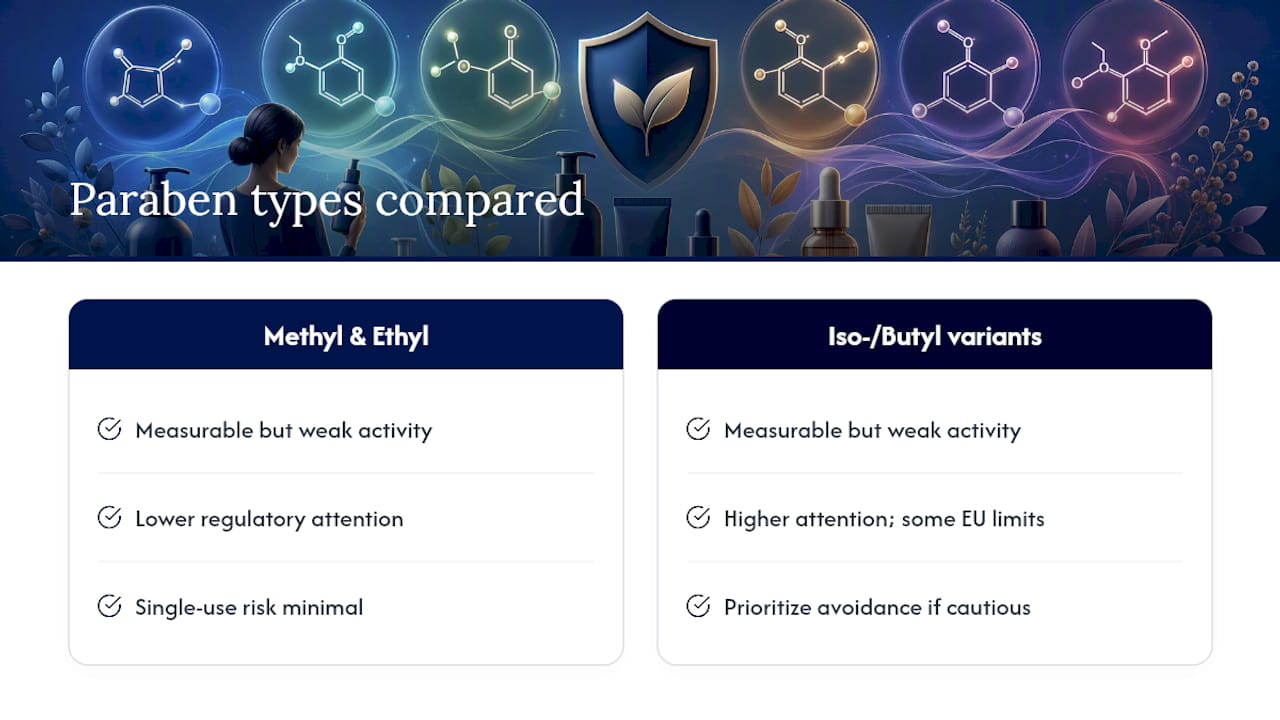
Parabens are processed and cleared from the body relatively quickly, according to Cleveland Clinic, which is why researchers focus on cumulative, everyday exposure rather than any single application. Not all parabens carry equal scrutiny, either. Longer-chain variants, isobutyl-, isopropyl-, and butylparaben, draw more regulatory attention than methyl- or ethylparaben, partly because the European Union restricts or bans several of these longer-chain types that remain permitted in the United States.
The practical takeaway: if you’re managing exposure out of caution rather than a doctor’s specific advice, prioritizing avoidance of iso- and butyl-parabens does more than avoiding every paraben with equal urgency.
Which Products Are Most Likely to Contain Parabens
Parabens show up most often in water-based formulas and anything packaged in a jar you’ll dip into repeatedly over months. The wetter the product and the more air exposure it gets, the more preservation it needs.
Categories where you’ll find parabens most frequently:
- Moisturizers and face creams, especially multi-use jars opened dozens of times
- Liquid and cream makeup, including foundation, concealer, and eye products
- Shampoo and conditioner, both heavily water-based
- Body washes and lotions, used daily and stored in humid bathrooms
- Sunscreen, particularly lotion and cream formats rather than sprays
- Some baby care products, though many baby-specific lines have shifted formulas in response to parent demand
If you’re starting your label-reading habit somewhere, start with anything in a wide-mouth jar. Multi-use pots invite more contamination risk than a pump or tube, which means formulators lean harder on preservatives to keep them safe over time.
How to Confirm a Product Is Really Paraben-Free
A “paraben-free” claim on the front of a bottle is marketing language. The ingredient list on the back is the legal document. Here’s how to check it properly.
- Read past the claim. Cosmetics sold in the United States are legally required to list ingredients by their common or usual names, so the full formula should always be visible on the packaging.
- Scan for the paraben family by name. Look specifically for methylparaben, ethylparaben, propylparaben, butylparaben, isobutylparaben, and the broader chemical term “parahydroxybenzoate.”
- Watch for reformulation drift. Brands change formulas over time, so a product you trusted as paraben-free a year ago might not be today. Check each new purchase, not just the first.
Pro Tip: Keep a note on your phone with the five or six paraben names to watch for. Ingredient lists are printed small and dense, and having the exact terms in mind makes scanning ten times faster than trying to remember them each time.
If a brand’s packaging is vague, ingredients are printed illegibly small, or a company won’t respond to a direct question about its preservative system, treat that as a signal to look elsewhere rather than assume the best. For more on why “clean” and “natural” labels can be just as slippery as “paraben-free,” it helps to read the first five ingredients closely before trusting front-of-package language at all.
What Replaces Parabens, and What You Give Up
Dropping parabens doesn’t mean dropping preservation. It means switching to a different chemical toolkit, and each option comes with its own strengths and limits.
- Phenoxyethanol: Broad-spectrum and widely used, though it requires careful formulation to hit an effective concentration without irritating sensitive skin.
- Benzyl alcohol: Effective against bacteria but often needs to be paired with another preservative for full fungal protection.
- Organic acids (like sorbic or benzoic acid): Work best in lower-pH formulas, which limits which products they suit.
- Ethylhexylglycerin: Often used as a booster alongside another preservative rather than a standalone solution.
- Sorbates: Gentle and commonly used in food-adjacent formulas, but narrower in what they protect against.
None of these alternatives is a drop-in replacement. Swapping a paraben system for one of these often means adjusting the whole formula’s pH, packaging, and even how the product is stored and shipped to keep it stable.
That’s the detail worth remembering: paraben-free rarely means preservative-free, and a poorly preserved “clean” product can spoil faster than a conventionally preserved one. Watch expiration dates closely, keep jars away from humidity and direct sunlight, and toss anything that shows a change in smell, color, or texture, even before the printed expiration date.
Pro Tip: A product that separates, smells “off,” or develops a film on top has likely broken down its preservative system. Trust your senses over the expiration date printed on the box.
Our Approach to Ingredient Transparency
Formulating without parabens is a real trade-off, not a marketing shortcut. Plant-based hair and skincare products are manufactured with care, and every preservative choice starts with the same question: does this protect the formula without compromising what it is applied to on skin and scalp every day.
We list every ingredient plainly because we think ingredient-conscious shoppers deserve to check our work, not just take our word for it. That’s the same habit we’d encourage with any brand you’re considering, paraben-free or not: read the list, learn the handful of names that matter, and ask questions when something’s unclear. If you want to go deeper on how plant-based ingredients function in scalp and hair formulas specifically, our guide to plant-based ingredients for scalp health walks through the reasoning behind our formulation choices.
Ready to put that label literacy to work? Our Ayurvedic hair growth oil for thinning hair is formulated with full ingredient transparency, so you can see exactly what’s protecting the formula and what isn’t in it at all.
Where the Paraben-Free Conversation Gets Oversimplified
The conventional advice on this topic tends to split into two unhelpful camps: parabens are fine, stop worrying, or parabens are dangerous, avoid them entirely. Neither holds up against what the regulatory guidance and peer-reviewed research actually say.
The more useful framework treats this as a spectrum. Methylparaben and ethylparaben carry a different risk profile than isobutylparaben and butylparaben, yet most “clean beauty” messaging lumps them together as one villain. That’s a missed opportunity for the ingredient-conscious shopper who wants to make a targeted decision instead of an anxious blanket one.
What gets overrated is the “paraben-free” sticker itself, treated as a finish line rather than a starting question. What gets underrated is the discipline of checking what actually replaced the parabens, and whether that new preservative system is doing its job. A jar that spoils in six weeks because it’s underpreserved isn’t safer than one with a well-studied paraben blend.
Prioritize the ingredient list over the front-of-package claim, every single time. That habit will serve you better than memorizing any single ingredient to fear.
— CRISAN
This article is general information, not a substitute for advice from a qualified doctor. Consult a qualified healthcare professional about your own circumstances before acting on anything here.
Sources
Claims in this article draw on the FDA’s cosmetic ingredient guidance, its consumer safety Q&A on parabens, Cleveland Clinic’s explainer, and a peer-reviewed PMC review. If you have specific health concerns about paraben exposure, talk to a dermatologist or physician who can weigh your individual situation.
FAQ
What is a paraben and why do some people avoid it?
A paraben is a synthetic preservative from the parahydroxybenzoate family, used in cosmetics since the 1920s to prevent microbial growth. Some people avoid them out of precaution around chronic exposure and estrogenic activity, even though the FDA has not found them harmful at typical use levels.
Is paraben-free actually better for your skin?
Not automatically. Paraben-free products can be gentler for people sensitive to that specific ingredient class, but they still need effective preservatives, and a poorly preserved formula can spoil and cause its own skin issues.
Is Vaseline paraben-free?
Petroleum jelly itself is a single, shelf-stable ingredient with no water content, so it doesn’t require the same preservative systems that water-based creams do. Always check the specific product’s ingredient list, since scented or blended petroleum jelly formulas can differ.
Does “organic” mean a product is paraben-free?
No. Organic certification relates to how agricultural ingredients are grown and sourced, not whether synthetic preservatives are used. A product can be certified organic and still contain parabens, so the ingredient list remains the only reliable check.


